36 works in this view — arrow keys or swipe to move between them.
Dance in Art
Minuet
Eugene, Frank
- Dance:
- Minuet
- Era:
- 1900-1920 (Ragtime/Early Jazz)
- Source:
- Victoria and Albert Museum
- Rights:
- Rights vary by item — check the source record before reusing this image. Source record ↗
- Recorded as:
- Check V&A creditLine
It captures the minuet at a pivotal moment in its cultural life—no longer a living social dance but a symbol of elegance and the past, treasured in memory and theater. For anyone studying how Victorians understood and romanticized historical dance, this image is key: it shows the minuet transformed from social practice into aesthetic ideal.
What you are looking at
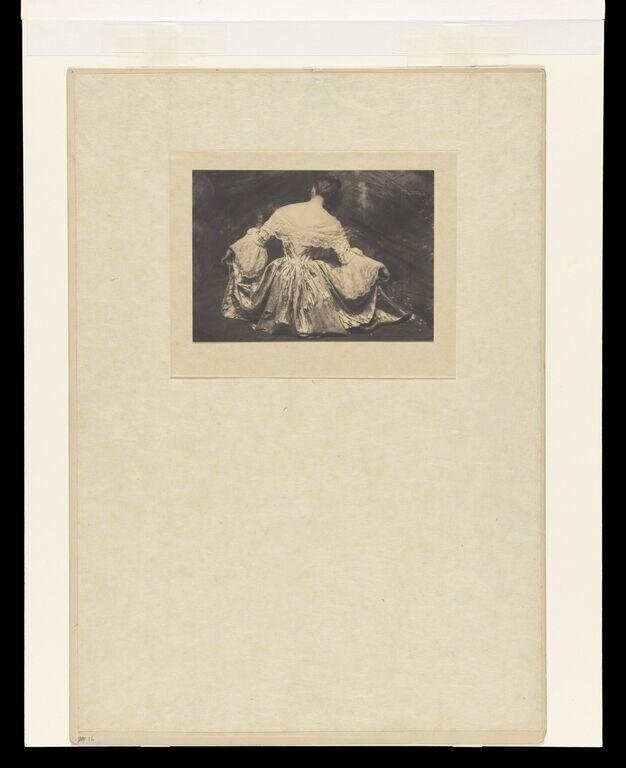
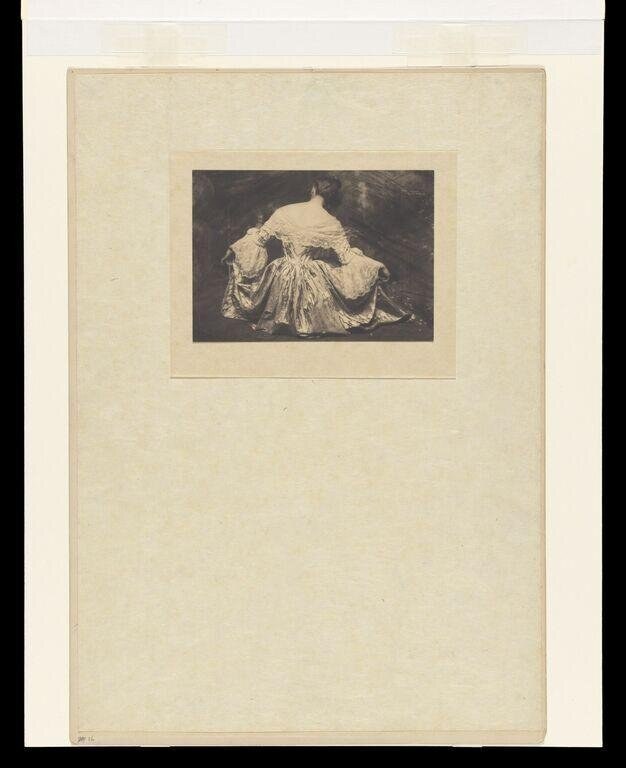
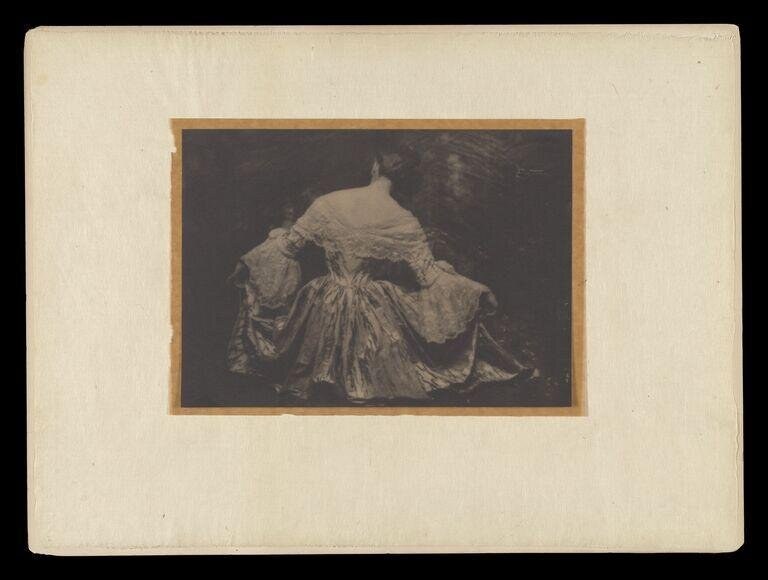
A woman in a flowing, diaphanous gown stands alone, turned away from the viewer in three-quarter profile, her body angled to the left. The dress is rendered in pale tones with deep shading that suggests voluminous fabric gathered at the shoulders and falling in heavy folds to the floor. Her head is bowed slightly, her hair arranged up and back. The background is nearly black, providing stark contrast and focusing all attention on the figure. The lighting is dramatic, with the figure emerging from shadow as if caught in a shaft of light—a technique characteristic of theatrical or romantic imagery. The pose suggests a moment of stillness or contemplation rather than vigorous motion, with the dancer's weight evenly distributed on both feet.
The dancing
A single female figure in a closed, introspective pose. Her body is long and elegant, the shoulders held softly back. Both arms appear to rest at her sides or lightly gathered at the front, creating a modest, gathered silhouette rather than an extended or lifted frame. There is no visible extension of the limbs or turnout of the feet—the posture is natural and upright. The pose suggests waiting, reflection, or the opening of a formal suite rather than active stepping or turning.
The dance depicted
The catalogue identifies this as a *Minuet*, and the dress, pose, and era align with that identification. The minuet was the formal, stately social dance of the Baroque and Rococo periods and remained a ceremonial or theatrical gesture into the 19th century. This image appears to depict not the dance in motion but a moment of introduction or presentation—the dignified entrance of a woman before the dance begins. The solitary figure, the formal dress, and the theatrical lighting suggest either a portrait of a dancer in role, or an illustration of the minuet's aesthetic as a dance of elegance and restraint. The artist has chosen to show the dancer as a composed figure rather than in active steps.
How it was made
The medium is not recorded, but the image is a print, likely an etching or photogravure. The deep blacks, the soft tonal gradations, and the use of light emerging against shadow are characteristic of intaglio processes. The technique allowed for subtle modeling of fabric and dramatic chiaroscuro effects that would have reproduced well and circulated widely. The quality of the tonal work suggests this was a high-quality reproductive print, possibly used for illustration or fine art distribution in the late 19th or early 20th century.
About this work
This is an image of the minuet as a dance of formal presentation and dignity. Rather than showing the minuet in its actual steps and measured turns, the artist has isolated a single moment—the dancer as a composed, almost sculptural figure emerging from shadow. The work belongs to a long tradition of romantic and theatrical visualization of historical dances, in which the aesthetic and character of the dance are conveyed through pose, costume, and mood rather than through documentation of movement. Eugene's handling of light and fabric elevation suggests a deep sympathy with the minuet's association with grace, refinement, and introspection. This is a work about what the minuet *meant* to the artist's era, not what it looked like to perform.
How to look at it
Attend to the moment of stillness the artist has chosen: not a step or turn, but a pause before or after motion. The drama lies in the lighting and the fabric, which is rendered with as much care as the figure herself. The pose is entirely frontal and modest—there is no flirtation or display, only a formal, almost ritualistic presentation. This tells you something important about how the minuet was understood in 1900: as a dance of propriety and closure, not openness or spontaneity. The backward turn of the head and the downward gaze add a note of melancholy or introspection, suggesting nostalgia.
The artist
Frank Eugene (1865–1936) was an American photographer, painter, and printmaker who worked in both naturalistic and pictorialist modes. He was a founder of the Photo-Secession and known for his theatrical and romantic imagery. He often worked with theatrical subjects and drew from the aesthetics of painting and print traditions in his approach to the photographic or printed image.
The period
The date 1900 places this work at the height of Pictorialism in photography and art, a movement that valued mood, atmosphere, and romantic effect over documentary clarity. The minuet itself, by 1900, had not been a living social dance for over a century; it survived mainly in ballet, courtly ceremony, and the historical imagination. The late Victorian fascination with the 18th century—its manners, its dances, its supposed refinement—made the minuet a powerful symbol of a lost elegance. Images like this one were part of a broader cultural project of recovering and aestheticizing the dance practices of the past.
Where it lives
The work is held in the Victoria and Albert Museum collection and is identified as a late 19th-century work labeled within the museum's taxonomy as 'Late 1800s (Victorian Ballroom)' era material. It represents the museum's holdings of theatrical and dance imagery from the pictorialist period.
Dance in this work
Questions about this work
Is this actually a minuet, or is that just what the museum called it?
The title and costume are consistent with minuet imagery from the period, though the image does not show the dance in action—only a posed moment. By 1900, the minuet existed primarily as a historical memory, a theatrical gesture, or a ceremonial form, so a static, introspective image is appropriate to how it was understood and represented in that era. The title likely reflects both historical accuracy and romantic reinterpretation.
What is the dress she is wearing?
The gown is styled to evoke 18th-century dress—the era of the minuet—with gathered shoulders, a full bodice, and voluminous skirts falling to the floor. It is rendered in pale fabric with subtle tonal modeling to suggest the weight and movement of the material. The style is theatrical rather than historically accurate: it is a Victorian or Edwardian woman's fantasy of 18th-century elegance.
Who is Frank Eugene?
Frank Eugene was an American photographer, painter, and printmaker (1865–1936) associated with the Photo-Secession and pictorialist movements. He was known for theatrical, romantic, and artistic imagery that drew on painting traditions. He worked in both photography and printmaking, often creating works with strong atmospheric and mood-based qualities.
Why does it look so dark and theatrical?
The dramatic lighting and tonal work are deliberate artistic choices reflecting pictorialism, a movement that valued mood and atmosphere over documentary clarity. The high contrast and theatrical effect were also practical advantages of the print medium—intaglio processes like etching and photogravure allowed for rich blacks and subtle gradations that made images more striking and memorable.
More Minuet artwork