34 works in this view — arrow keys or swipe to move between them.
Dance in Art
Minuet dancer
William Duesbury & Co.
- Dance:
- Minuet
- Era:
- 1700s (Enlightenment/Minuet Era)
- Source:
- Victoria and Albert Museum
- Rights:
- Rights vary by item — check the source record before reusing this image. Source record ↗
- Recorded as:
- Check V&A creditLine
This object reveals what the minuet actually looked like in practice: not the vigorous movement of later dances, but a highly formalized, almost sculptural posture of genteel restraint. For dance historians, it is a primary document of eighteenth-century ballroom dance, one that captures both the movement vocabulary and the social meaning of the minuet—a dance that marked its performer as educated, refined, and of the right social class.
What you are looking at
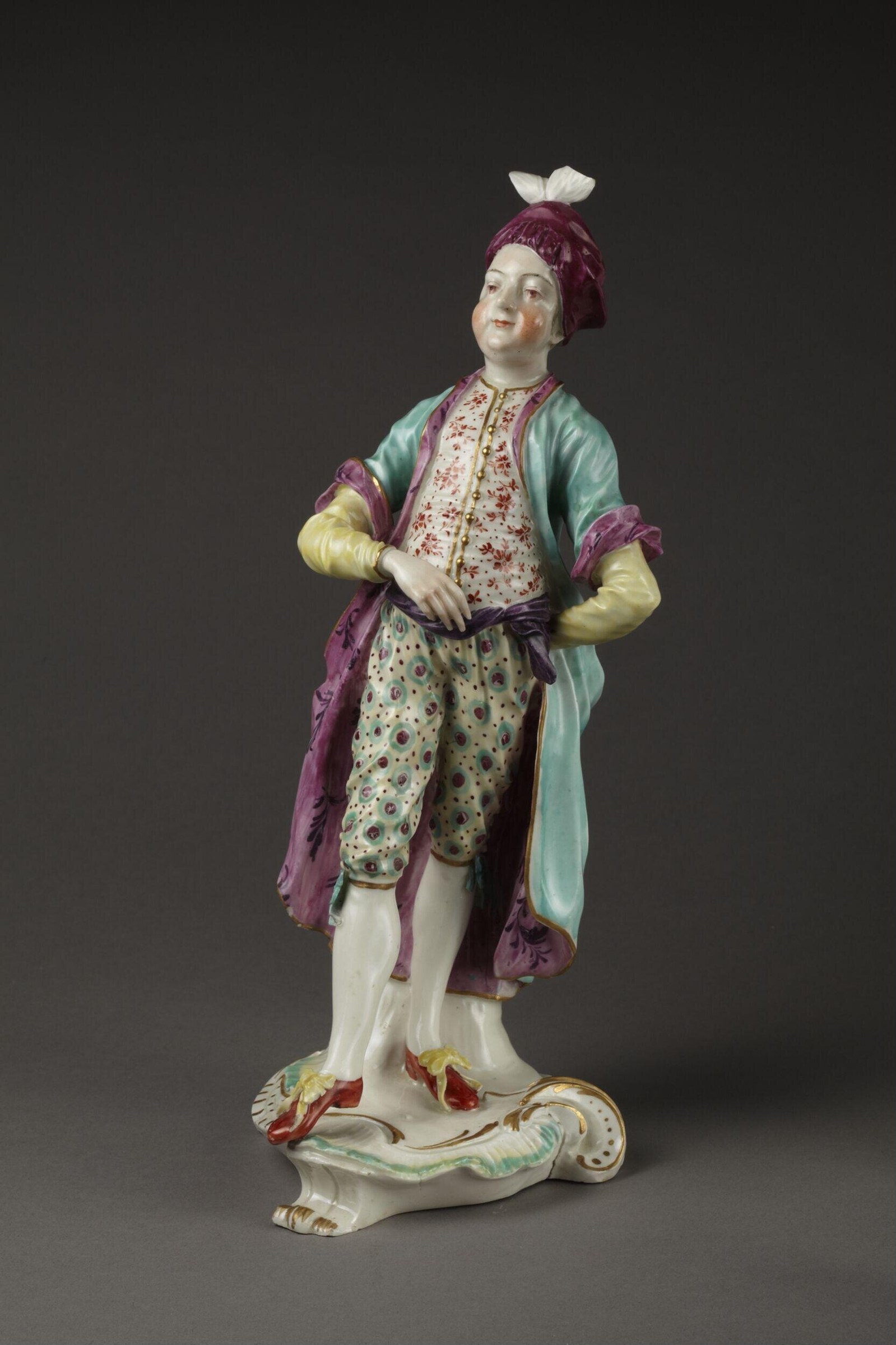
A porcelain figure of a young male dancer stands alone against a dark background, captured mid-performance. He wears a richly decorated coat in sage green with deep mauve cuffs and collar, layered over a patterned waistcoat in cream with red and green embroidery. His breeches are cream with coloured floral sprigs, and cream stockings extend to red-heeled shoes. A mauve sash drapes across his body, and a white bow adorns his dark purplish hair. His posture is upright and composed, with one arm resting against his torso and the other held naturally at his side—a stance of composed elegance rather than vigorous motion. The base is a curved C-scroll in white porcelain, painted with trailing sprays of flowers in green and red. The figure's face is painted with careful detail: rosy cheeks, fine features, and a gentle, almost serene expression. The whole object gleams with the translucence and precise decoration typical of eighteenth-century porcelain.
The dancing
A single male dancer fills the composition. His weight appears evenly distributed, feet planted firmly on the base in a posture of formal readiness rather than active movement. The arms are held with restrained elegance—not extended or dramatically positioned, but arranged to display the fine tailoring of his coat and the delicacy of his hands. His upright frame and composed expression suggest a dancer between movements, or captured in a moment of courtly presentation rather than mid-phrase. There is no indication of turnout, extension, or the dynamic tension of active dance.
The dance depicted
This figure represents a dancer of the minuet, the most formal and widely danced social dance of the eighteenth century. The title, costume, and period all confirm this identification. The minuet was performed by well-dressed gentlemen in court and aristocratic settings, and this figure appears to embody that ideal—groomed, finely clothed, and posed with courtly restraint. The figure's stillness and composed stance suggest how the minuet was actually danced: a dance of small, precise steps, careful timing, and studied elegance rather than exuberance. He is shown not in the moment of action but as a type—the minuet dancer as a figure of social refinement.
How it was made
This is a porcelain figure, almost certainly Meissen or in the Meissen style, the dominant luxury ceramic of eighteenth-century Europe. The medium allowed for delicate undercutting (visible in the scroll base and the separation of arms from the body), precise painting of costume detail, and the creation of small, portable objects for the homes of the wealthy. Porcelain figures of dancers were fashionable luxury goods; they documented contemporary dance and fashion, and served as ornaments on the mantelpiece or cabinet of a gentleman or lady of taste. The technique required multiple firings, careful hand-painting, and considerable skill to execute without breakage.
About this work
This is a porcelain figurine of a minuet dancer, created circa 1760 by the William Duesbury & Co. factory in Derby (a leading English porcelain maker). It depicts a young male dancer dressed in the elaborate court costume of the mid-eighteenth century—silk coat with contrasting cuffs, embroidered waistcoat, and buckled shoes—posed in the formal, composed manner appropriate to the minuet, the most prestigious social dance of the age. The work is a document of both dance history and material culture: it shows what a fashionable minuet dancer looked like, how he held himself, and the extreme refinement of his dress. The porcelain medium made it an object of luxury, designed to be admired and displayed in the homes of the wealthy.
Minuet dancers were celebrated figures in eighteenth-century society, and porcelain manufacturers across Europe created figures of them. This English example is part of a widespread tradition of documenting contemporary dancers and dance fashion in three-dimensional form. The minuet itself was ancient—it had been danced for over a century—but its dominance in polite society in the 1760s ensured that images of it were in high demand.
How to look at it
Attend to the stillness of the pose. There is no suggestion of stepping, turning, or the weight-shifts that characterize active dance. Instead, the figure is composed and frontal, almost like a courtly portrait translated into three dimensions. The extreme refinement of the costume—the precision of the embroidery, the fine cuffs, the perfect stockings—tells you that this was a dance of the social elite, where appearance mattered as much as movement. Notice also the carefully painted face: this is an individual, or at least an idealized type meant to represent a particular kind of person. The scroll base and the way the figure stands upon it are also characteristic of Meissen-style porcelain; the base is not practical to dance on, but decorative—a reminder that this is an ornament, not a document of action.
The artist
William Duesbury & Co. established the Derby Porcelain Factory in 1756 and became one of England's leading manufacturers of luxury porcelain. The factory was known for fine tableware and decorative figures in the Meissen tradition, but English in execution. Duesbury figures, including dancers, are highly valued for their quality and are held in major museums. The factory continued production into the nineteenth century and is now part of the Royal Crown Derby heritage.
The period
The minuet reached its height of social prestige in the mid-eighteenth century, particularly in aristocratic and court circles. It was by then an old dance—over a century old—but it had acquired the status of a prerequisite for anyone of good breeding. Every young person of rank was expected to dance it well. At the same time, new dances were emerging (contredanses, cotillions), but the minuet's formal beauty and its association with refinement kept it central to social dancing. The 1760s saw a flourishing of minuet music, prints, and objects like this figurine, which celebrated the minuet dancer as an ideal of grace and propriety. Porcelain figures of dancers were also part of a broader European fashion for collecting and displaying small luxury objects that documented contemporary life and fashion.
Where it lives
According to the catalogue record, this work is held by the Victoria and Albert Museum. Duesbury figures are a staple of major decorative arts collections; the V&A holds many examples. This object is classified as a decorative figure or 'porcelain model,' a category that includes hundreds of works depicting contemporary fashion, social life, and entertainment.
Dance in this work
Questions about this work
What was the minuet?
The minuet was a formal, dignified social dance in triple time, originating in France in the late seventeenth century. By the eighteenth century, it was the most prestigious ballroom dance and was a requirement for anyone of good breeding. It featured small steps, careful timing, and studied elegance, typically danced by couples in court dress. Its formality and refinement made it a favorite subject for artists and manufacturers documenting social life.
Why was this figure made?
Porcelain figures of dancers were luxury goods—decorative objects for the homes of the wealthy that documented contemporary dance and fashion. They were collected and displayed on mantels or in cabinets as objects of beauty and as records of how fashionable people danced and dressed. They were also produced for sale to a broad market of middle-class and aristocratic consumers who enjoyed miniature representations of social life.
Is this a particular dancer, or a generic type?
It is almost certainly a generic type—an idealized representation of a fashionable minuet dancer—rather than a portrait of a named individual. The careful hand-painting of the face gives it the appearance of individuality, but the figure was produced in a factory, likely in multiple versions. Porcelain manufacturers typically created generic figures of dancers, musicians, and fashionable characters that could be repeated and sold widely.
How do I know it's Duesbury?
The catalogue record attributes it to William Duesbury & Co. Precise dating and attribution of eighteenth-century porcelain can be difficult; marks, style, and materials help identify maker and date. The V&A's curatorial judgment is documented in the record. Meissen figures and their English and European imitations were widely copied, but this piece is catalogued as a Derby product.
More Minuet artwork