32 works in this view — arrow keys or swipe to move between them.
Dance in Art
Minuet dancer
William Duesbury & Co.
- Dance:
- Minuet
- Era:
- 1700s (Enlightenment/Minuet Era)
- Source:
- Victoria and Albert Museum
- Rights:
- Rights vary by item — check the source record before reusing this image. Source record ↗
- Recorded as:
- Check V&A creditLine
Porcelain figurines like this one offer a rare domestic view of 18th-century social dance, showing how dance was understood and valued outside the theatre. The minuet was the universal marker of a lady's education and breeding, and figurines such as this circulated that ideal among those who aspired to or admired courtly culture.
What you are looking at
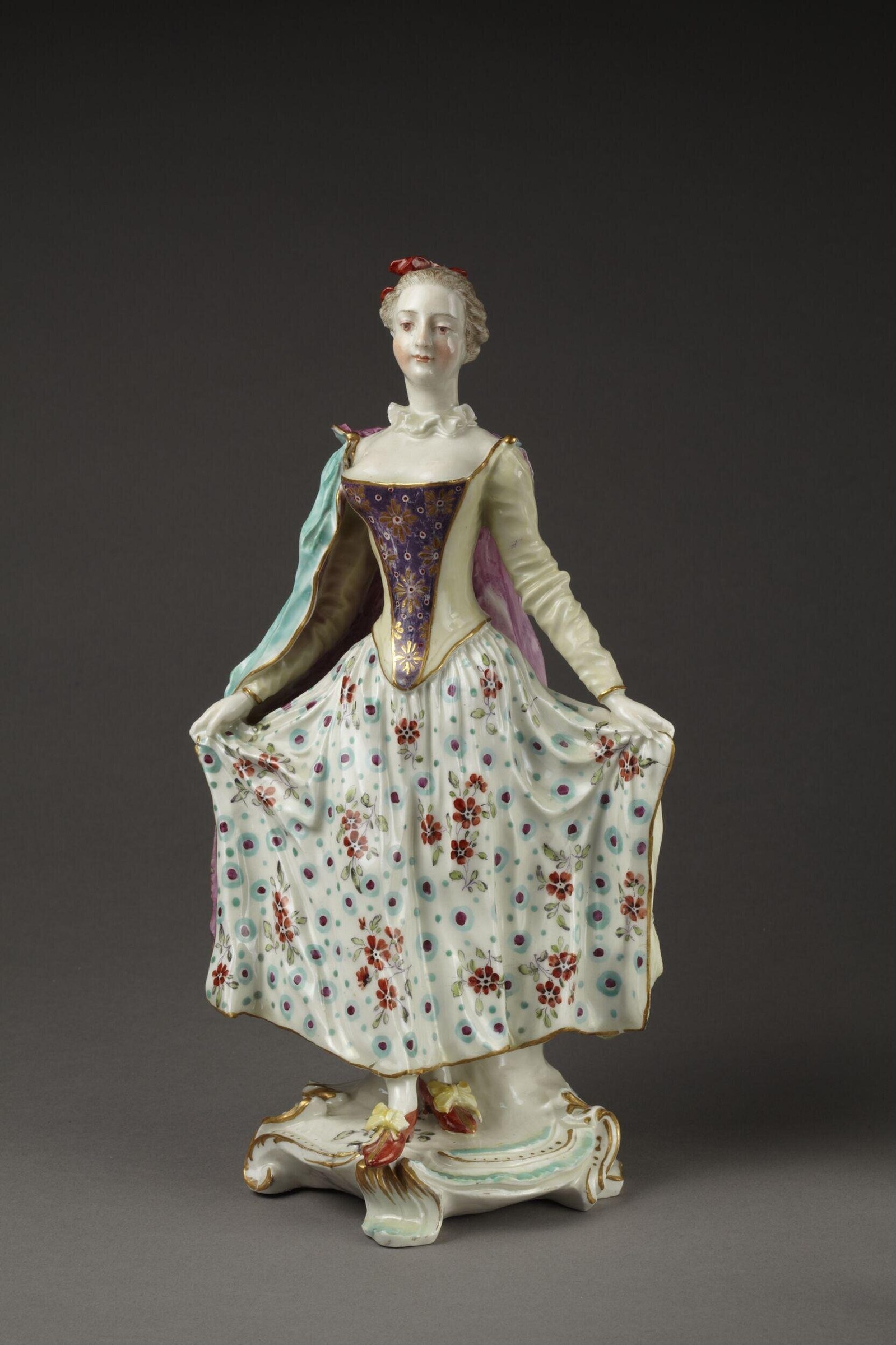
A porcelain figure of a young woman stands on a scrolled, shell-like base, poised in the attitude of a minuet dancer. She wears a richly embroidered purple bodice with gold details over a cream linen chemise, and a full skirt of pale fabric printed with scattered sprigs of red flowers and blue dots—a design typical of mid-18th century furnishing textiles. A turquoise-blue silk mantle drapes from one shoulder, lined in deep mauve. Her hair is styled fashionably with a red ribbon woven through pale curls. Her pose is one of studied elegance: her weight appears balanced, her frame upright, one arm extended slightly as if acknowledging a partner or acknowledging the space around her. The figure's gaze is downward and serene, the whole composition capturing the refined, formal deportment demanded by court dance.
The dancing
The dancer stands in a three-quarter view, her body composed in the vertical axis typical of minuet stance. Her left arm extends in a gentle curve, as if holding or presenting to a partner; her right arm hangs at her side with the hand positioned forward. The posture suggests the formal frame of couple dance—upright spine, the chest open, no bend at the waist. Her feet are positioned close together, with weight evenly distributed; the stance conveys readiness rather than mid-movement, which was the convention for representing social dance in porcelain.
The dance depicted
This depicts the minuet, the defining dance of 18th-century European courts and drawing rooms, where it served as a marker of breeding, refinement, and social status. The minuet was a couple dance in triple meter, performed with precise, small steps and elaborate courtesy—far more a display of deportment than of athleticism. The pose here captures the minuet's essential character: stillness, formality, and the careful management of the body within social space. This figure would have graced a European porcelain service or been kept as a cabinet piece, a souvenir of fashionable taste.
How it was made
This is a porcelain figurine, glazed and painted with underglaze blue and overglaze enamels in red, gold, turquoise, and mauve. The technique allowed for fine detail in the face, intricate patterning on the textiles, and a lifelike rendering of flesh tone through careful layering of glazes. The figure's base is modelled in the Rococo taste with scrolled, organic forms. Porcelain figurines of this kind were expensive, labour-intensive objects, produced in dedicated manufactories and circulated among the wealthy and court-connected as symbols of taste and continental sophistication. Their small scale and domestic setting contrasted sharply with the grand theatrical productions of ballet that were emerging simultaneously.
About this work
This is a Rococo porcelain figure of a minuet dancer, produced by the Derby or Chelsea manufactory in mid-18th-century England. It captures a single instant of social dance at its most formal and codified—the minuet was less a dance of large movement than a grammar of gesture, performed in the drawing room to music in slow triple time. The figure's costume, pose, and the delicacy of its execution all point to the minuet's role as the primary social dance of the European aristocracy and gentry, a ritual of courtship and status.
Within the history of dance representation, porcelain figurines occupy a particular niche: they are neither record nor instruction, but rather tokens of fashion and taste, capturing a momentary pose rather than the flow of movement. This figure is valuable not as a document of minuet choreography—the steps are invisible—but as evidence of how the minuet was imagined and treasured by the consumer classes of 18th-century Britain: as an emblem of refinement, restraint, and feminine grace.
How to look at it
Notice the artist's attention to the textiles: the printed cotton of the skirt is rendered with individual flowers, the silk mantle catches light, the embroidery on the bodice is suggested through gold paint. These details anchor the figure in a specific moment of fashion. Also observe the pose itself—the careful balance, the slight turn of the head, the precise placement of the hands. There is no suggestion of motion; instead, the moment captured is one of introduction or acknowledgement, a pose that could be held indefinitely. This is the minuet's true nature: less dance than choreographed courtesy.
The artist
William Duesbury & Co. (also known as Derby Porcelain) was one of the principal English porcelain manufacturers of the 18th century, founded in Derby around 1750. Duesbury was known for figured wares—carefully modelled and painted figurines and groups that rivalled Continental porcelain in quality and finesse. The manufactory employed skilled modellers and painters, many trained in Continental traditions, and supplied a market of affluent customers. Dance and theatrical subjects were popular, particularly single figures posed in attitudes that conveyed grace and refinement.
The period
The minuet reached its height of fashion in the mid-18th century, though it had dominated European court dance since the 17th. By the 1750s and 1760s, when this figure was likely made, the minuet was already becoming a symbol of old-fashioned formality—a sign of breeding and restraint in an era of growing informality and sentiment. Porcelain figurines thrived as status objects during the Rococo period; collecting them was a mark of taste and wealth. At the same time, theatrical dance was undergoing rapid change: the ballet d'action was emerging, and dancers were beginning to move with greater speed and abandon, leaving the minuet behind as a relic of the previous century's courtly discipline.
Where it lives
The object is attributed to William Duesbury & Co., a Derby porcelain manufactory, and is held in the Victoria and Albert Museum collection. Derby was one of the three major English porcelain manufacturers (alongside Chelsea and Worcester) and produced high-quality figurines for the domestic market. Such pieces would have been displayed on mantels or kept in cabinets.
Dance in this work
Questions about this work
How do I know this represents a minuet and not just any formal dance?
The catalogue record identifies it as a minuet dancer, and the pose—upright, composed, standing still—is consistent with minuet deportment. However, the image alone does not show footwork or movement patterns; it captures an attitude or 'stop' that could belong to other formal 18th-century dances. The title guides us, and the costume—the formal dress, the precise hair, the careful grooming—all speak to a context of refined, court-adjacent social dance.
Why would someone collect a porcelain figure of a dancer?
Porcelain figurines were luxury goods that displayed taste, wealth, and cultural knowledge. A figure of a minuet dancer served multiple purposes: it was an ornament, a souvenir of fashionable culture, and a way of associating oneself with refinement and breeding. Such figures were often displayed on mantels or in cabinets, visible to guests as evidence of the owner's discernment.
Is this figure accurate to how minuets were actually danced?
The pose reflects the formal, upright carriage demanded by minuet style, but it is a still image, not a document of choreography. Minuets involved specific step patterns and floor tracks that this figure cannot show. It tells us how a dancer should look—composed, dignified, graceful—rather than how the steps were executed.
More Minuet artwork