31 works in this view — arrow keys or swipe to move between them.
Dance in Art
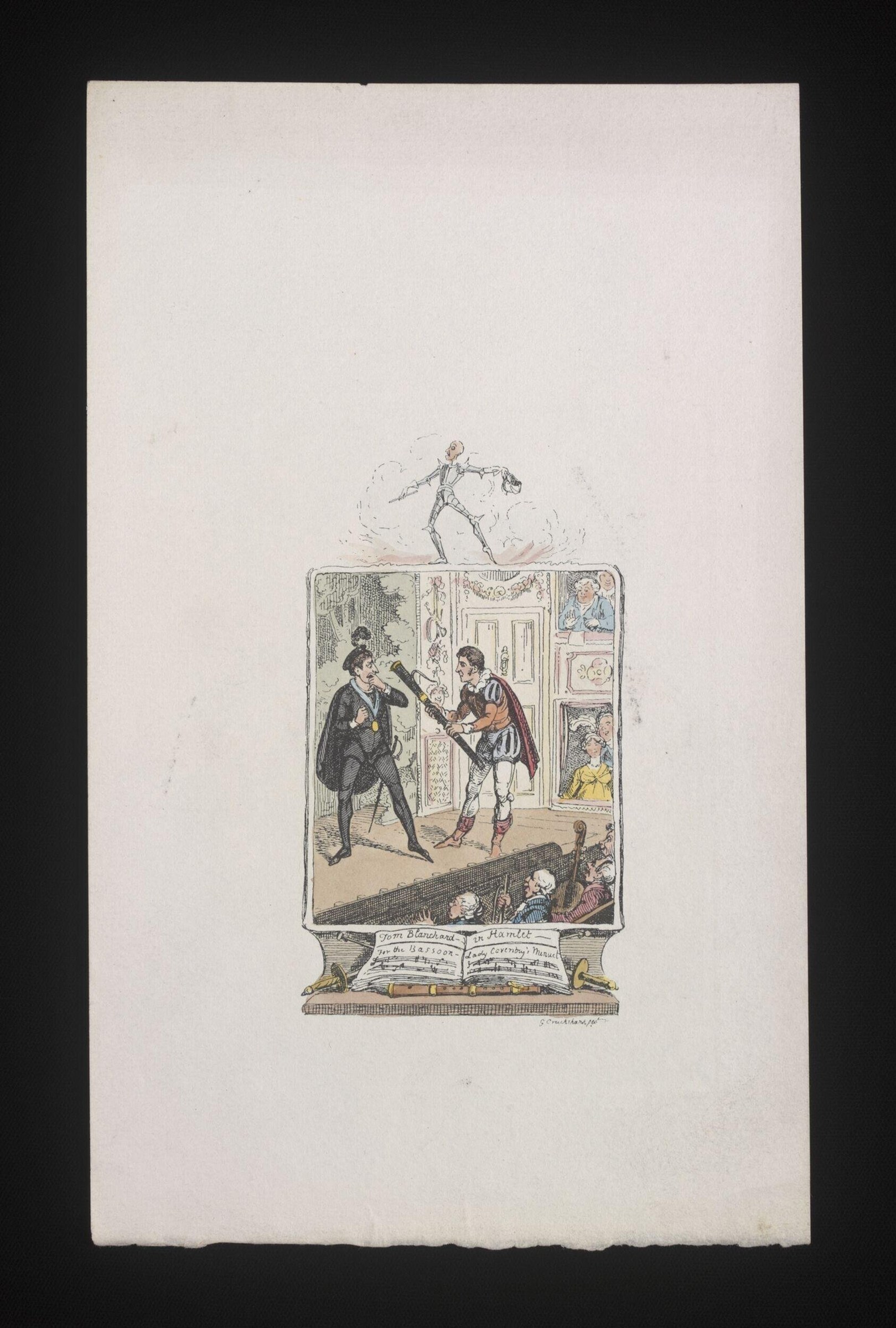
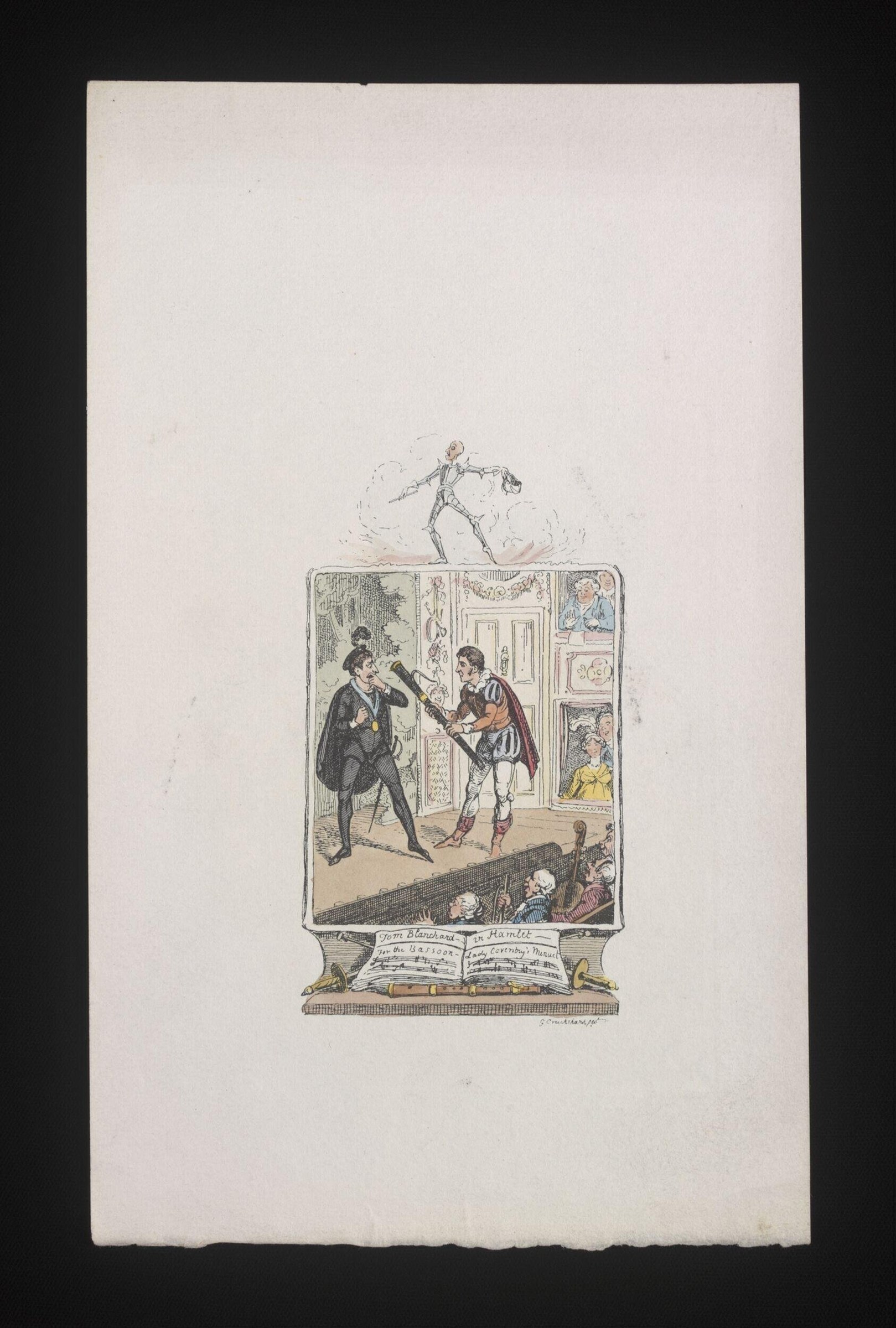
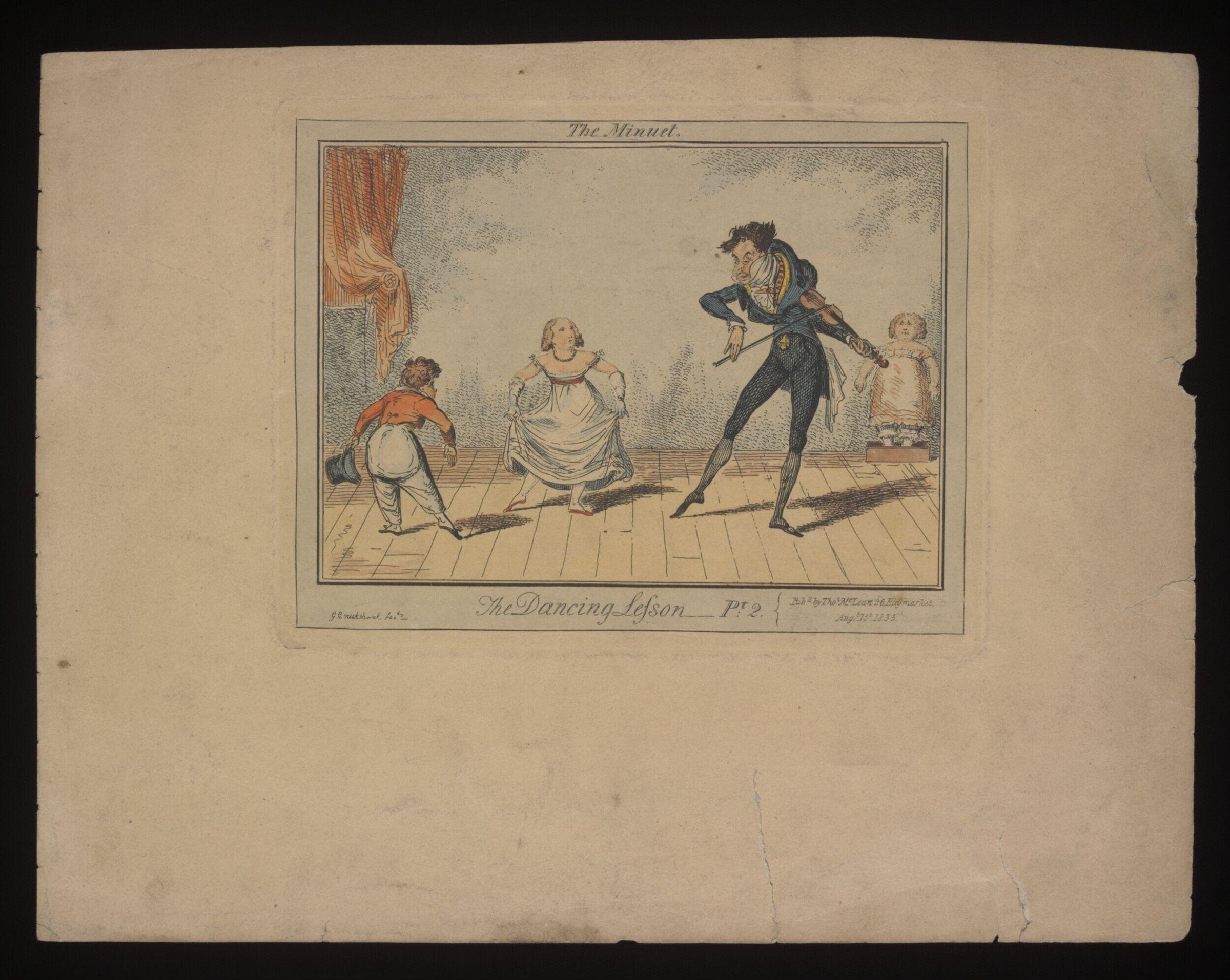
The Dancing Lesson, The Minuet.
Cruikshank, George
- Dance:
- Minuet
- Era:
- Mid 1800s (Polka Era)
- Source:
- Victoria and Albert Museum
- Rights:
- Rights vary by item — check the source record before reusing this image. Source record ↗
- Recorded as:
- Check V&A creditLine
This image is one of the few surviving documents that shows how the minuet was actually taught—the postures, the leverage, the sequential drilling of children. For scholars of dance pedagogy and social history, it is invaluable evidence of how body discipline was administered in the household. For dancers today, it offers a rare visual guide to the actual mechanics of the style as it was transmitted.
What you are looking at
A dancing master instructs three pupils—two small children and a young woman—in the minuet on a wooden floor. The master, in military-dress coat with high collar and breeches, bends forward with one arm extended in teaching gesture while his other arm guides a small child in red coat. The young woman in white muslin stands at a distance, watching or awaiting instruction. An older woman, possibly a governess or parent, stands to the left near a red curtain that suggests an interior domestic or studio space. The composition captures a teaching moment rather than a finished dance, with attention to the careful postures and formal bearing required of the period.
The dancing
The master demonstrates the characteristic upright, controlled posture of minuet technique, bending slightly at the hips to guide the child at his level. His extended arm shows the arm position and reach typical of the style. The small child mirrors his frame in miniature, suggesting the drill-like instruction of court dance. The young woman stands at a formal distance, her body aligned and ready, indicating the dignified bearing required. The other adult observes from the margin, reinforcing this as a formal lesson rather than social dancing.
The dance depicted
This is unquestionably a minuet lesson. The title, the formal dress, the indoor studio setting, and above all the rigorous posture and controlled geometry of the figures all confirm the historic-baroque minuet, which remained a cornerstone of polite education throughout the 18th and into the early 19th century. The image documents not the performance of the minuet but its transmission—the painful, deliberate teaching of a dance that encoded class status and courtly refinement. The presence of children as pupils confirms the minuet's role in the social training of the gentry.
How it was made
This is a hand-colored engraving or etching, identifiable from the fine linear hatching, the restrained palette (ochres, soft grays, flesh tones, and touches of red and blue), and the careful burin work. The technique allowed for mass reproduction and circulation in print form, making this image a document for a broad reading public—likely servants, tradespeople, and the aspiring middle classes learning to mimic genteel manners. The soft coloring and elegant line work suggest a refined market; this is not a popular or satirical print despite being by Cruikshank, but rather an instructional or documentary image.
About this work
This is a visual record of minuet instruction in the early 19th century, captured in the moment between the dance master's demonstration and the pupil's performance. Cruikshank's engraving documents not a finished dance but the grammar of courtly movement—the geometry of the body, the control of the limbs, the social distance between teacher and pupil. It belongs in a dance history because it shows the minuet not as historical abstraction but as lived pedagogy: a discipline imposed on children's bodies to mark them as genteel. The print format signals that this was public knowledge, circulated widely enough that viewers without access to a dancing master could study the correct method.
How to look at it
Attend to the master's bent posture and extended arm—this is a teaching posture, showing rather than performing the dance. Notice the geometric precision of the young woman's stance, even at rest; the minuet demanded alignment and control even in stillness. The spatial arrangement, with pupils at different distances and states of readiness, suggests the sequence of instruction: watch, imitate, take your place. The composition privileges the moment of transmission over the moment of display.
The artist
George Cruikshank (1792–1878) was a prolific English engraver and caricaturist known for satirical social commentary. This print appears to be from his earlier, less satirical work documenting manners and customs. His large output of educational and instructional prints brought visual culture to a mass audience, though he is better remembered for his more barbed social critique.
The period
The minuet had been the foundation of court and ballroom dancing since the 17th century, but by 1835, when this print was made, it was already becoming historicized. The waltz had displaced it in fashionable circles, and the image captures the minuet in a paradoxical moment: still essential to the education of well-born children, yet already marked as old-fashioned. The print itself belongs to the early 19th-century explosion of instructional imagery—dance manuals, deportment guides, and prints on etiquette flooded the market as the middle classes sought to acquire the visible markers of gentility that birth no longer guaranteed.
Where it lives
The work is held in the Victoria and Albert Museum collection, a major repository of 19th-century prints and decorative arts. The source tag 'va' confirms the V&A as the holding institution. No accession number, acquisition date, or further provenance is provided in the catalogue record.
Dance in this work
Questions about this work
Was the minuet still danced in 1835?
Yes, but primarily in teaching contexts and formal court occasions. By this date the waltz had become fashionable in ballrooms, but the minuet remained mandatory education for upper-class children as a marker of gentility and propriety. This print documents that educational role rather than social dancing practice.
What do the children's ages tell us about minuet training?
The inclusion of very young children suggests that minuet instruction began in early childhood and was embedded in domestic life, likely overseen by a resident or visiting master. It was not a social accomplishment learned by adolescents, but a foundational discipline imposed early.
Why does the master bend down to the child?
He is demonstrating the correct posture and position at the child's eye level, making his body a visible model. This teaching method—embodied demonstration rather than verbal instruction—was standard in dance pedagogy and required close physical proximity.
Who was George Cruikshank and why does he matter for dance history?
Cruikshank was a prolific commercial engraver whose prints reached a mass audience. His documentary work on manners and customs, like this minuet lesson, provides rare visual evidence of how dance was actually taught and performed in everyday contexts, not just in formal or theatrical settings.
More Minuet artwork