30 works in this view — arrow keys or swipe to move between them.
Dance in Art
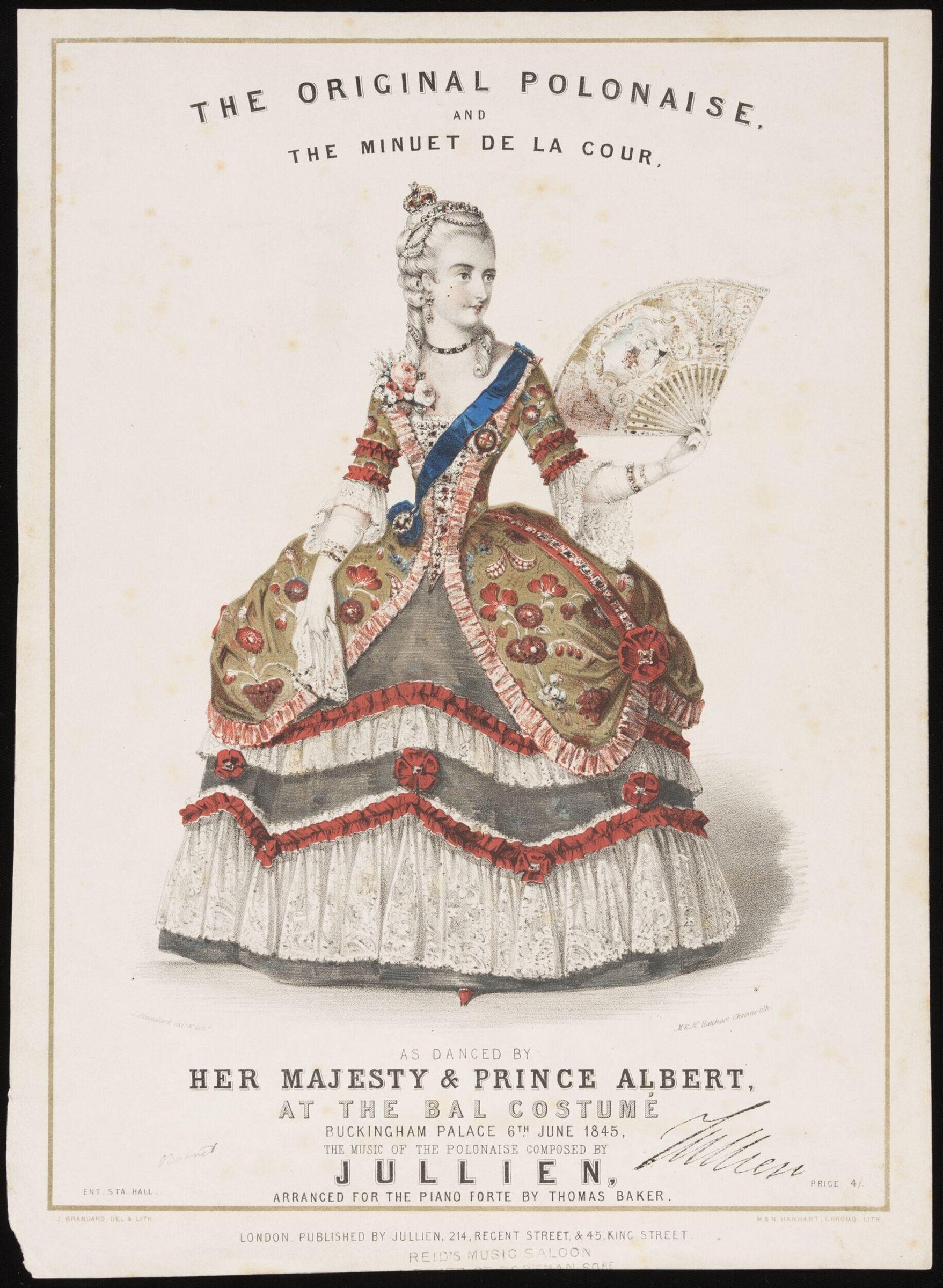
The Original Polonaise and the Minuet de la Cour
Brandard, John
- Dance:
- Minuet
- Source:
- Victoria and Albert Museum
- Rights:
- Rights vary by item — check the source record before reusing this image. Source record ↗
- Recorded as:
- Check V&A creditLine
This print is evidence that the Minuet and Polonaise remained living court dances in the Victorian era, performed by the monarch herself as part of state ritual, even as social dancing was rapidly evolving elsewhere. It shows us the costume, posture, and formal conventions of 19th-century court dance at the moment it was becoming historic. For historians of dance, fashion, and monarchy, it is a primary document of how royalty performed pageantry and claimed continuity with the 18th-century court.
What you are looking at
This is a hand-colored engraving showing a woman in elaborate 18th-century court dress, posed as if mid-dance. She wears a voluminous pale skirt with deep flounces trimmed in red ribbon, over which falls a stomacher and petticoat of embroidered olive-green silk scattered with red flowers. Her corseted bodice is richly decorated; she wears a blue sash across one shoulder (suggesting rank or order), a jeweled necklace, and her hair is dressed high and ornamented with flowers and ribbons. In her right hand she holds an open fan of ivory lace; her left arm extends gracefully. Her posture is elegant and composed, her gaze directed away in the refined manner of court portraiture. The figure is shown three-quarter length against a plain background, presented as a fashion plate or dance instruction image rather than a narrative scene. The engraving is bordered in a thin gold frame line and includes printed text above and below identifying the dances and the royal dancers for whom they were performed.
The dancing
A single female dancer is shown in an elegant, upright stance with weight centered and arms arranged to display courtly grace—one arm extended to hold the fan, the other positioned for balance. Her posture is refined and stationary rather than dynamic, suggesting the poised presentation expected of court dance rather than vigorous movement. The positioning of her body and the careful arrangement of her costume elements emphasize elegance and propriety over action. Her stance is consistent with the formal comportment of Baroque and early Rococo court dancing, where display and correct positioning mattered more than visible exertion.
The dance depicted
The title identifies this as a representation of the Polonaise and the Minuet de la Cour as danced by Queen Victoria and Prince Albert at the Bal Costumé held at Buckingham Palace on 6 June 1845. The Polonaise was a processional court dance of Polish origin, stately and ceremonial in character; the Minuet de la Cour was the French court minuet, the most formal and prescribed of all court dances. Both were dances of display and rank, performed in elaborate costume as part of royal pageantry. The image appears to be a commemorative publication, likely circulated among the court and the fashionable public to document the event and display the costumes worn. The inclusion of music (composed by Juliet and arranged for piano by Thomas Baker) suggests this was meant to allow others to learn and perform the dances.
How it was made
This is a hand-colored engraving, as indicated by the fine linear work and the careful application of watercolor or gouache over a printed base. The engraver has used fine parallel lines (hatching) to create shading and depth, particularly visible in the folds of the skirt and the modeling of the face and arms. The colored layers—the delicate greens, reds, and flesh tones—were applied after printing, making each copy slightly individual. This technique was standard for fashion and commemorative prints of the 1840s, allowing both the precision of line engraving and the visual appeal of color. The quality of execution suggests a London print house of some standing, and the inclusion of music and text indicates this was a commercial publication aimed at a middle- and upper-class audience who could afford hand-colored prints and owned pianos.
About this work
This is a commemorative fashion and dance instruction print marking Queen Victoria and Prince Albert's performance of the Polonaise and Minuet de la Cour at a royal ball in 1845. It documents both the dances themselves and the extravagant court costume of the mid-19th century, at a moment when these ancient court dances were still performed as ritual rather than entertainment. The print served multiple purposes: as a record of a royal event, as a fashion plate for the fashionable world, as sheet music for domestic performance, and as a social document of Victorian court life and the place of formal dance within it.
The work belongs to a tradition of commemorative dance prints stretching back to the 17th century, when engravings of court balls and royal performances were circulated among the elite. By 1845, photography was emerging but not yet capable of capturing color and costume detail; the hand-colored engraving remained the best way to document a spectacle. This print occupies the intersection of dance history, fashion history, and royal portraiture, and shows us not only what the dance looked like but how it was remembered and commercialized.
How to look at it
Look at the posture and the stillness of the figure. This is not a snapshot of vigorous movement but a formal presentation, the dancer 'frozen' in an attitude of grace and composure. The Minuet was prescribed almost to the point of rigidity—the music, the steps, the arm positions, even the angle of the head were all codified. The engraver has chosen to show not the moment of a step but the appearance of nobility and elegance in repose, which was what mattered in court dance. The elaborate costume also matters: the dance was inseparable from the display of wealth, rank, and beauty. Notice how the composition balances the massive skirt, the jewels, the sash, and the fan—all elements that announced the dancer's status and were part of the dance itself.
The artist
John Brandard was a London engraver and print publisher active in the mid-19th century, specializing in fashion plates, theatrical prints, and commemorative engravings. He worked in the tradition of commercial printmaking, producing images for middle-class consumption rather than fine art. The firm operated from Regent Street and King Street in London, positioning it among the fashionable print houses that served the West End and court circles. Little is known of Brandard's training or personal biography; his name survives chiefly through his prints, which are now held in museum collections including the Victoria and Albert Museum.
The period
The 1840s saw a peculiar moment in the history of court dance. The Minuet and Polonaise belonged to the 18th century and earlier; they had been displaced in social dancing by the waltz and other couple dances decades before. Yet they persisted in royal and aristocratic ritual as symbols of rank, tradition, and formality. Victoria's reign saw an intensification of court ceremony and an emphasis on the majesty and antiquity of the monarchy; performing these ancient dances was one way to assert continuity and distinction from the increasingly democratic world outside the palace. At the same time, the 1840s were the height of the Romantic era in ballet, when dancers were performing Giselle and La Sylphide in tutus and pointe shoes; court dance and theatrical dance had become entirely separate domains. This print sits at the intersection of those two worlds.
Where it lives
Published by Julien, 214 Regent Street & 45 King Street, London. The print came from the Victoria and Albert Museum collection, which holds extensive examples of 19th-century commemorative and fashion prints. It was originally sold as sheet music and a fashion plate combined, a common format for popular dances of the period.
Dance in this work
Questions about this work
Did Queen Victoria really dance the Minuet?
Yes. Court etiquette required the monarch to perform certain dances at state occasions, and the Minuet remained the most formal of these. Victoria and Albert performed it at royal balls; it was ritual rather than pleasure. By the 1840s, the Minuet was primarily a display of rank and tradition, performed slowly and with great ceremony. The print commemorates an actual event.
What is a Bal Costumé?
A fancy-dress ball where guests wore historical or exotic costume. The Bal Costumé was a Victorian entertainment favored by the aristocracy and royal court. Guests would often be assigned roles or themes; the 1845 ball at Buckingham Palace appears to have been elaborate enough to warrant both a printed invitation and a commemorative print afterward.
How was this print used?
It served multiple purposes: as a souvenir of the royal event (sold to people who attended or read about it), as sheet music so that people could play the dances on their pianos at home, and as a fashion plate showing the costume worn. It was a commercial product aimed at the fashionable and musical public.
Why does she look so formal and still?
The Minuet de la Cour was the most formal and prescribed of all dances, with codified steps, positions, and arm movements. It was performed slowly and with great ceremony. The engraver has shown not a moment of vigorous action but the refined posture and presentation that was the point of the dance—to display elegance, rank, and perfect control.
More Minuet artwork