44 works in this view — arrow keys or swipe to move between them.
Dance in Art
Quadrille pool
unknown
- Dance:
- Quadrille
- Era:
- 1700s (Enlightenment/Minuet Era)
- Source:
- Victoria and Albert Museum
- Rights:
- Rights vary by item — check the source record before reusing this image. Source record ↗
- Recorded as:
- Check V&A creditLine
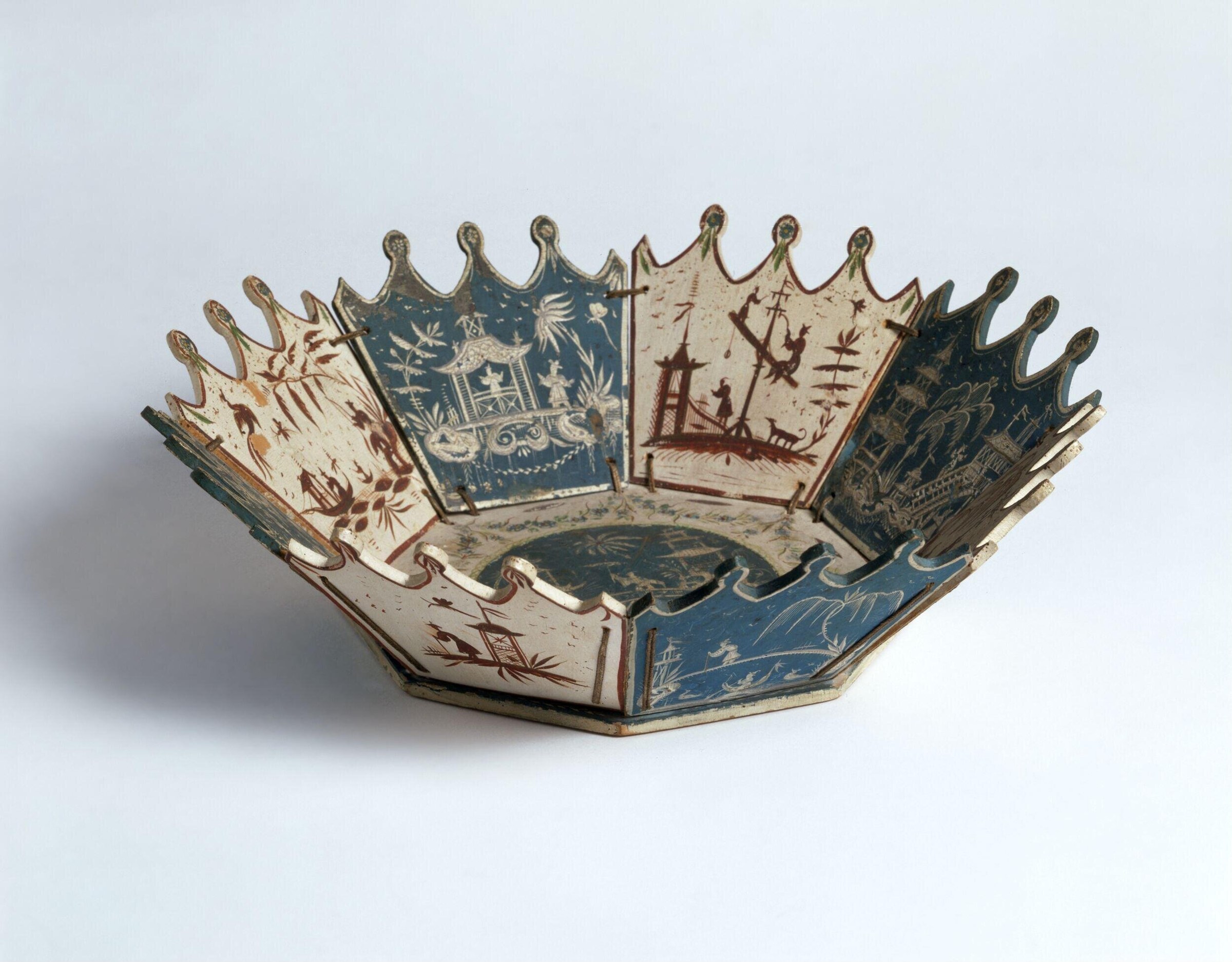
This object is significant as a document of European taste and manufacturing in the 18th century, not as dance imagery. It demonstrates how the japanning trade created new aesthetic standards and how 'the Orient' was imagined and constructed through decorative objects.
What you are looking at
This is a decorative object formed as an octagonal or fan-shaped bowl with a scalloped, crown-like rim. The interior and exterior surfaces are divided into eight distinct panels, each depicting a different scene in Chinoiserie style. The panels alternate between two color schemes: some feature pale cream or off-white grounds with reddish-brown ink drawings, while others display dark blue or slate grounds with gilt or pale ink details. The scenes show architectural structures (pagodas and pavilions), figures in motion or posed within landscapes, trees, birds, and decorative natural elements rendered in the refined, stylized manner of 18th-century European interpretations of East Asian aesthetics. The object appears to be made of lacquered metal or japanned wood, with the decorative panels creating a continuous narrative or decorative scheme around the form. The scalloped rim and octagonal structure suggest this was a functional table object, possibly a basket, serving piece, or ornamental container.
The dancing
The human figures visible in various panels are small and rendered in silhouette or outline, their poses suggesting movement and activity within architectural settings. They appear to be walking, standing, or engaged in domestic or leisurely pursuits rather than formal dance positions. The figures lack the detailed anatomical articulation or specific balletic posture that would indicate formal choreographed movement; instead, they suggest the everyday activities of an imagined East Asian society as understood by 18th-century European craftspeople.
The dance depicted
This object does not depict dance. While it contains human figures in various poses within Chinoiserie scenes, there is no evidence of formal dance, partnered movement, specific dance holds, or choreographic composition. The figures appear to represent landscape vignettes and domestic or leisure activities rendered in the decorative vocabulary of 18th-century rococo taste for things Chinese. The attribution of 'Quadrille pool' as a title is unexplained by the visual content.
How it was made
This appears to be a japanned (lacquered) metal or wooden object, likely created through the European japanning technique that flourished in the 17th and 18th centuries. The technique involved applying multiple coats of a lacquer-like substance to a base form and hand-painting or gilding decorative designs in imitation of genuine Asian lacquerware. The panel structure and scalloped rim suggest the form was constructed first, then divided into distinct decorated sections. This method of production was expensive and labour-intensive, resulting in luxury objects for affluent households.
About this work
This is a decorative functional object—likely a serving bowl, basket, or ornamental container—created using the japanning technique and decorated in the Chinoiserie style fashionable in 18th-century Europe. The eight panels display landscapes, architecture, and small human figures rendered in the delicate, stylized manner that European craftspeople imagined East Asian art to be. The 'Quadrille pool' title remains unexplained by the object's visual content, which contains no discernible dance imagery. The work exemplifies the rococo fascination with exotic cultures and the luxury trades that served elite European collectors.
How to look at it
Examine each of the eight panels individually and note how the artist has organized the composition: how figures are scaled within their architectural settings, how the landscape and buildings are rendered in perspective, and how the colour scheme (light ground versus dark ground) creates visual rhythm around the object. The scalloped rim and three-dimensional form mean the decoration was designed to be viewed from multiple angles as the object sat on a table or shelf, inviting the owner to turn it and discover each panel in sequence.
The period
The japanning industry flourished in Britain and continental Europe during the 17th and 18th centuries as a response to both the prestige of genuine Asian lacquerware and the technical challenges of importing it in volume. The Chinoiserie style—a fanciful European interpretation of Chinese and East Asian aesthetics—became dominant in rococo design from the 1730s onward. Decorative objects like this one were central to displays of wealth and cosmopolitan taste among the European aristocracy and gentry. The style valued delicacy, exoticism, and the suggestion of luxury imported from distant lands, even when the objects were entirely European in manufacture.
Where it lives
The object is recorded in the Victoria and Albert Museum collection. The catalogue record provides minimal information about its construction, material, dimensions, or previous ownership.
Questions about this work
Why is this called a 'Quadrille pool' when there is no dance visible?
The title is unexplained by the object's visual content. It is possible the name refers to a different object, was applied in error, or references a function or context now lost. The V&A record does not clarify the origin or meaning of the title.
What is japanning?
Japanning is a European technique developed in the 17th century to imitate genuine Asian lacquerware. A base object (wood or metal) is coated with successive layers of a hard, glossy substance, then decorated with hand-painted or gilded designs. It was cheaper to produce than importing real Asian lacquer but could achieve striking visual effect, making japanned objects status symbols in wealthy European households.
What is Chinoiserie?
Chinoiserie is the style of European artistic representation of East Asia—primarily China and Japan—created by artists and craftspeople who had little direct knowledge of those cultures. Rather than accurate documentation, it offered a fantastical, decorative vision of exotic lands, emphasizing delicate lines, architectural whimsy, and natural forms. It became the dominant aesthetic in rococo design.
What was this object used for?
Based on its form—an octagonal or scalloped bowl with a central depression—it may have been a serving dish, ornamental basket, or small container for the display of luxury goods. Japanned objects of this type were typically placed on prominent furniture where they could be admired and handled by visitors, serving as visible markers of the owner's taste and wealth.
More Quadrille artwork