45 works in this view — arrow keys or swipe to move between them.
Dance in Art
French Quadrille
Jullien, Louis Antoine
- Dance:
- Quadrille
- Source:
- Victoria and Albert Museum
- Rights:
- Rights vary by item — check the source record before reusing this image. Source record ↗
- Recorded as:
- Check V&A creditLine
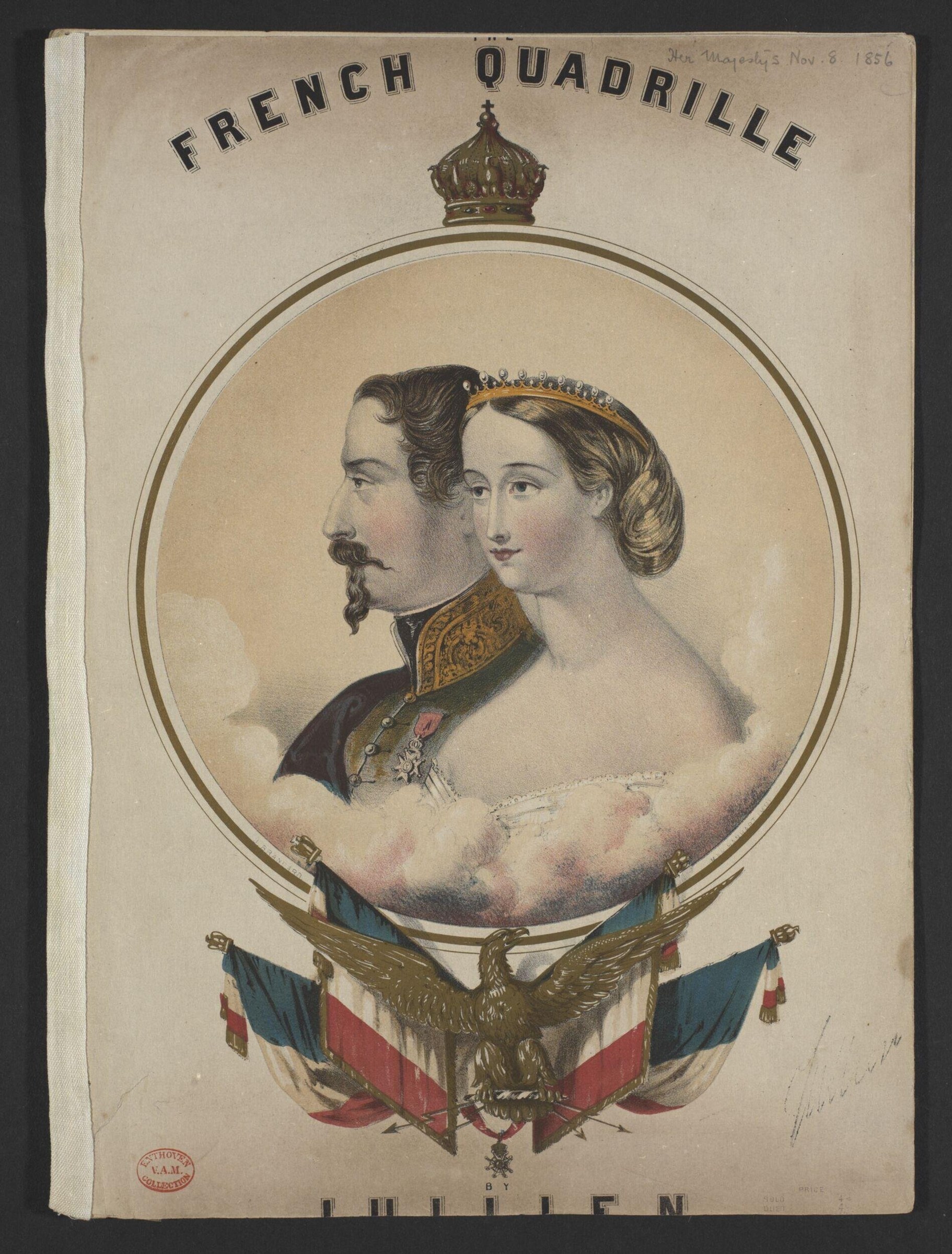
This print reveals how the quadrille operated in the nineteenth-century imagination as something more than a dance: it was a marker of civility, empire, and hierarchical order. For historians of dance and visual culture, it shows how a social dance could be invoked without being shown, used instead as a badge of belonging to a formal world.
What you are looking at
A formal portrait of a man and woman set within an ornamental circular frame topped by a crown. The man, shown in profile on the left, wears a dark military or court coat with an ornate gold-embroidered collar and a small medal or decoration on his chest. The woman on the right faces slightly toward the viewer, her shoulders bare, her hair styled in the fashion of the 1850s with a gold tiara or jeweled band across her head. Both figures are rendered in soft, idealized tones against a cream background. Below the circular frame hangs a ribbon of French and imperial colors (blue, white, and red) with a golden eagle at its center, a symbol of state authority. The composition is bilaterally symmetrical and deeply formal, printed on cream card stock.
The dancing
The two figures are arranged in profile and three-quarter view rather than in active dance position. Their bodies are static and posed, not captured mid-movement. The woman's shoulders are relaxed and exposed, the man's posture is formal and upright. Neither figure demonstrates the frame, hold, or weight distribution characteristic of quadrille dancers. The arrangement is heraldic rather than kinetic.
The dance depicted
The title identifies this as a 'French Quadrille,' but the image shows no dancing. No couples are in motion, no floorwork is visible, no dance hold is demonstrated. The quadrille was a popular group dance of the period, typically performed by four couples in formation with specific figures. This print appears to commemorate or celebrate two specific people—likely members of the French imperial court—rather than to document or teach the dance itself. The title may refer to the dance's association with formal court ceremony, or may indicate a quadrille named in honor of these two figures.
How it was made
This is a color lithograph, evidenced by the soft gradations of tone, the hand-colored quality of the blues, reds, and gold accents, and the characteristic texture of lithographic printing. The delicate rendering of the faces and the ornamental frame suggest a specialized printing house, likely French. Lithography made this type of commemorative portrait affordable for wider circulation than engraving, and the formal color treatment would have suited both state archives and the popular market for imperial imagery.
About this work
This is a commemorative print from the French Second Empire, likely the 1850s, using the quadrille's name to honor two figures of imperial rank. It is not a dance instruction or documentation piece, but rather a formal portrait in which the quadrille title may reference the dance's centrality to court life and courtship ritual. The work belongs in a dance gallery not because it depicts dancing, but because it shows how the quadrille functioned in the nineteenth century as an icon of state ceremony and social prestige, worthy of appearing in official portraiture. The object demonstrates that 'quadrille' had become a symbol of French imperial culture as much as a dance form.
How to look at it
Observe the heraldic arrangement: the two figures are not captured in motion but staged as symbols, frontal as a coat of arms. The crown and the imperial eagle below are the print's true subject; the human figures are subordinate to state iconography. The styling—the gold ornament, the idealized faces, the formal frame—all work to elevate the subjects into a timeless realm of ceremony rather than the specific moment of a social dance.
The artist
Louis Antoine Jullien (1812–1860) was a French conductor and composer famous for his promenade concerts and orchestral arrangements. He composed quadrilles and popular dances, and his name is associated with the promotion of social dance music in the nineteenth century. His involvement in this print may indicate it was a state commission or a commercially distributed souvenir tied to imperial ceremony.
The period
The quadrille dominated European ballrooms from the 1830s through the 1880s, becoming the signature dance of the Napoleonic and post-Napoleonic court. It required formal dress, instruction, and space, marking it as an elite social practice. By the 1850s, when this print was likely made, the quadrille was so established as a symbol of social order that it could be invoked purely through title and imperial insignia without need to show the dance itself. The lithographic process allowed mass production of such commemorative objects.
Where it lives
The work is held in the Victoria and Albert Museum collection, catalogued as an artwork by Jullien. The collection mark and handwritten accession information visible in the upper right corner confirm its institutional provenance. It is a decorative print of the type distributed as both official state commemoration and popular souvenir.
Questions about this work
Why is this called a quadrille if there is no dancing?
The quadrille was so embedded in nineteenth-century ideas of French courtship and imperial order that its name alone could evoke those values. By the Second Empire, the quadrille had become shorthand for formal society. The title may honor these figures by associating them with the most prestigious social dance, or may record that a quadrille was danced in their honor at a state ceremony. The print is not a dance document but a state portrait that uses the dance's cultural weight.
Who are these two people?
The catalogue record does not identify them. Their imperial dress and the French state symbols suggest they were members of or close to the Second Empire court (1852–1870). The tiara and military decoration mark them as people of high rank. The print was likely sold or distributed as a commemorative souvenir among the educated and wealthy public.
How was this print made?
This is a color lithograph, a printing technique that allowed multiple colors to be applied from separate stone plates. Lithography was faster and cheaper than engraving, making it ideal for producing commemorative prints in quantity. The soft modeling of the faces and the precise color registration visible here show skilled craftsmanship.
More Quadrille artwork