46 works in this view — arrow keys or swipe to move between them.
Dance in Art
The Faust Quadrille
Coote
- Dance:
- Quadrille
- Era:
- Late 1800s (Victorian Ballroom)
- Source:
- Victoria and Albert Museum
- Rights:
- Rights vary by item — check the source record before reusing this image. Source record ↗
- Recorded as:
- Check V&A creditLine
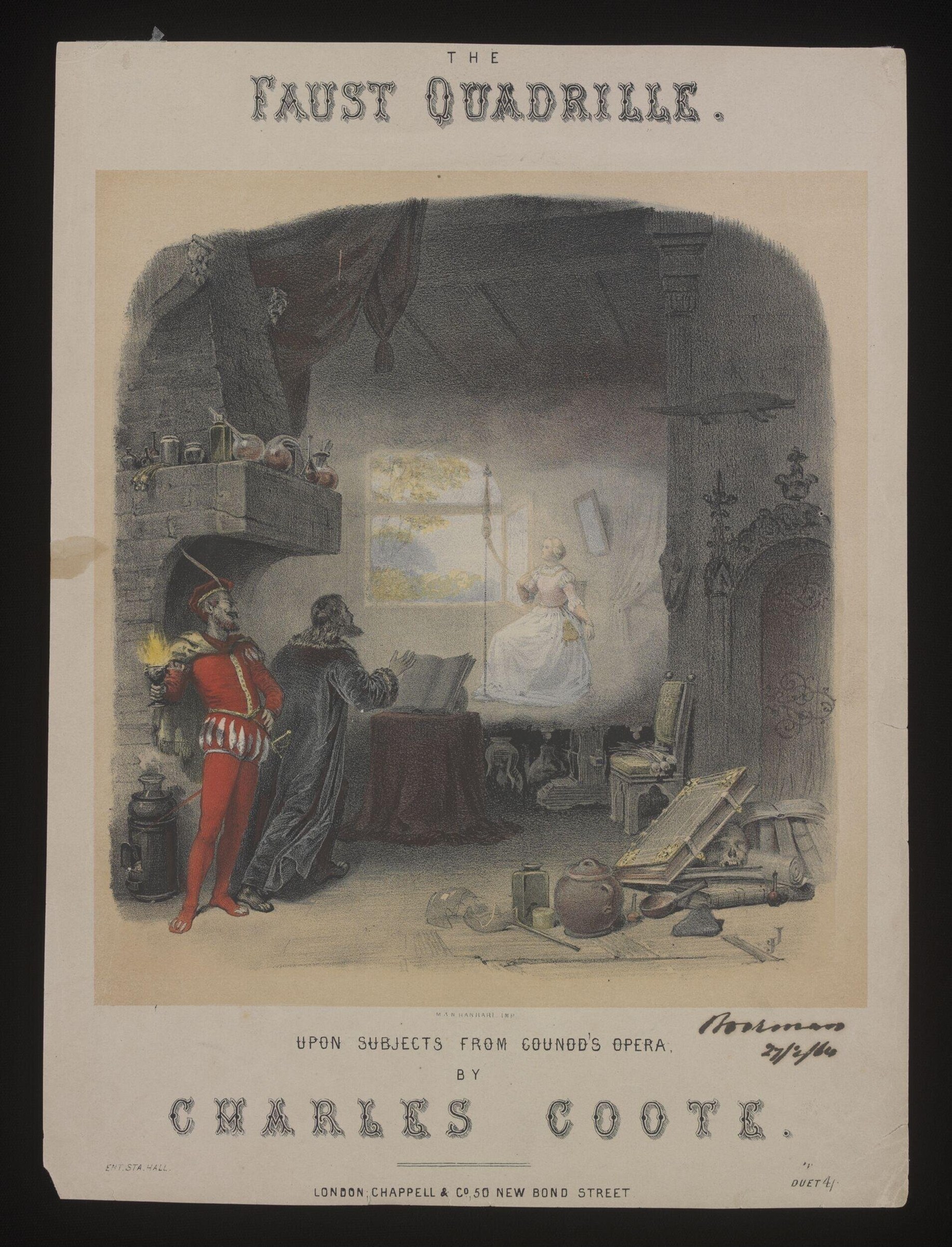
The Faust Quadrille was a real social dance, and this print connects it to the operatic source from which its musical material came. For historians of Victorian dance, it shows how high art (Gounod) reached the ballroom (quadrille) through multiple media: opera houses, printed scores, illustrated narratives, and choreographic adaptation. The image captures a moment when printed illustration could serve as a mass medium for narrative, directing viewers' emotional attention to a precise dramatic instant—the conjuration—and so training a form of theatrical looking that dance audiences would have brought to the ballroom.
What you are looking at
A theatrical interior staging the famous legend: the scholar Faust, dressed in crimson doublet and hose, stands at left conferring with Mephistopheles in dark robes. Between them, materialised on a raised platform draped with heavy fabric, appears the ethereal figure of Marguerite in white, luminous against the shadowed stone. The setting is a vaulted medieval chamber with Gothic arches, fortress towers visible through the opening, and scattered props of alchemy and learning—books, vessels, instruments—strewn across the foreground. The lighting pools on the central apparition, leaving Faust and his tempter in chiaroscuro, a visual grammar of temptation and illusion. The moment is the conjuration itself: the woman materialises, the bargain made visible.
The dancing
Faust stands in a slight contrapposto, his posture alert but contained, one arm extended as if in amazement or greeting toward the vision. Mephistopheles is hunched and inward, his gesture more restrained, almost proprietorial—he has delivered on his promise. Marguerite hovers en-face in a languid, almost weightless pose, her white gown voluminous and ethereal. The composition is asymmetrical: Faust and the devil occupy the foreground left, the woman floats isolated in the deep space between them, creating distance and unreality. No actual embrace or contact occurs; the figures relate through sight and desire, not touch.
The dance depicted
This is not a depiction of dance in the ballroom sense, but the work belongs in dance history as a record of how the Faust legend circulated through popular culture in the Victorian era. The title page announces itself as based on 'subjects from Counod's Opera'—referring to Charles Gounod's *Faust* (1859), one of the century's most performed operas. The theatrical tradition of the opera house, where elaborate ballets were standard features, meant that the Faust legend reached mass audiences partly through choreographed scenes. This particular image is narrative illustration, not dance depiction, but it documents the cultural apparatus through which Victorian audiences encountered classical myth.
How it was made
This is a hand-coloured engraving or lithograph, identified from the fine linear hatching visible in the shadows and the delicate tonal gradations typical of 19th-century reproductive printmaking. The colouring—pale cream ground, subtle washes of grey and blue in the stonework, the bright crimson of Faust's costume striking against the darkness, the luminous white of Marguerite—is applied by hand, suggesting a luxury object. The publisher Chappell & Co of New Bond Street, London was a significant print house, and this would have been a relatively expensive item for domestic or institutional display. The technique allows fine narrative detail while maintaining dramatic lighting contrasts essential to the theatrical mood.
About this work
This is a hand-coloured engraving advertising an illustrated edition of dramatic scenes from Gounod's *Faust*, itself a work deeply embedded in 19th-century ballroom and operatic culture. It belongs in the dance collection not as a depiction of choreography but as evidence of how opera—a form that integrated dance as a major spectacle—disseminated classical narratives through Victorian visual culture. The image shows the infrastructure of popular taste: a French opera adapted into English prints for drawing-room display, narrative illustration serving as a mass medium for stories that would have been encountered live in theatres with full corps de ballet. The Faust Quadrille itself (the historical dance) would have been performed to tunes drawn from Gounod's score; this print documents the opera that seeded those melodies into ballroom repertory.
How to look at it
Attend to the composition's use of depth and light to stage an act of magic: Faust and Mephistopheles occupy the foreground and near-middle ground, solid and material, while Marguerite floats in a luminous void between them and the fortress, made weightless by the artist's use of white paper and delicate shadow. The central moment is one of revelation, not movement—the artist chooses the instant of apparition. Notice how Faust's extended arm and open stance register wonder and appetite, while Mephistopheles remains contracted and watchful. The theatrical lighting (impossible in the stone chamber) signals that this is a realm of illusion and operatic convention, not naturalism.
The artist
Charles Coote was a Victorian illustrator and engraver working in London in the mid-19th century. He was among the numerous draughtsmen producing narrative illustrations for the expanding market in gift books, opera editions, and serialised literary works. The signature and date visible on the print ('Pimlico 27/7/44, or similar) place him in a specific London tradition of reproductive printmakers. Little is recorded of Coote's individual practice, but his work exemplifies the division of labour in Victorian printmaking: commissioned designs, engraved and hand-coloured for commercial distribution.
The period
Gounod's *Faust* premiered in Paris in 1859 and reached London within a few years, becoming one of the century's most frequently staged operas. The 1860s and 1870s saw a proliferation of illustrated editions and related merchandise, including the Faust Quadrille (music published by various London houses). The quadrille was the dominant ballroom form in mid-Victorian Britain, and the practice of composing quadrilles to operatic airs was standard—orchestras would arrange selections from popular operas into the four or five sections of the form. Simultaneously, chromolithography and hand-coloured engraving were at their peak as methods of disseminating illustrated narrative, before photomechanical printing. This print sits at the intersection of three markets: opera houses, ballrooms, and domestic print collections.
Where it lives
This work is held in the Victoria and Albert Museum's collection and is identified as a late 19th-century print (the exact date is uncertain). It is one item in a series of illustrated subjects from the Faust opera, issued by Chappell & Co as a commercial publication for the mass market.
Questions about this work
What is the Faust Quadrille?
A quadrille—a set dance in four or five sections—composed to melodies from Gounod's opera *Faust*. It was a standard ballroom dance in the 1860s-1890s, part of the Victorian practice of arranging operatic material for social dancing. Multiple composers published versions; the dance would have been performed by sets of four couples in formation.
Did people really dance to opera music at balls?
Yes, extensively. Ballroom orchestras routinely arranged selections from popular operas—Gounod, Verdi, Offenbach—into quadrilles, galops, and waltzes. A successful opera would generate multiple dance arrangements within months of its premiere, allowing middle-class dancers to participate in fashionable operatic culture without attending the theatre.
Why is this print coloured by hand?
Hand-colouring was the standard method for adding colour to engravings and early lithographs before chromolithography became cost-effective in the 1880s-90s. Each print would be passed through the hands of several workers applying different colours in sequence. It was labour-intensive but allowed fine control over tone and finish, and commanded a premium price.
What does this tell us about Victorian visual culture?
It shows how narrative illustration functioned as mass media, distributing stories and images of fashionable culture through affordable prints for domestic display. Operatic subjects were particularly popular, appealing to aspirations toward gentility and cosmopolitan taste. The print also reveals the interconnection between theatre, ballroom, and home.
More Quadrille artwork