49 works in this view — arrow keys or swipe to move between them.
Dance in Art
Erminie Quadrille
Joseph Williams
- Dance:
- Quadrille
- Era:
- Late 1800s (Victorian Ballroom)
- Source:
- Victoria and Albert Museum
- Rights:
- Rights vary by item — check the source record before reusing this image. Source record ↗
- Recorded as:
- Check V&A creditLine
This print documents the intersection of ballroom dance, theatrical parody, and commercial print culture. For historians of dance, it raises a crucial question: what counted as 'dance' in the public imagination of 1885 was not only what was performed in ballrooms, but what was exaggerated, mocked, and sold as entertainment. The work is evidence of how quadrilles were understood as material for comedy.
What you are looking at
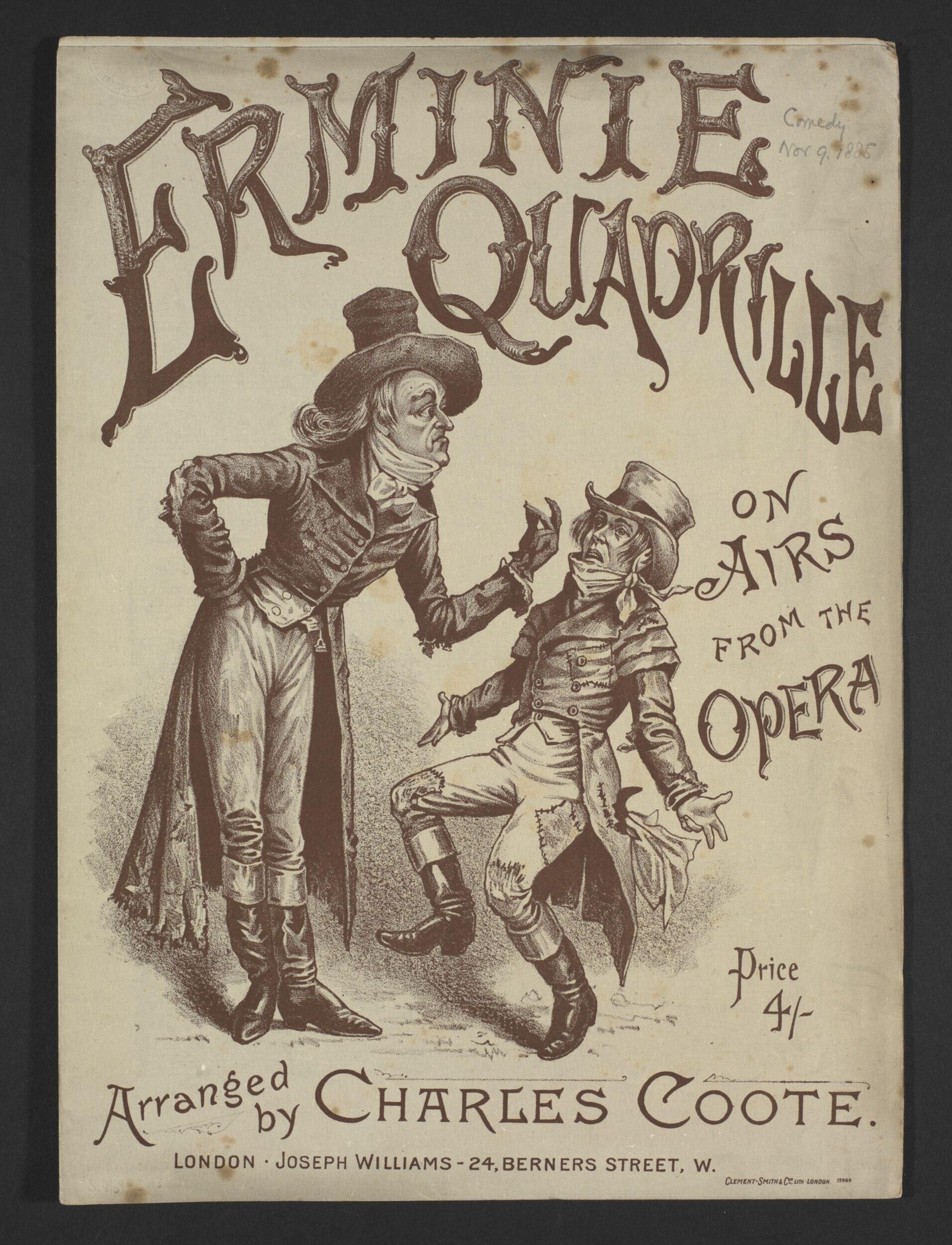
A tall, thin figure in early 19th-century male dress—coat with tails, tight breeches, and a top hat—bends toward a much shorter, stockier man dressed in a military-style tunic with buttons and epaulettes, also wearing a top hat. The taller man gestures with one hand extended in a teaching or directive pose, while the shorter man stands with one leg raised in a high kick, his arms akimbo in a posture of exaggerated compliance or comic defiance. The composition is theatrical and humorous, with the figures set against a plain background. The engraving emphasizes the contrast in their physiques and the absurdity of the moment—an impossible or ridiculous dance instruction caught mid-performance. The date 1885 and price of 4 shillings anchor this as a commercial print.
The dancing
The standing man demonstrates a deliberate teaching posture: weight settled, torso inclined forward, one arm raised to direct. The kicking man has lifted one leg high and outward in an exaggerated extension, arms held wide and bent at the elbows in a position that reads as both comedic and defiant. The physical disparity between the two—one rail-thin and commanding, the other compact and obedient—reinforces the pedagogical or master-servant relationship. Neither figure shows the fluid, continuous movement of social dance; instead, they are frozen in discrete, illustrative positions.
The dance depicted
The title *Erminie Quadrille* and inscription 'On Airs from the Opera' identify this as a quadrille—a four-couple country dance popular in ballrooms throughout the 19th century. The image, however, parodies rather than celebrates the form. The absurd height of the kick, the exaggerated postures, and the visual comedy suggest this is an advertisement or illustration for a burlesque, music-hall, or theatrical adaptation of quadrille steps, not a depiction of the dance as it was actually performed in society. The 'Erminie' reference—likely to the 1886 operetta *Erminie* by Edward Jakobowski—dates the print and explains the operatic connection. This is dance as spectacle and parody rather than instruction.
How it was made
The image is a wood engraving or steel engraving, a technique that allowed for mass reproduction at low cost. The fine cross-hatching visible in the shading, the strong linear quality, and the crisp, reproducible lines are characteristic of 19th-century commercial engraving. Published by Joseph Williams (London printer) and sold through the London music and print publisher Joseph Williams, 24 Berners Street, this was a commodity print—affordable, ephemeral, intended for broad distribution to theater-goers, music buyers, and amateur dancers. The technique's precision and reproducibility made it ideal for capturing the exaggerated comic detail that sells the joke.
About this work
This is a commercial engraving advertising or illustrating the quadrille as performed (or parodied) in a late-Victorian theatrical context, likely in connection with the operetta *Erminie*. The quadrille was by 1885 an established ballroom and theatrical form, but this image mocks its formality through grotesque physical exaggeration. The work belongs in a gallery of dance imagery not because it documents the dance accurately, but because it shows how dance was consumed, mediated, and transformed through popular print and theatrical culture. It reveals the gap between ballroom propriety and music-hall farce, and how dance imagery sold entertainment in the late 19th century.
How to look at it
Notice the impossible geometry of the kick—no dancer performing a quadrille would raise the leg this high or with this force. The print freezes a moment of instruction, but the exaggeration transforms it into farce. The viewer's eye should track the contrast between the tall, composed instructor and the compact, obedient but ridiculous student. The theatrical notation of the figures—their costumes, their clear poses, the plain background—reads like a stage direction rather than a ballroom scene. This is an artifact of how 19th-century print media made dance legible and laughable simultaneously.
The artist
Joseph Williams was a London music and theatrical print publisher active in the mid-to-late 19th century, based at 24 Berners Street in the West End. His firm published affordable prints, sheet music, and theatrical ephemera aimed at urban middle- and working-class audiences. The house style combined clear, readable engraving with strong comic or promotional intent. Williams' practice was typical of Victorian-era entertainment publishing: rapid response to theatrical successes, accessible pricing, and visual humor as a selling strategy.
The period
The quadrille dominated European ballroom culture from the 1830s through the 1890s, coexisting with the waltz and polka. By the 1880s, when this print was made, the quadrille was established repertoire—respectable enough for ballrooms, familiar enough for parody. The operetta boom of the 1880s (particularly the success of Gilbert and Sullivan) created a market for theatrical ephemera and dance-related novelties. Music halls and theaters mined ballroom dances for comedy, exaggerating the formality and rigidity that made them ripe for satire. This print sits at that intersection: ballroom dance as both serious social practice and rich material for theatrical mockery.
Where it lives
The print is held by the Victoria and Albert Museum. It is a commercial mass-produced engraving published by Joseph Williams, London, priced at 4 shillings—positioning it as affordable entertainment ephemera for a broad urban audience rather than an art-historical document.
Dance in this work
Questions about this work
What is a quadrille?
A quadrille is a four-couple ballroom dance in square formation, composed of linked figures and choreographic sequences. It originated in France in the late 18th century and dominated ballroom culture through the 19th century, rivaling the waltz in popularity. The quadrille was considered respectable, geometric, and sociable—ideal for mixed-gender groups at formal balls and assemblies.
What is 'Erminie' and why is it referenced?
*Erminie* was an operetta that premiered in London in 1886 (the year after this print). The print likely advertises or commemorates a quadrille performed in or adapted from the operetta, capitalizing on the show's popularity. Victorian theatrical culture generated enormous quantities of dance-related ephemera tied to successful stage productions.
Why is this image comic?
The print exaggerates the physical demands and formality of the quadrille to absurd effect. The impossibly high kick, the rigid postures, and the visual contrast between the two male figures (one thin and commanding, one compact and obedient) transform ballroom decorum into music-hall farce. Comedy comes from the gap between the dance's reputation for propriety and its theatrical, exaggerated performance.
Who was Joseph Williams and what did he publish?
Joseph Williams was a London music and theatrical print publisher based on Berners Street. His firm produced affordable, mass-market prints, sheet music, and theatrical ephemera for urban audiences. His publications were typically responsive to popular theatrical successes and designed to appeal to amateur musicians and theater-goers rather than connoisseurs.
More Quadrille artwork