36 works in this view — arrow keys or swipe to move between them.
Dance in Art
The Pretty Bird Quadrille
Coote, Charles Junior
- Dance:
- Quadrille
- Era:
- Late 1800s (Victorian Ballroom)
- Source:
- Victoria and Albert Museum
- Rights:
- Rights vary by item — check the source record before reusing this image. Source record ↗
- Recorded as:
- Check V&A creditLine
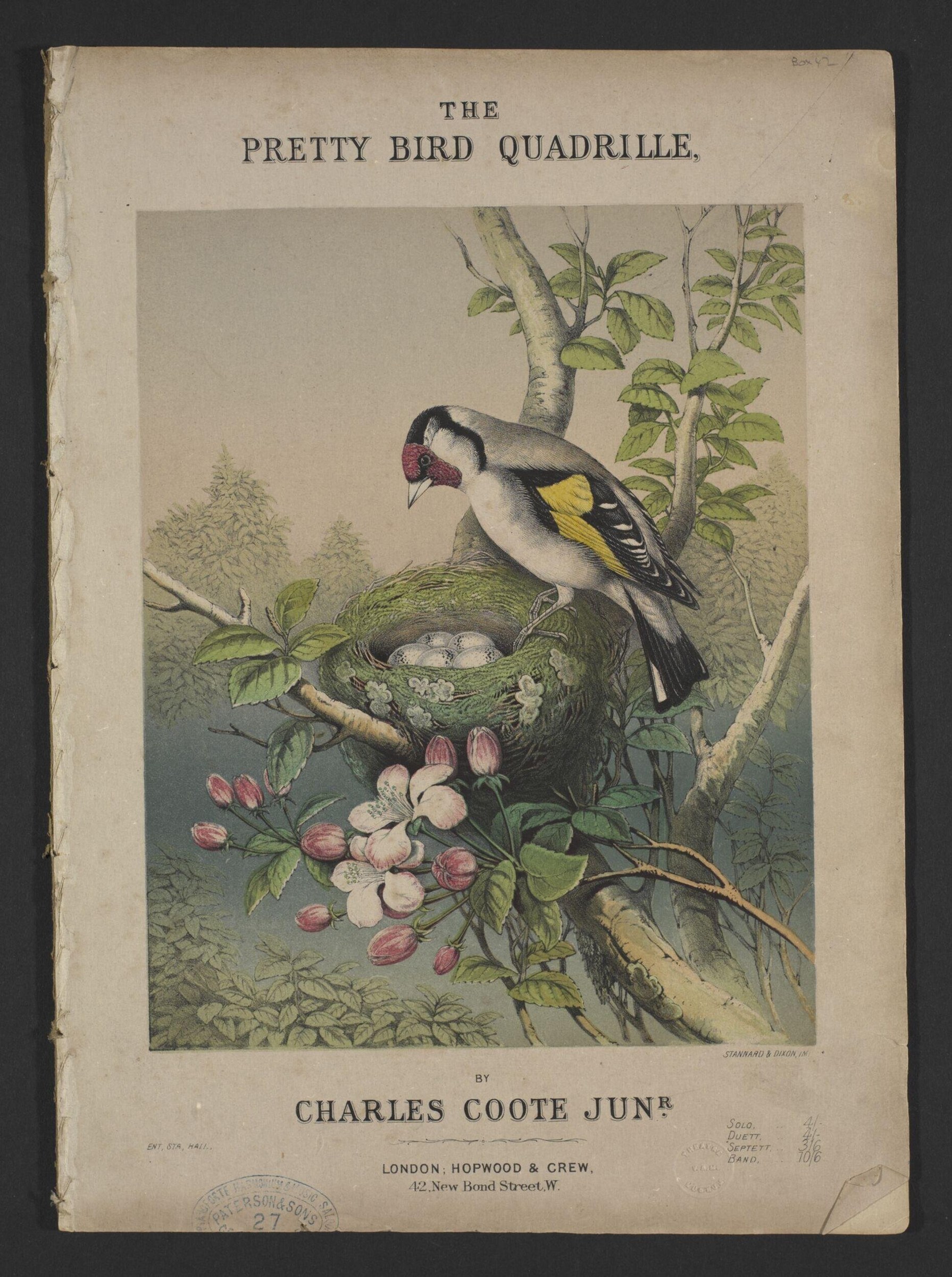
This work reveals the ambiguity between title and image in Victorian decorative practice, and serves as a useful test case for how libraries and galleries assign content labels. For dance researchers, it is a negative example: proof that not all works in 'quadrille series' depict quadrilles, and a reminder that visual cataloguing requires looking at the actual image rather than trusting series titles.
What you are looking at
A hand-colored engraving shows a single bird—a European Goldfinch with distinctive red face marking, pale body, and striking yellow and black wing pattern—perched on a branch beside a woven nest containing speckled eggs. The bird is positioned in profile, gazing toward the nest. Flowering branches with white blossoms and pink buds surround the scene, rendered in soft greens and flesh tones. The background is hazy, with feathery vegetation suggesting a woodland setting. The composition is intimate and naturalistic, focused on the bird's relationship to its nest rather than any landscape vista. The engraving is finely detailed, with careful hatching defining the bird's plumage and delicate stippling creating depth and shadow.
The dancing
This is ornithological rather than dance imagery. The single bird is depicted in a natural, observational posture—alert but at rest, its body held at an angle that creates visual interest. There is no human figure, no partner, no choreography, and no movement that would constitute dance.
The dance depicted
This work does not depict dance. The catalogue identifies it as part of a quadrille series and assigns it the dance-style label 'Quadrille,' but the image is a naturalistic study of a bird and nest. No human dancers, no ballroom setting, and no choreographic content are visible. The title 'The Pretty Bird Quadrille' is literary rather than documentary—the quadrille was a popular social dance of the period, and the whimsical title appears to be a naming convention for a decorative print series, not a record of the image content.
How it was made
This is a hand-colored engraving or chromolithograph, as evidenced by the fine parallel hatching visible in the rendering of the bird's feathers and the soft, layered application of color. The technique allowed for both precision in ornithological detail and the warm, naturalistic palette characteristic of Victorian decorative prints. The quality of reproduction and hand-finishing suggests this was a commercial print, likely intended for framing and domestic display rather than scientific documentation.
About this work
This is a decorative print from the Victorian period, part of a series titled 'The Pretty Bird Quadrille' by Charles Coote Junior. The work is a naturalistic study of a European Goldfinch at its nest, rendered in hand-colored engraving. While catalogued under the dance genre due to its series title, the image itself contains no dance content—it is an ornithological illustration designed for domestic wall display. Its inclusion in LODance raises a question about how decorative titles intersect with iconographic content: the quadrille reference is nominal rather than pictorial.
How to look at it
Attend to the precision of the goldfinch's plumage—the fine gradation of color in the wing feathers, the bright red face mask, the subtle shading that gives the body volume. Notice how the artist has positioned the bird in a posture of engagement, turned toward the nest rather than presented in profile symmetry. The flowering branches frame rather than compete with the central subject. This is the language of Victorian natural-history prints: clarity, domestic intimacy, and modest charm rather than dramatic movement or grand composition.
The artist
Charles Coote Junior was a 19th-century British illustrator and printmaker active in ornithological and natural-history illustration. He worked for commercial publishers including Hopwood & Crew of London, producing decorative prints suited to the Victorian domestic market. His practice centered on naturalistic rendering of birds, flowers, and small creatures—subjects that aligned with the period's growing enthusiasm for natural-history collecting and domestic decoration. Little is recorded of his individual training or career trajectory.
The period
The Victorian era (1837–1901) saw an explosion in chromolithographic reproduction and hand-colored prints for domestic consumption. Publishers like Hopwood & Crew marketed decorative series to middle-class households, often giving them whimsical titles that referenced current entertainments—in this case, the quadrille, a four-couple square dance that had been fashionable in ballrooms for half a century and remained culturally resonant as a marker of gentility. The prints were rarely intended as literal depictions of their titles; instead, the title functioned as a sales device, a way of adding narrative charm to images of natural subjects.
Where it lives
The work is held in the Victoria and Albert Museum collection. It is a commercial decorative print issued by the London publisher Hopwood & Crew, identifiable from the publisher's mark visible in the lower margin. Such prints were mass-produced and intended for retail sale to households rather than museum acquisition, so this example is one of presumably many surviving copies.
Questions about this work
Why is this catalogued as dance if there's no dancing?
The series title 'The Pretty Bird Quadrille' triggered automatic assignment to the quadrille dance category. The title is a Victorian marketing device—quadrilles were fashionable, and naming a print series after one added commercial appeal. The image itself is ornithological, not choreographic. This illustrates the risk of relying on titles rather than visual content for cataloguing.
What is a quadrille?
A quadrille is a four-couple square dance that became fashionable in ballrooms during the 19th century. It consists of five figures danced in formation, and was a central feature of genteel social dancing. The reference here is purely nominal—a marketing hook rather than a visual subject.
Is this a scientific illustration?
It has elements of scientific observation—the goldfinch is rendered with ornithological accuracy, the nest and eggs are detailed—but it is a commercial decorative print rather than a scientific document. The soft, hand-colored technique and the framing emphasize aesthetic appeal and domestic suitability over systematic documentation.
More Quadrille artwork