33 works in this view — arrow keys or swipe to move between them.
Dance in Art
Hop Light Loo Quadrille
Coote, Robert
- Dance:
- Quadrille
- Era:
- Late 1800s (Victorian Ballroom)
- Source:
- Victoria and Albert Museum
- Rights:
- Rights vary by item — check the source record before reusing this image. Source record ↗
- Recorded as:
- Check V&A creditLine
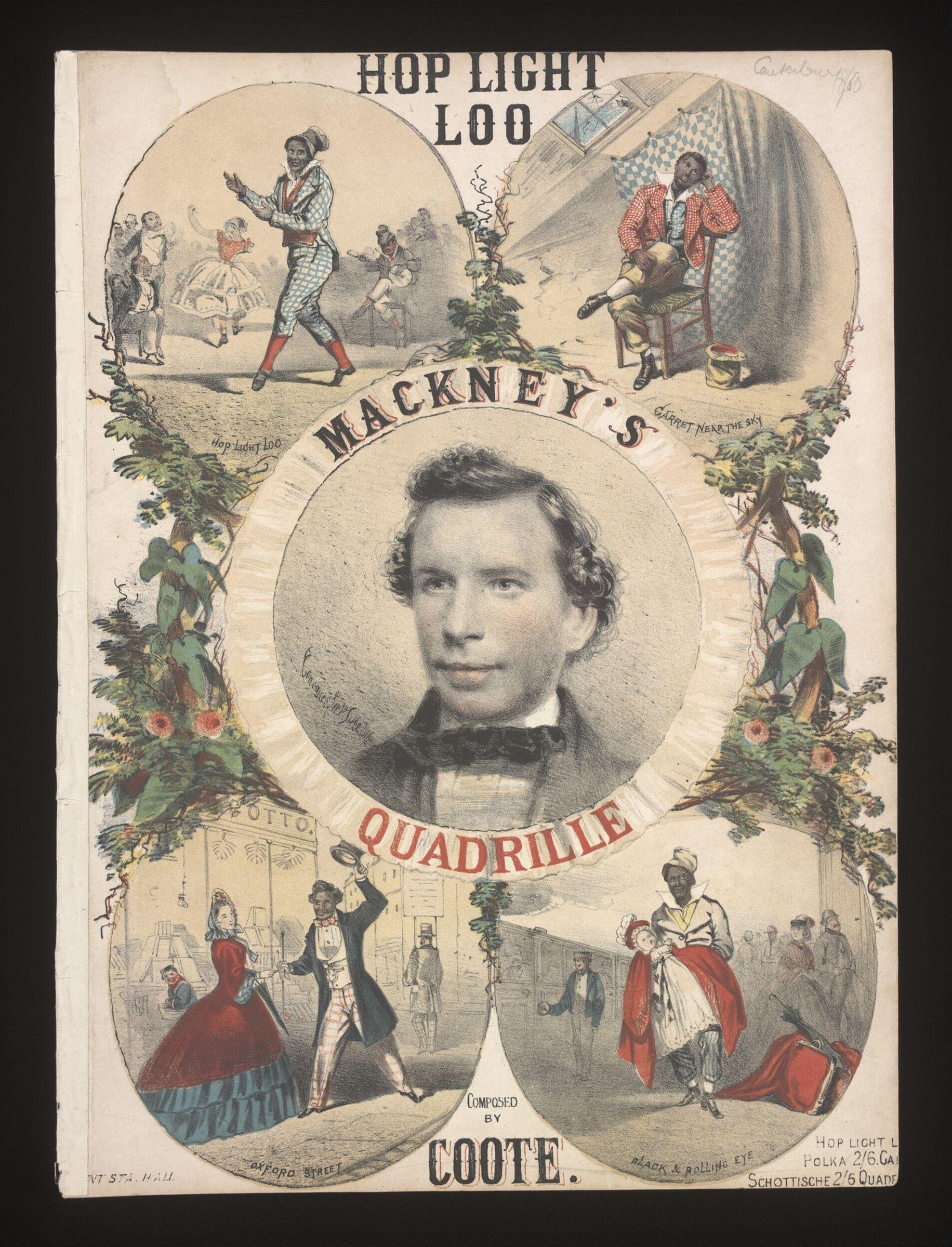
This object is evidence of the quadrille as a lived social practice, not just a choreographic notation. The five scenes tell us that the quadrille existed in multiple venues—ballrooms, streets, seaside—and involved not just dancers but spectators, and that composers like Coote created dozens of named variations and locally-known versions. The emphasis on clothing, setting, and social interaction shows how the dance was entangled with respectability, gender, and public performance in the 19th century.
What you are looking at
This is a lithographic cover for a quadrille composition titled "Hop Light Loo," credited to composer Coote and printed by Schottische, showing the dance in five vignettes arranged around a central portrait. The central oval contains a formal portrait of a young man in black jacket and bow tie, surrounded by a wreath of hop plants with delicate flowers. The four corner scenes depict different moments of the quadrille being danced: at upper left, couples in outdoor dress with a man in patterned jacket performing an elevated gesture while onlookers watch; at upper right, an indoor scene with a woman in red and white dress being attended to by a man in evening wear beneath a draped fabric backdrop; at lower left, a street scene with a woman in deep red cloak and a man in formal dress with top hat; at lower right, a sailor in white uniform gestures toward a woman in red and white, with crowds visible in the background. The overall composition is typical of Victorian-era dance music publication covers, with ornamental typography and hand-colored lithography.
The dancing
The dancers shown are in ballroom dress, moving in pairs and small groups typical of social dance. The male figures wear tailcoats, waistcoats, and top hats; the female figures wear voluminous skirts with cloaks and wraps, and bonnets or bare heads. The gestures are theatrical and expansive rather than technically precise—figures with raised arms, gestural rather than structural holds, weight distributed in presentations to partners rather than in unified movement. The variety across the four scenes suggests different moments or variations within the quadrille rather than a single frozen moment, with emphasis on social interaction and spectacle over technical execution.
The dance depicted
This is a quadrille, one of the most popular ballroom dances of the Victorian era. The title "Hop Light Loo" is a variant name; the quadrille itself—typically danced by four couples in a square formation—was the foundational social dance of the 19th-century ballroom. The five vignettes do not depict the geometry of the square dance formation, but rather capture the social performance, outdoor and indoor settings, and the theatrical spectacle that surrounded quadrille dancing in public and private contexts. The inclusion of a figure in naval dress in one scene and the street setting in another suggests the dance's presence across social classes and venues, though the overall presentation remains tied to respectable society.
How it was made
This is a hand-colored lithograph, a commercial music cover. Lithography allowed for mass production of theatrical, detailed imagery at affordable cost, making these covers widely circulated among piano-owning households and dance halls. The technique supported the fine detail visible in the ornamental typography, the botanical precision of the hop plant wreath, and the subtle shading in the portrait. The hand coloring—evident in the reds of the women's garments, the greens of the foliage, and the flesh tones—was applied after printing, typical of mid-to-late 19th-century music publication. This object would have been sold as sheet music cover, a primary source for understanding how the quadrille was marketed to and consumed by the Victorian public.
About this work
This is a Victorian-era dance music cover illustrating the quadrille through five scenes arranged around a portrait of the composer. The work captures not the technical structure of the dance but its social context: ballrooms, streets, and seaside settings populated by well-dressed couples and spectators. It is a commercial object—a lithographed music cover—designed to sell both the composition and the idea of the quadrille as a fashionable, accessible, and publicly visible form of entertainment. The work belongs in a dance archive because it documents what the quadrille looked like in practice, where it was danced, and how it was marketed to the Victorian middle classes.
How to look at it
Look at how the artist has chosen to show the quadrille not as a formation but as a social encounter. Each vignette captures a different social moment—flirtation, presentation, spectacle—rather than a step or a figure. The formal portrait of the composer at center anchors the cover as a commercial object promoting a specific composition and a specific artist. Notice the architectural and costume detail that anchors each scene in a particular place: the indoor ballroom with its draped backdrop, the outdoor seaside or promenade settings, the street. This is how the quadrille existed for Victorians—not as an abstraction, but as a located, social, visible practice.
The artist
Robert Coote is credited as composer. Very little is documented about him beyond the publication record; he was one of many Victorian-era composers of ballroom music, creating named quadrilles and other dances for commercial publication. The fact that his name appears prominently on the cover, alongside a formal portrait, suggests he had some standing in the music trade, though he is not now well-known. Composers of quadrilles were typically prolific and anonymous contributors to the vast Victorian music market.
The period
The quadrille dominated ballroom dancing from roughly 1815 to the 1890s, though it remained popular into the early 20th century. By the time this cover was printed—likely 1860s-1880s based on printing style and dress—the quadrille had spread from elite French salons to middle-class ballrooms across Britain and America. Named variations and locally-composed versions (like Coote's "Hop Light Loo") were extremely common; composers and publishers created hundreds of these pieces to supply demand from dance halls, private parties, and home musicians. The lithographic cover as a commercial product reflects the democratization of ballroom dance culture and the rise of mass-market music publishing. By this period, the quadrille was beginning to compete with newer dances like the waltz and polka, though it remained the foundational group dance.
Where it lives
The object is held by the Victoria and Albert Museum. It is catalogued as a lithographed music cover, a common and abundant form of Victorian ephemera. The maker and printer information (Schottische, noted at bottom) indicates it was produced by a commercial music publisher; "2/6 Quadrille" indicates the retail price in shillings and pence.
Dance in this work
Questions about this work
What is a quadrille?
A quadrille is a ballroom dance for four couples arranged in a square, performed to music in 2/4 or 6/8 time. It originated in France in the early 19th century and became the dominant social dance of the Victorian era. Each dance consisted of five figures (movements), and composers created hundreds of named variations.
Who danced the quadrille?
The quadrille was a respectable, middle-class and upper-class ballroom dance. It required some instruction and was typically taught in dancing schools or learned socially. Both men and women danced it, and it was a fixture of balls, public assemblies, and private parties throughout the 19th century.
Why is there a portrait of the composer on the cover?
Composers of popular ballroom music were often marketed as celebrities, and their portraits appeared on music covers to add prestige and sell copies. This was a common practice in Victorian music publishing, treating the composer as part of the product's appeal.
What do the hop plants symbolize?
The hop plant wreath surrounding the portrait is likely a pun or reference in the title "Hop Light Loo." Hops are used in brewing, and the decorative frame turns the title into a visual conceit. This kind of botanical or pictorial wordplay was common on Victorian music covers.
More Quadrille artwork