13 works in this view — arrow keys or swipe to move between them.
Dance in Art
A Cotillion
Kingsbury, Henry
- Dance:
- Cotillion
- Source:
- Victoria and Albert Museum
- Rights:
- Rights vary by item — check the source record before reusing this image. Source record ↗
- Recorded as:
- Check V&A creditLine
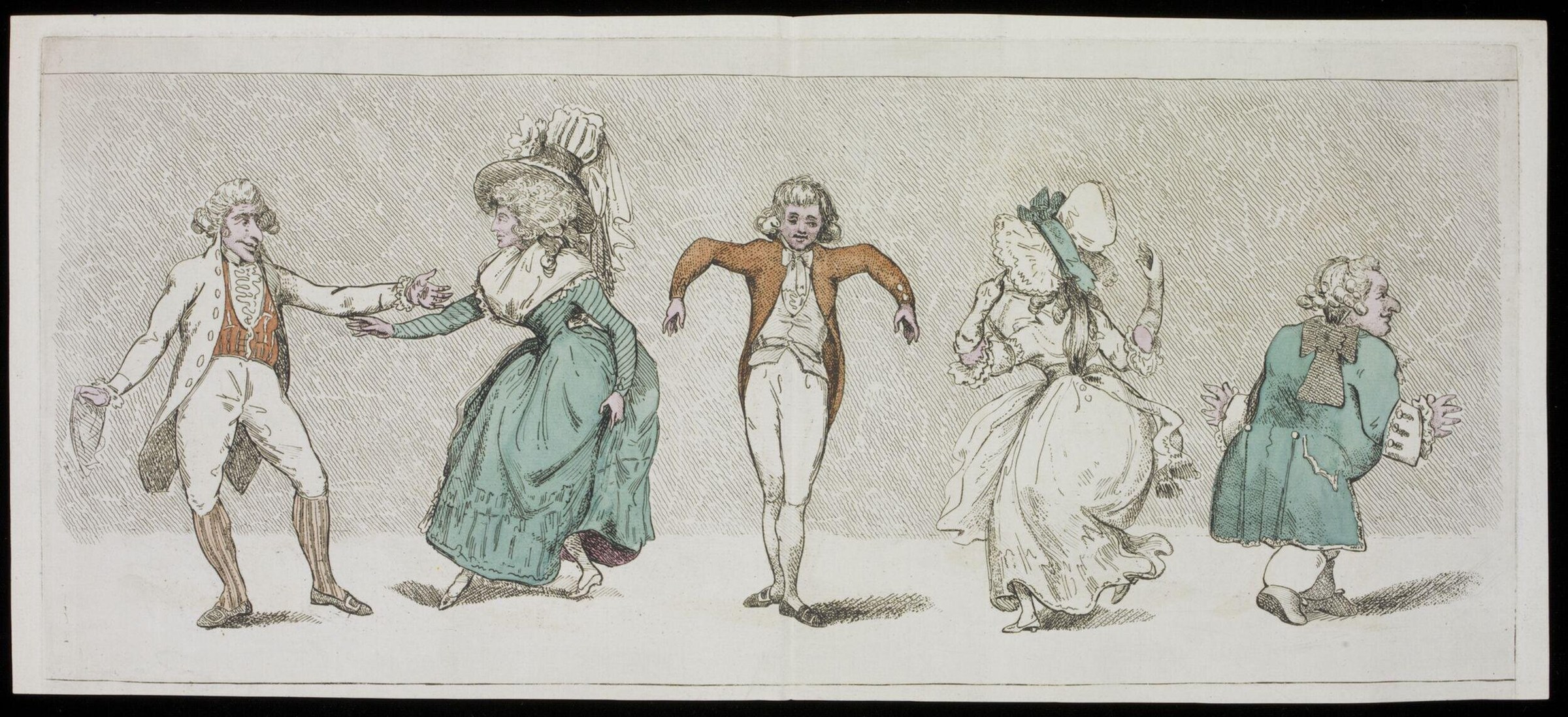
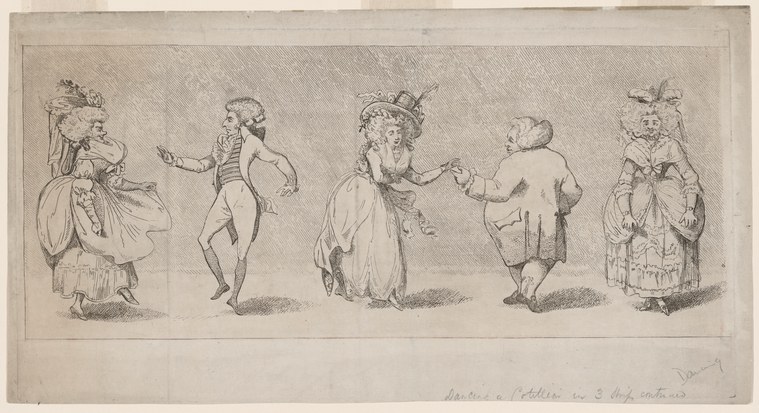
The Cotillion was a foundational social form that structured courtship, status negotiation, and entertainment in aristocratic and upper-middle-class society for nearly a century. This image is evidence of how the dance actually looked in motion—not the formalized positions of instruction manuals, but the improvised, varied, and sometimes ridiculous reality of social dancing. It documents both the dance and the satirical visual culture that surrounded it.
What you are looking at
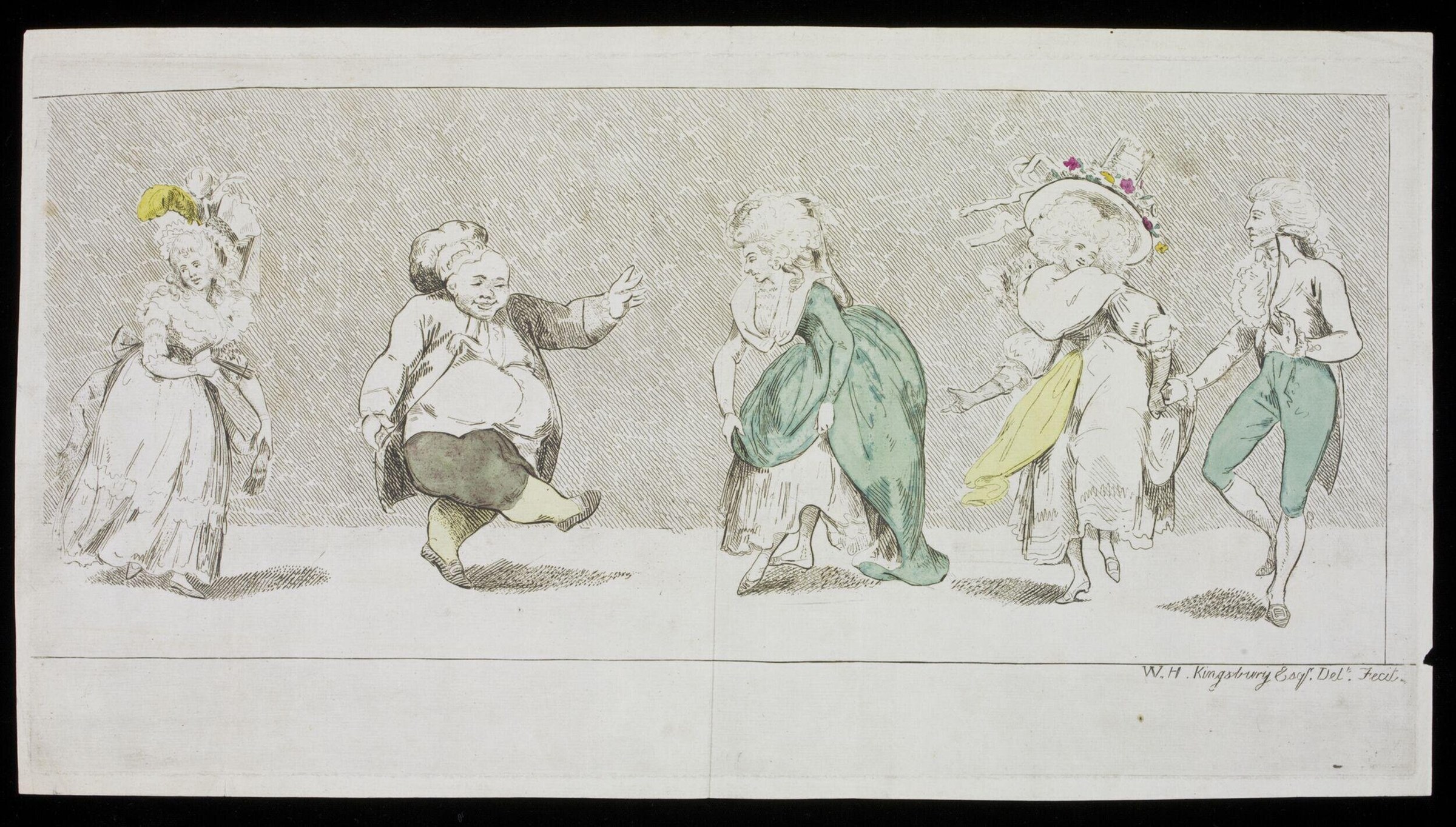
Five figures stand in a line across a shallow stage space defined by sketched ground, arranged as if pausing within a dance. From left to right: a woman in a pale gown with yellow plume holds a fan; a portly man in breeches and coat gestures outward with one arm raised; a woman in a green skirt and white bodice looks toward the next figure; a woman in yellow drapery holds green fabric; and at right, a man in green breeches and coat stands in profile. The figures are rendered in pen and ink with selective hand-coloring—yellows, greens, and flesh tones applied over the linear base. The style is light and satirical, with exaggerated proportions (the second figure is notably obese) that suggest social comedy. The background is hatched with fine parallel lines, creating atmospheric recession without depth.
The dancing
The poses suggest a promenade or processional moment: bodies are upright and arranged side-by-side rather than in closed partnership holds. Arm positions vary—some figures gesture openly, others hold fabrics or fans—and the stance is relaxed rather than formally aligned. The weight appears distributed evenly, with no visible turnout or balletic frame. The spacing and arrangement suggest a social gathering pause rather than a unified choreographed moment, and the varying heights and body types suggest these are character types rather than trained dancers executing identical technique.
The dance depicted
The title identifies this as a Cotillion, a social dance form that dominated late 18th-century ballrooms. The Cotillion evolved from the French Quadrille and was performed by groups of four to six couples in a variety of figures, often with musical changes and frequent promenade sections. This image appears to capture a promenade moment—a standard Cotillion figure in which dancers move side-by-side or in pairs around the room. The loose grouping, the variety of arm positions, and the absence of rigid formation suggest the informal, social character of the dance during its fashionable period. The caricatural treatment and varied body types imply this is satirical commentary on Cotillion society rather than an instruction manual.
How it was made
This is a hand-colored engraving or etching, identifiable by the fine parallel hatching that creates tone and the selective application of watercolor or gouache over the inked line. The technique was common for popular prints, dance instruction plates, and satirical commentary in the late 18th and early 19th centuries. Such prints were affordable and widely circulated, suggesting this work was intended for a broad audience—likely buyers interested in current fashions, dance satire, or social conduct. The combination of precise line work and rough handling of the figures suggests a professional shop production, possibly one of a series.
About this work
This hand-colored engraving depicts five figures in the midst of a Cotillion, the dominant social dance of the late 18th century. The Cotillion was a figure dance performed in groups, composed of multiple sections and typically including promenade figures like the one shown here—where dancers moved in loose formation around the ballroom. The image is satirical in tone, exaggerating the body types and fashions of its participants rather than teaching proper technique. It serves as a record of how the Cotillion appeared in practice and of the visual comedy drawn from social dancing in its era.
How to look at it
Look first at the arrangement: the figures stand roughly in line, which is characteristic of Cotillion promenade figures where dancers process around the room in formation rather than in tight couples. Notice the variety of arm positions and the unselfconscious gestures—this is not ballet or formal court dance, but social dance where arms and hands moved naturally. The exaggeration of the second figure's proportions is deliberate satire; the print is not celebrating elegance but gently mocking the pretensions of Cotillion society. The artist has caught not the peak of movement but a moment of passage or pause, when the dancers' social consciousness would be highest.
The artist
Henry Kingsbury is recorded as a printmaker active in the late 18th or early 19th century. The signature on this work ('W.H. Kingsbury Esq. Del. Fecit') indicates he was both designer (del.) and maker (fecit) of the print, or that it was executed after his design. Beyond this attribution and the work itself, little is known of his practice or output. The style and subject matter suggest he was engaged in producing satirical or observational prints of social life and dance customs.
The period
The Cotillion was at the peak of fashion from roughly 1760 to 1840, though it remained in use much longer. By the late 18th century, when this print was likely made, the dance had become the subject of satire as well as instruction—a sign of its ubiquity in society. The figure was complex enough to require instruction manuals and simple enough that everyone of social standing was expected to know it. Satirical prints of dance, fashion, and social behavior were a thriving industry in London and Paris during this period, offering commentary on vanity, pretension, and changing manners.
Where it lives
This work is held by the Victoria and Albert Museum, London, which is a comprehensive collection of prints, drawings, and decorative arts. The attribution to Kingsbury and the hand-coloring suggest it was a commercial or semi-professional production intended for sale to the middle-class print market.
Dance in this work
Questions about this work
What is a Cotillion and why was it so popular?
A Cotillion was a group social dance, usually performed by four to eight dancers in a set of figures that changed with each musical section. It was popular from the 1760s through the 1840s because it was complex enough to demonstrate skill and taste, yet simple enough that any person of social standing could learn it. Unlike country dances, which were open to anyone, the Cotillion was exclusive to the ballroom elite and was a primary venue for courtship and social advancement.
Is this image meant to teach people how to dance?
No. The exaggerated body types, the loose composition, and the satirical line style all indicate this is social commentary, not instruction. There were formal Cotillion teaching prints and manuals, but this is not one of them. Instead, it offers a humorous view of how these dances actually looked in social practice, with real bodies of various shapes and temperaments.
How do I know this is an engraving and not a painting?
The parallel hatching lines that create tone and shadow are a signature of engraving and etching technique—the artist scraped or incised lines into a plate to hold ink. The precision and regularity of these lines, visible especially in the background, could not be achieved with a brush. The watercolor or gouache was added by hand after printing, which is why the color sometimes sits loosely on top of the line work.
More Cotillion artwork