10 works in this view — arrow keys or swipe to move between them.
Dance in Art
Fandango
Jeanne Paquin
- Dance:
- Spanish/Flamenco
- Era:
- 1900-1920 (Ragtime/Early Jazz)
- Source:
- Victoria and Albert Museum
- Rights:
- Rights vary by item — check the source record before reusing this image. Source record ↗
- Recorded as:
- Check V&A creditLine
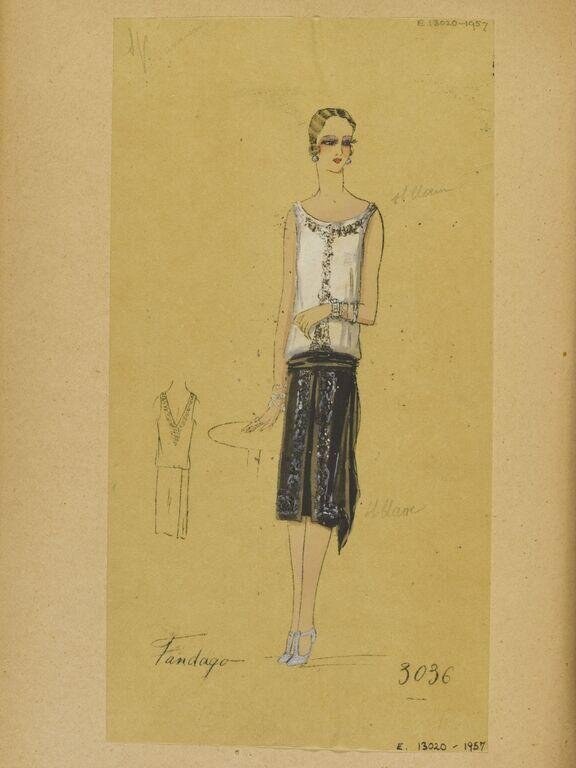
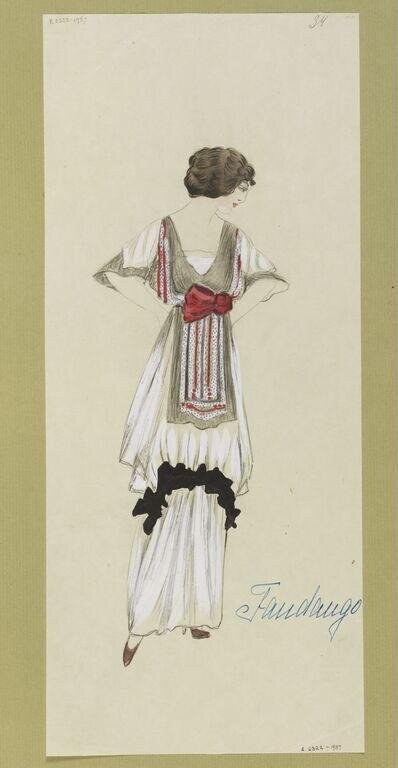
This work provides rare documentary evidence of how an elite Edwardian woman dressed for ballroom dancing, rendered by one of the period's most celebrated dress designers. Paquin's illustrations record the silhouettes, fabrics, and ornamental details that shaped the experience of ballroom dancers in the years before World War I.
What you are looking at
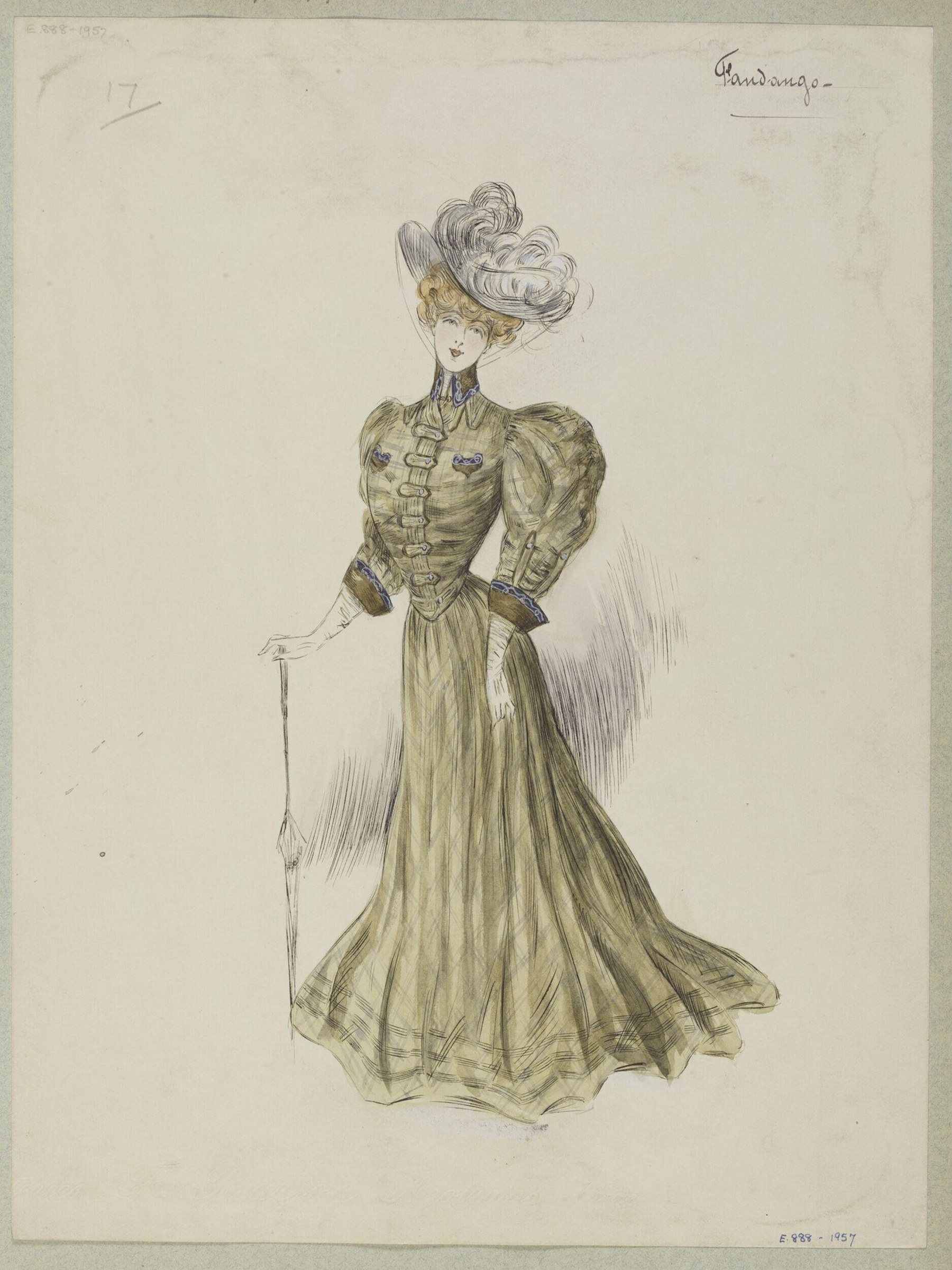
A single figure stands against an empty background in a three-quarter pose, her body turned slightly away from the viewer. She wears a pale yellowish-green gown with a high waist, fitted bodice with prominent puffed sleeves, and a train that sweeps across the ground behind her. The bodice is decorated with ornamental buttons or fastenings in dark blue or navy, running down the center front. A blue choker or collar encircles her neck. Her hair, rendered in delicate curling lines, is piled high on her head in the Gibson Girl style typical of the 1890s–1900s. She holds a long slender cane or walking stick in one hand, angled gracefully downward. The drawing technique uses fine pencil work with subtle watercolor wash, particularly in the gown's skirts where diagonal shading creates volume and movement. The composition is a fashion illustration rather than a narrative scene—the figure is isolated, posed, and presented as though for a couture catalogue.
The dancing
The dancer stands in an elegant, upright posture with weight evenly distributed, the body held in a ballroom frame without a partner. The left arm extends naturally downward holding the cane; the right arm hangs at the side. The shoulders are level and relaxed. The posture is formal and dignified, the kind of stance required for social ballroom dancing of the period—shoulders back, chest open, head held high. There is no indication of weight shifting, footwork in motion, or the dynamic tension of active movement; this is a posed presentation of an elegant figure dressed for an evening of fashionable dance.
The dance depicted
The work is titled 'Fandango,' which refers to a Spanish courtship dance, but the evidence in the image contradicts this attribution. The figure's posture, dress, and setting are those of a late-Victorian or Edwardian ballroom dancer, not a Spanish or flamenco performer. Fandango traditionally involves rapid footwork, castanets, and passionate movement; this figure displays none of those attributes. The cane and the refined ballroom stance suggest a woman prepared for English or American high-society dancing—likely a waltz, foxtrot, or other contemporary ballroom form. The catalogue record may be in error, or the title may refer to a musical composition rather than the depicted dance form.
How it was made
This is a drawing executed in pencil and watercolor wash on paper, a standard technique for fashion illustration of the period. The pencil provides fine linear detail in the hair, facial features, and the cane; the watercolor gives form and volume to the gown through soft shading, particularly in the skirts and the shadows of the sleeves. The technique allows for rapid production and easy reproduction—fashion illustrations were made to circulate as designs for couturiers and as inspiration for dressmakers. The relatively modest level of finish (compared to a formal portrait) and the focus on the costume rather than the face or surroundings mark this as a working design or editorial illustration rather than a fine-art work. This type of drawing would have been made for publication or for a dressmaking or costume house.
About this work
This is a fashion illustration of an elegant woman dressed for Edwardian ballroom dancing, attributed to Jeanne Paquin, a leading Parisian couturière of the early 1900s. The figure wears a haute-couture gown of the period, with the high-waisted silhouette, puffed sleeves, and abundant skirts characteristic of the Gibson Girl era. Though titled 'Fandango,' the image depicts the ballroom aesthetic and posture of fin-de-siècle Europe rather than Spanish dance tradition. Paquin's work bridges fashion design and theatrical costume—she created garments for stage and social use, and this illustration may have served both as a design record and as documentation of how her clients appeared in fashionable dress while dancing.
How to look at it
Observe the posture: the figure stands in perfect ballroom readiness, shoulders back, head high, weight centered. Notice how the gown is constructed to enable movement—the high waist allows the hips to articulate, the puffed sleeves permit arm elevation, and despite their volume, the skirts are cut to permit stepping. The cane is a fashion accessory and a gesture of elegance rather than a dance prop; it signals social status and refinement. The artist has captured not a moment of motion but the state of preparation—the figure as she would appear at the beginning of a dance, composed and ready.
The artist
Jeanne Paquin (1869–1936) was a pioneering French fashion designer and one of the first women to establish an haute-couture house under her own name. Based in Paris, her atelier was renowned for sophisticated, elegant gowns that appealed to wealthy society women, actresses, and dancers. Paquin was known for both innovation in cut and silhouette and for her understanding of how garments functioned on the body—she designed for movement, a skill crucial to theatrical and ballroom costumes. Her house produced fashion illustrations and designs throughout the Belle Époque and Edwardian periods, and her work was influential on both sides of the Atlantic.
The period
This drawing dates to approximately 1904, during the height of the Gibson Girl era and the Edwardian ballroom boom. The early 1900s saw ballroom dancing—especially the waltz, foxtrot, and tango—become the dominant social entertainment for European and American high society. Simultaneously, fashion underwent dramatic changes: the Victorian corset was being reformed, waistlines rose, and skirts became slightly more mobile to accommodate dance. Paquin's designs were at the forefront of this evolution, creating gowns that were both decorative and functional for the ballroom. The theatrical world also drove innovation in dance costume, and Paquin worked with ballet and music-hall dancers as well as society women.
Where it lives
The work is held in the Victoria and Albert Museum collection, a British institution that houses extensive fashion illustration, design records, and theatrical costume materials. The accession record provides minimal additional information, but the archive context and the catalogue reference to the V&A's fashion and theater holdings suggest this was either acquired as a design document, part of a Paquin archive or collection, or as an example of fin-de-siècle fashion illustration.
Dance in this work
Questions about this work
Why is this titled 'Fandango' when the figure looks ready for ballroom dancing?
The title may be erroneous, or it may refer to a musical piece rather than the Spanish dance form. The costume, posture, and Edwardian setting are inconsistent with fandango tradition. It is also possible that the work was retitled or catalogued under a generic or mistaken label after its creation. Without additional provenance information, the discrepancy cannot be resolved.
Is this a portrait of a specific dancer or an ideal type?
This is a fashion illustration and design drawing, not a portrait. The figure is generalized—a type of elegant, fashionable woman rather than a representation of an identifiable person. Paquin's illustrations were made to showcase her designs and to serve as reference for construction and sale, not to record individual sitters.
What was Jeanne Paquin known for in the world of dance?
Paquin was a couturière who designed for both high society and the stage. Her understanding of how garments functioned on the moving body made her work particularly valued by dancers and theatrical performers. She created costumes for ballet and music hall as well as gowns for ballroom use, and her designs were worn by prominent performers of the era.
How was this drawing used when it was made?
Fashion illustrations like this one served multiple purposes: as design records within the atelier, as inspiration for clients, as patterns or references for seamstresses, and potentially as promotional material for Paquin's house. They could also be published in fashion magazines or kept in a client's design portfolio.
More Spanish/Flamenco artwork