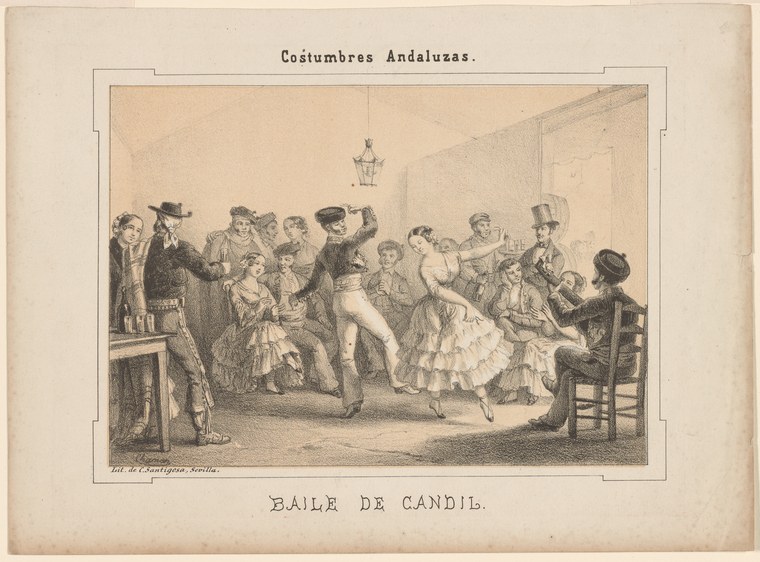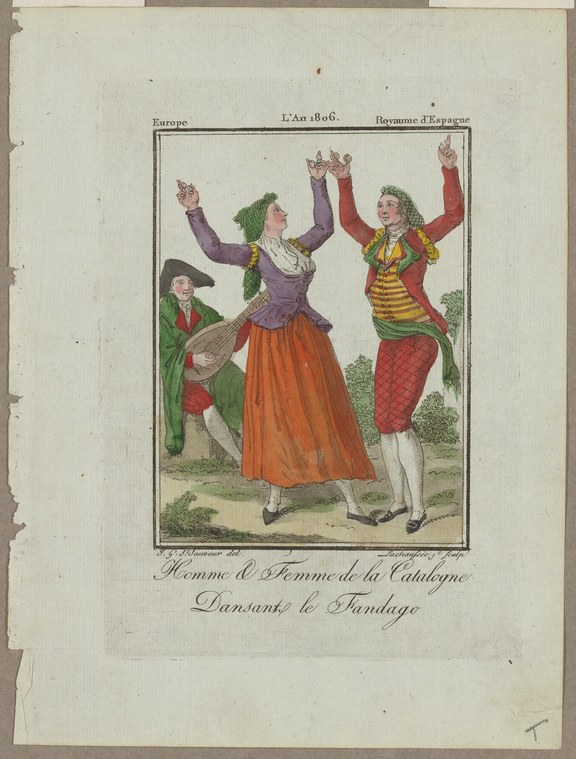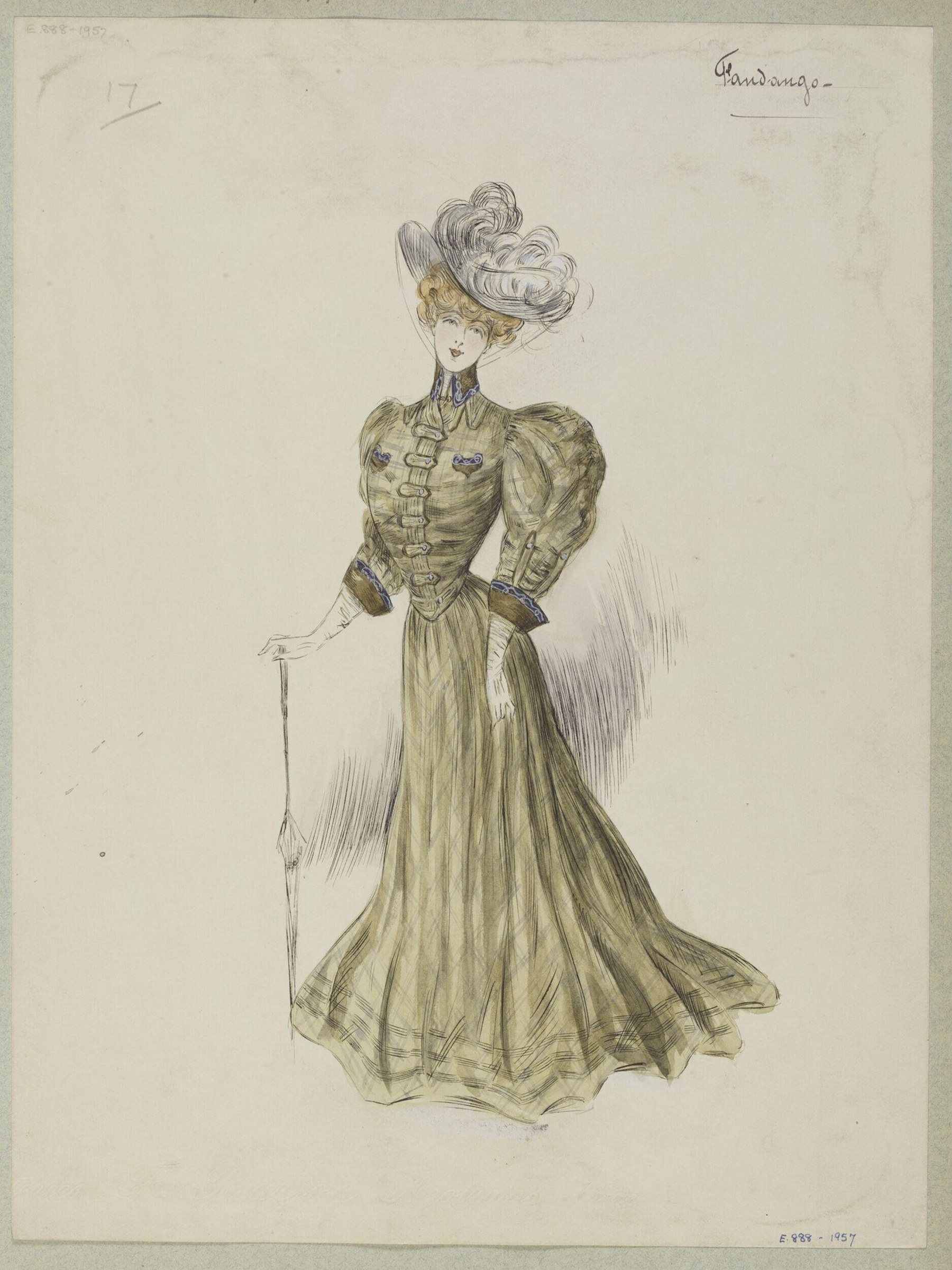
10 works in this view — arrow keys or swipe to move between them.
Dance in Art
Fandango
Worth, Jean-Charles
- Dance:
- Spanish/Flamenco
- Era:
- 1920-1950 (Swing Era)
- Source:
- Victoria and Albert Museum
- Rights:
- Rights vary by item — check the source record before reusing this image. Source record ↗
- Recorded as:
- Check V&A creditLine
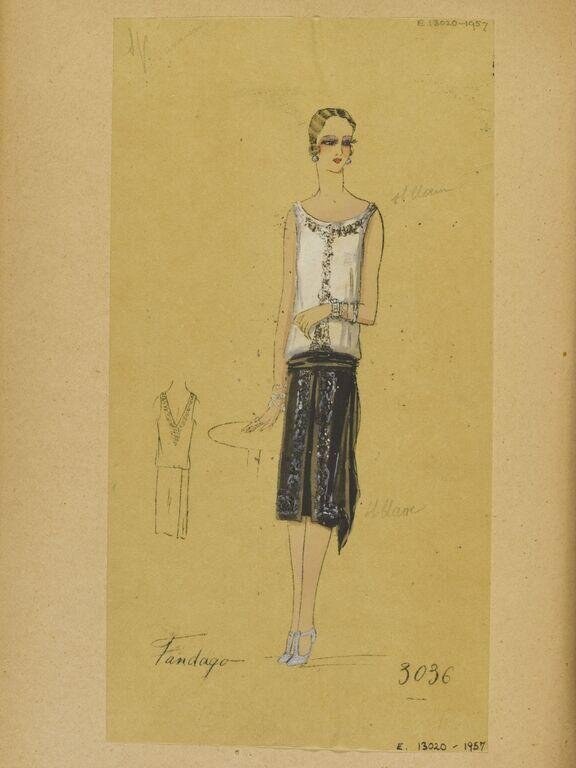
Worth was one of the most influential couturiers of the early 20th century, and his design drawings are primary evidence for how professional and fashionable dress was conceived. This drawing shows the relationship between theatrical or national dance traditions and fashion during the 1920s, when Spanish and Latin American influences were reshaping European and American style. For dance historians, it documents not technique or movement, but the material and visual presentation of a Spanish dance tradition in the luxury fashion market.
What you are looking at
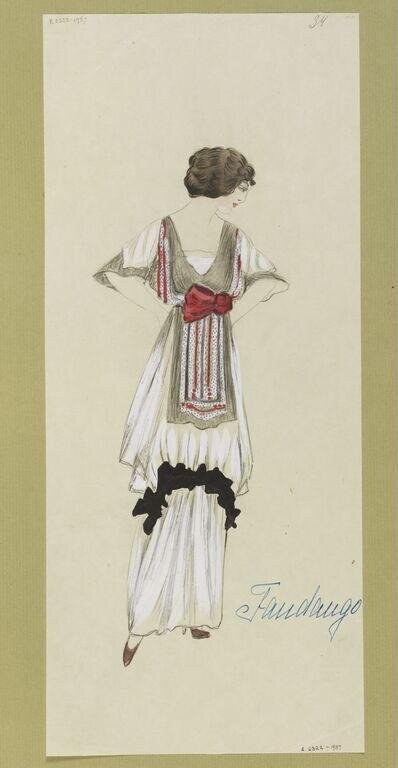
A fashion design drawing in ink and watercolour on a cream ground, showing a single female figure in elegant 1920s dress. The model stands in a contrapposto pose against the pale background, her head turned slightly upward with an air of sophistication. She wears a sleeveless white shift dress with ornamental beading or embroidery concentrated at the neckline, falling straight to the knee with no waist definition—characteristic of 1920s silhouette. Over this, she wears a dramatic dark skirt or overdress with a bold decorative pattern, draped asymmetrically and caught at one side, creating a sweeping line that extends below the lighter dress. The figure's legs and feet are rendered in light blue, and a small detail sketch of a dress front appears at lower left. The title "Pendargo" is inscribed in pencil at lower left, with the number "3036" marked at lower right.
The dancing
The single figure is presented frontally but with a subtle contrapposto shift, the right leg bearing weight while the left relaxes slightly. The pose is static and formal—typical of fashion illustration—rather than captured mid-movement. The arms hang naturally at the sides with minimal gesture. This is a presentation stance for display of costume rather than a depiction of active dance: the body is elongated and stylized according to the conventions of 1920s fashion drawing, with emphasis on the silhouette and drape of the garments.
The dance depicted
The catalogue identifies this as a fandango design, yet the image shows no evidence of active dance movement, footwork, or the bodily engagement that characterizes fandango. The figure is posed stationary for the purpose of costume display. If this represents fandango at all, it documents the dress worn for the dance rather than the dance itself. The asymmetrical draped skirt and the overall silhouette are consistent with Spanish or Spanish-influenced fashionable dress of the 1920s, but the pose and context are those of a fashion illustration, not dance documentation.
How it was made
This is a fashion design drawing, likely executed in pencil, ink line, and watercolour on paper. The technique is typical of haute couture design practice in the 1920s: precise ink outlines define the silhouette, while watercolour is applied selectively to indicate colour and fabric weight—particularly effective in the dark patterned overdress and the pale blue of the legs. The small sketch detail at lower left suggests this is a working design document. Such drawings were produced for presentation to clients or for workshop records and circulated within the fashion industry rather than as fine art.
About this work
This is a fashion design drawing by Jean-Charles Worth dated 1926, held in the Victoria and Albert Museum. It presents a single female figure modelling an evening or ceremonial dress combining a plain 1920s shift with an ornate draped overdress. The title and the catalogue designation as 'fandango' suggest a connection to Spanish dance or Spanish-inspired fashion, yet the image itself is a static costume study for display rather than a representation of dance in motion. The work belongs in a gallery of dance in art as a document of how fandango and Spanish dance were visualized and costumed in haute couture of the period—what dancers and patrons wore to the ballroom, not how they moved within it.
How to look at it
Pay attention to the asymmetrical drape of the dark overdress and how it creates movement and visual drama even in a static pose. Notice the contrast between the plain, severely modern shift dress and the heavily patterned, ornamental overlay—a tension between modernist simplification and decorative richness characteristic of 1920s luxury fashion. The artist has chosen to show the costume from front, flat, and at a scale that emphasizes the overall silhouette and pattern rather than anatomical detail. This is a design document intended to communicate the look of the garment to a client or workshop.
The artist
Jean-Charles Worth (1881–1960) was the son of Charles Frederick Worth, founder of haute couture. He took over the House of Worth in Paris and became one of the most celebrated couturiers of the interwar period, known for innovative draping and rich ornament. His design drawings are held across major costume and design collections. Worth's practice included designs for stage costume as well as civilian dress, and his archive reflects the close relationship between theatre, dance, and high fashion in the 1920s.
The period
The 1920s saw a revival of interest in Spanish and Latin American dance and music in European and American culture, partly driven by fashion and entertainment. The fandango, already centuries old, was encountered and interpreted anew through contemporary costume and performance. At the same time, the silhouette of women's dress underwent radical transformation: the straight, narrow, near-waistless line seen here replaced the hourglass of the Edwardian era. Worth's design captures this moment when a traditional Spanish dance form met modernist fashion.
Where it lives
This drawing is held in the Victoria and Albert Museum, London. It is part of the museum's costume and textiles collection, which includes papers, sketches, and designs from major fashion houses. The accession number and classification suggest it was catalogued as a dance-related design, though it functions as a fashion design drawing.
Questions about this work
Is this drawing actually about fandango dancing?
The title and catalogue label identify it as fandango, likely referring to the Spanish theatrical tradition or to fashionable evening dress inspired by Spanish and Spanish-American culture. However, the image itself is a static costume drawing, not a depiction of dance movement. It shows what a fashionable woman might wear to a fandango or a formal event with Spanish-influenced style, but not how the dance was performed.
Why is a fashion drawing in a dance collection?
Fashion and dance are deeply entangled: dancers wear costumes that shape how they move, and fashion designers drew inspiration from stage and ballroom dance. This drawing documents how a specific dance tradition—or its aesthetic—was translated into couture in the 1920s. For dance historians, it is evidence of how fandango and Spanish dance were imagined and presented in elite culture.
Who was Jean-Charles Worth?
Worth (1881–1960) was the son of Charles Frederick Worth, who founded haute couture as a profession in Paris in the 1860s. Jean-Charles took over the House of Worth and made it one of the most prestigious fashion houses of the early 20th century, known for innovative cuts, rich embroidery, and draping. He designed for both private clients and theatrical productions.
More Spanish/Flamenco artwork