10 works in this view — arrow keys or swipe to move between them.
Dance in Art
Fandango
Jeanne Paquin
- Dance:
- Spanish/Flamenco
- Era:
- 1900-1920 (Ragtime/Early Jazz)
- Source:
- Victoria and Albert Museum
- Rights:
- Rights vary by item — check the source record before reusing this image. Source record ↗
- Recorded as:
- Check V&A creditLine
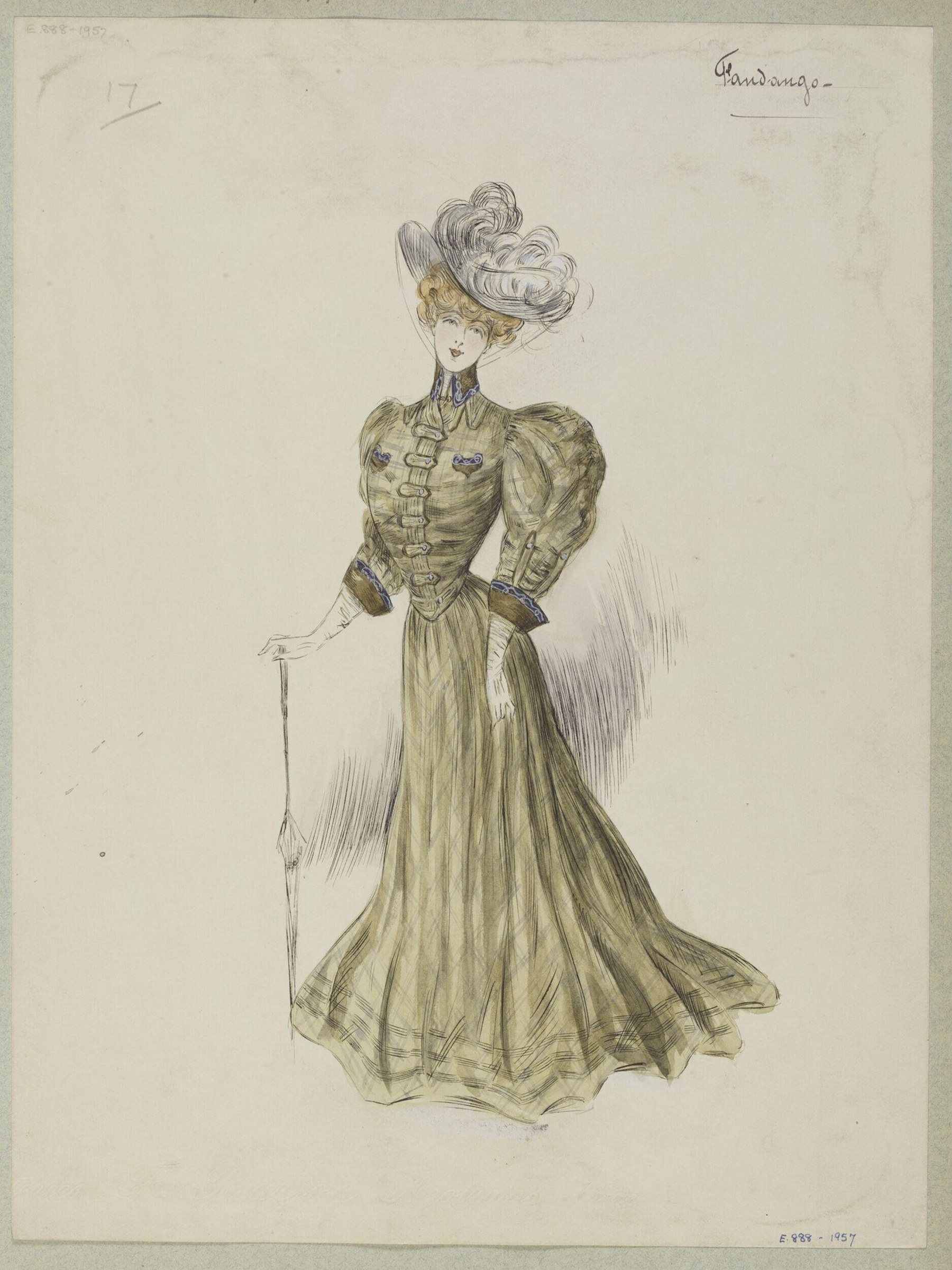
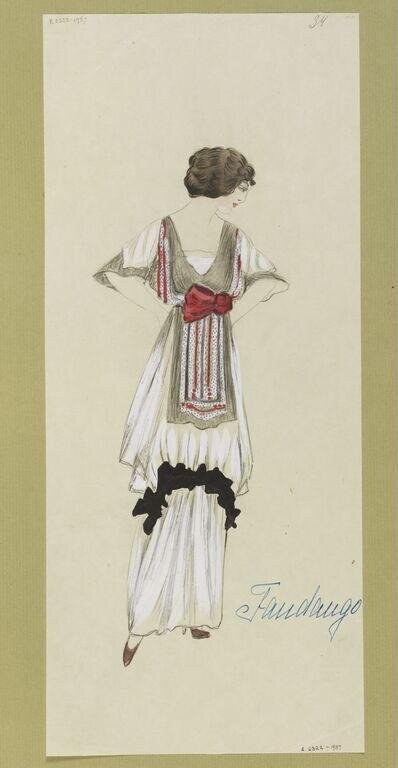
For dance historians, this work matters because it documents how Spanish dance and flamenco were imagined in elite fashion during the 1910s—not as folk practice, but as theatrical exoticism for wealthy clients. The sketch shows the costume, color, and silhouette that ballroom dancers and performers of the period would have worn to evoke Spanish character, revealing the distance between historical fandango and its fashionable reinterpretation.
What you are looking at
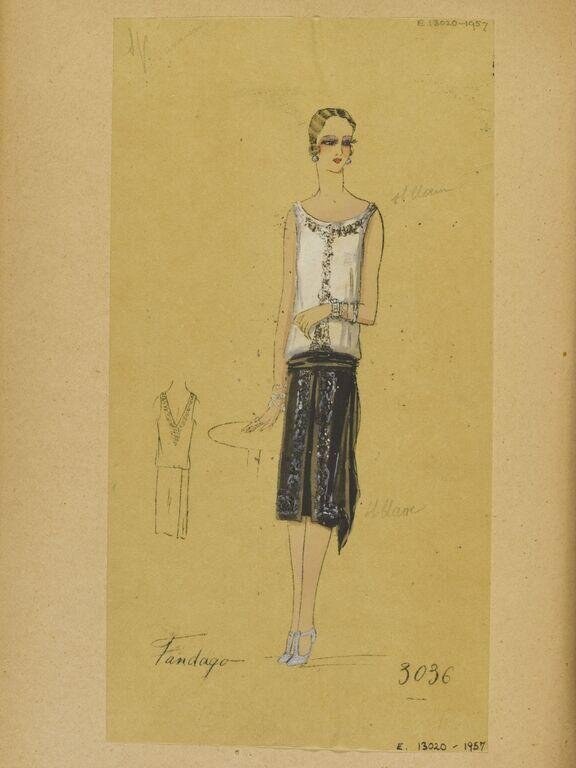
A fashion design sketch depicting a woman in an elegant evening ensemble, shown from behind in a three-quarter view. She wears a floor-length white gown with a dropped waistline characteristic of 1910s silhouette, featuring a deep V-back and short flutter sleeves. Over the dress sits a sleeveless tunic or overdress in cream with vertical striped detailing in rust and burgundy tones, tied at the waist with a prominent red bow. Black fabric—possibly ruffles or decorative elements—frames the hem, and the woman's hair is styled in the upswept waves typical of the Edwardian period. The sketch is rendered in watercolor and ink on paper, with careful attention to the drape of fabric and the architectural quality of the garment's construction. The composition emphasizes the garment's back detail, a key selling point for high-fashion design.
The dancing
The figure stands in a quiet, frontal pose with her weight evenly distributed, her body axis vertical and untwisted. The arm position—hands resting naturally at the sides or gently forward—is neutral and presentational rather than dynamic. This is a mannequin-like stance designed to display the costume rather than to convey movement or character. The silhouette is long, columnar, and elongated, typical of fashion illustration of the period.
The dance depicted
This work is not primarily a dance image. Although the catalogue labels it 'Fandango' and attributes it to flamenco, the sketch is a costume design for theatrical or ballroom wear, not a depiction of the fandango or any flamenco dance. The pose is static and presentational—the body angle, stillness, and frontal orientation are those of fashion display, not dance. While the garment itself—with its Spanish styling, rich color palette, and decorative detail—could plausibly be worn in a Spanish or flamenco-influenced theatrical context, there is no evidence of movement, music, or the specific posture and footwork of fandango. The image documents fashion rather than choreography.
How it was made
This is a watercolor and ink fashion sketch on paper, a working drawing rather than a finished artwork. The medium was standard for haute couture houses and couturiers of the early 20th century, allowing rapid visualization of silhouette, color, and detail for clients and manufacturers. The technique shows confident linework in ink for structure and outline, with selective color application in watercolor to indicate fabric tone and decoration—particularly the striped tunic and red bow. This was a reproducible, distributable format suited to the fashion industry's commercial circulation.
About this work
This is a 1912 fashion design sketch by the couturier Jeanne Paquin, depicting a women's evening ensemble in the high-waisted, columnar silhouette of the 1910s. The sketch belongs to the V&A's costume and design collection rather than to a dance archive; it documents fashion rather than dance practice. However, the garment's Spanish styling, theatrical quality, and title 'Fandango' suggest it may have been designed for ballroom or theatrical wear with Spanish or flamenco references—the kind of costume worn by fashionable society dancers or stage performers of the era. Paquin was one of the most prestigious couturiers in Paris during this period, known for elegant evening wear and an international clientele.
How to look at it
The sketch should be read as a fashion designer's working drawing: look first at the silhouette (vertical, elongated, narrow through the hip) and then at the detail (the striped tunic, the red bow, the black hem decoration). The back view is deliberate—it displays the striking open back and the way the overdress sits over the underdress. The stillness of the pose is also deliberate: this is not a dance figure, but a dress form, meant to show how the garment hangs and drapes when the body is neutral. The Spanish color palette (cream, rust, burgundy, black) and the title are the only clues to the garment's imagined use.
The artist
Jeanne Paquin (1869–1936) was a pioneering French couturier and one of the first women to establish a major fashion house. Founded in Paris in 1891, the House of Paquin was renowned for elegant evening wear, intricate beadwork, and theatrical costume. Paquin was particularly celebrated for designs for stage performers and society clients, and her work bridged high fashion and theatrical costume design. She was a prominent figure in the Belle Époque and Art Deco periods and maintained ateliers in Paris, London, and Buenos Aires.
The period
In the 1910s, Spanish and flamenco aesthetics were fashionable among wealthy European and American society, part of a broader taste for exotic and orientalist styling. Ballroom dancing was a major social practice for the elite, and Spanish dances—including the fandango, tango, and bolero—enjoyed renewed popularity in fashionable dancing. Couturiers like Paquin capitalized on this demand by creating theatrical and flattering costume designs that allowed clients to perform exoticism on the ballroom floor. The decade saw increasing overlap between stage costume and evening wear, with the same designers serving both worlds.
Where it lives
This sketch is held by the Victoria and Albert Museum in London. It is a fashion design drawing from the House of Paquin's archives or a commission, part of the V&A's extensive collection of early 20th-century couture documentation. It is a primary-source object for the history of fashion rather than an artwork created for exhibition.
Questions about this work
Why is a fashion sketch in a dance gallery?
It is not primarily a dance image, but it documents how fandango and Spanish dance were imagined in elite ballroom culture. The sketch shows the costume that wealthy dancers would have worn to perform Spanish-themed dances in the 1910s, bridging fashion history and social dance history. Its inclusion here highlights the relationship between costume design, theatrical culture, and ballroom practice.
Is this a depiction of the fandango?
No. The title 'Fandango' refers to the intended use or character of the costume, not to a depiction of the dance itself. The figure is motionless and posed for display. However, the garment was likely designed to evoke Spain and Spanish dance, allowing the wearer to adopt a Spanish character on the ballroom floor.
Who was Jeanne Paquin?
Paquin (1869–1936) was one of the most prominent couturiers of the Belle Époque and Art Deco eras. Her fashion house, founded in Paris in 1891, was known for elegant evening wear and theatrical costume design for stage performers and society clients. She was one of the first women to achieve prominence as a fashion designer and ran a major international business.
More Spanish/Flamenco artwork