10 works in this view — arrow keys or swipe to move between them.
Dance in Art · 2019
Spanish dancing
Unknown artist
- Medium:
- Dance:
- Spanish/Flamenco
- Source:
- New York Public Library
- Rights:
- Public domain — free to use, share and adapt.
- Recorded as:
- public_domain
This image illustrates how early 20th-century European theater appropriated and reinterpreted Spanish dance traditions, filtering them through the vocabulary and aesthetic of classical ballet. It shows the gendered and Europeanized framing of Spanish cultural material during a period of intense colonial and imperialist power, and how theatrical dance both promoted and distorted non-European movement traditions for metropolitan audiences.
What you are looking at
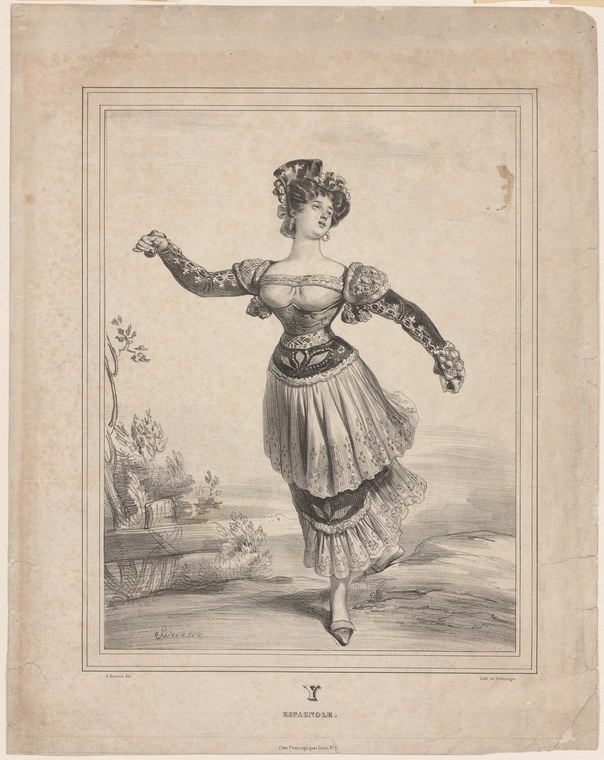
A single female figure dominates the composition, posed in a moment of spirited movement against a minimal landscape background. She wears an elaborate Edwardian ensemble: a heavily boned corset with ornate embroidery or beading at the waist, puffed sleeves of substantial volume gathered at the shoulders, and a skirt composed of deep pleats and gathered tiers that fall to mid-calf, with darker bands or trim at the hem. Her posture is one of balletic extension—her body arched, one arm raised and extended outward in an expressive gesture, the other positioned across her torso. Her head is tilted back slightly, her hair arranged in the elaborate updos of the early 1900s. To the left, a small vignette shows classical urns or garden ornaments nestled among flowering plants, suggesting a theatrical or garden setting. The engraving technique renders the figure with fine parallel lines that define volume and shadow, and the overall composition is framed by a ruled border that emphasizes its status as a print.
The dancing
The dancer is isolated in the frame, her body weight appears to be shifted onto one leg while the other extends or lifts—the positioning suggests balletic training rather than folk or social dance vocabulary. Her arms are positioned in what might be interpreted as a Romantic ballet arabesque or similar classical extension, with deliberate spacing from the body and clear line from fingertip through shoulder. The posture conveys controlled elevation and extension of the limbs. Her torso is actively engaged and tilted; this is not a neutral standing position but a moment of apparent movement or pirouette.
The dance depicted
The catalogue identifies this as Spanish dancing, but the figure's training, costume, and pose suggest European theatrical ballet or balletic exhibition rather than flamenco or Spanish regional dance. The elaborate Edwardian corsetry, the balletic arm and leg positions, and the theatrical staging point to a Western theatrical tradition. The print may depict a Spanish-themed ballet number or a dancer known for Spanish-inspired choreography during the Belle Époque or early Edwardian period, when Orientalist and nationalistic themes were popular in European theater. The specificity of 'Spanish dancing' in the title may indicate subject matter or costume theme rather than actual dance style.
How it was made
This is an engraving or etching, rendered in black line work with fine parallel hatching to create tonal depth and model the figure's form. The technique allows precise rendering of the costume's elaborate detailing—the beading, pleating, and texture of the fabrics are conveyed through deliberate mark-making. The ruled border and the inscription visible at the base indicate this is a reproductive print, likely from a serialized publication or portfolio. The medium's capacity for fine detail and its reproducibility suggest this was aimed at a broad educated audience interested in theater, fashion, and dance performance during the period.
About this work
This engraving depicts a woman in Edwardian theatrical costume posed in a balletic arabesque or similar extended position, identifying herself through the title as a Spanish dancer. The work belongs to a tradition of theatrical dance prints that documented and promoted stage performers and choreography in the early 1900s. The figure's training, pose, and elaborate costume suggest she represents a European interpretation of Spanish dance—likely a ballet number with Spanish theme or styling rather than authentic flamenco or regional Spanish dance. The engraving circulated as part of the NYPL collection, probably as a theatrical promotion or illustration in a dance or theater journal. It documents the period when European ballet companies and theatrical productions routinely incorporated exotic or national themes into their repertoire.
How to look at it
Observe how the artist has frozen the dancer at a moment of apparent peak extension or elevation—the lifted arm, the arched torso, and the stance all suggest a single dramatic moment rather than a walking or social position. The elaborate costume overwhelms the figure; its volume, trimming, and decorative detail were as much the subject as the dancer's body. Note that the pose and training visible in the body are fundamentally balletic: this is not a stance you would see in flamenco or Spanish regional folk dance, but rather a classical theatrical position adapted to a Spanish theme. The isolated figure against an minimal background emphasizes her role as a performer, not a social dancer.
The period
The costume and engraving style date this to approximately 1900–1920, the height of the Edwardian period and the Belle Époque in European theater. During these decades, European ballet and musical theater were fascinated with exoticist themes—Spanish, Oriental, Russian, and other 'foreign' materials. Sergei Diaghilev's Ballets Russes (founded 1909) exemplified this trend with works like *Le Spectre de la Rose* and Spanish-themed pieces. Simultaneously, the music hall and theatrical revue industries in London, Paris, and other capitals featured dancers in elaborate national costumes. The engraving technique itself was somewhat anachronistic by 1900, suggesting this may be a later print or a reproduction of an earlier theatrical image.
Where it lives
This print is held in the New York Public Library collections. It is catalogued as a theatrical print from an unspecified source and date, part of the NYPL's holdings of dance and theater imagery. The inscription at the base (partially visible) likely identifies the performer or artist.
Dance in this work
Questions about this work
Is this actual Spanish dance or ballet?
The dancer's body position, training, and costuming are balletic and Edwardian theatrical in character. While titled 'Spanish dancing,' the image likely depicts a Spanish-themed ballet number or theatrical interpretation rather than authentic flamenco or regional Spanish dance. Early 20th-century European theaters routinely incorporated Spanish imagery into classical ballet and revue performances.
What is the technique and why does it matter?
This is an engraving, a printmaking technique that uses fine line work and hatching to create tone and form. Engravings were reproducible and could circulate widely, making them ideal for theatrical promotion and documentation. The technique's precision allowed the artist to render the costume's elaborate detail—beading, pleating, trim—which was as central to the image as the dancer's pose.
When was this made?
The costume, engraving style, and theatrical aesthetic date this to approximately 1900–1920. The exact date is not recorded in the catalogue. The Edwardian corsetry and the fashion for Orientalist and nationalistic themes in European theater place it within the Belle Époque period.
More Spanish/Flamenco artwork