10 works in this view — arrow keys or swipe to move between them.
Dance in Art · 2019
Spanish dancing
Unknown artist
- Medium:
- Dance:
- Spanish/Flamenco
- Source:
- New York Public Library
- Rights:
- Public domain — free to use, share and adapt.
- Recorded as:
- public_domain
This image documents a form of dance that was not written down, not taught in academies, and existed only in lived practice and oral tradition. It shows the body in motion in its actual social context—not idealised, not staged, not codified—and in so doing it preserves evidence of how working people moved, celebrated, and socialised. For historians and dancers interested in the roots of Spanish and flamenco tradition, this is direct visual testimony to the body, the dress, the setting, and the social function of these dances.
What you are looking at
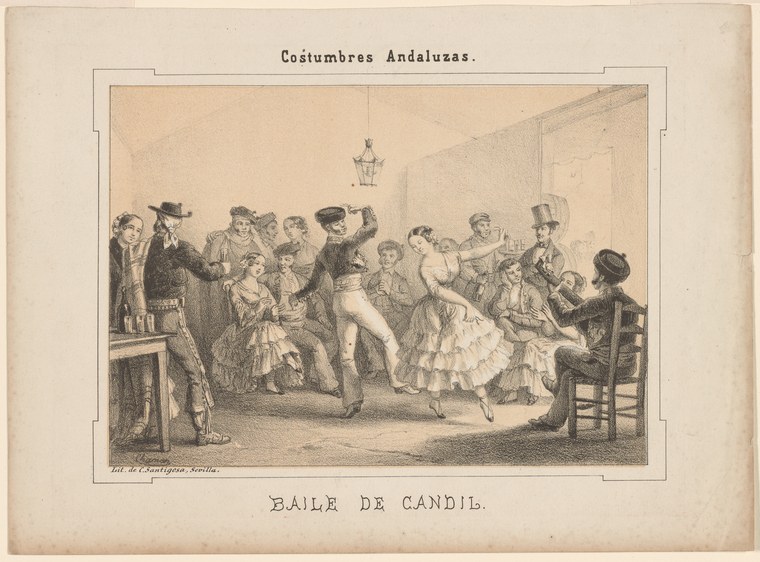
A crowded indoor celebration or dance gathering rendered in a classical engraving style, likely from the 19th century. The scene depicts dozens of figures in period dress—men in tailcoats and top hats, women in full skirts and bonnets—packed into a room with high ceilings and a hanging lantern. At the centre, two figures dance while others clap, gesture, and observe: a woman in a white or pale skirt executes an energetic movement, her body angled and her skirt caught mid-swing, while a male partner faces her. The surrounding figures create a dense, almost theatrical composition, their attention focused on the dancing couple. The setting appears to be a tavern, inn, or public dance hall rather than a formal ballroom—the informality and crowding suggest popular rather than courtly entertainment. Light is even and cool, typical of prints of the period.
The dancing
The central couple dances in open or semi-closed position, with the woman's body in a dynamic lean and her skirt flared from motion, suggesting brisk footwork and rotational energy. The man faces her with arm extended. Both maintain upright posture but with weight actively shifted. The woman's posture and the vigour of the skirt movement suggest rapid weight changes and perhaps traveling steps. Surrounding figures—perhaps 30 or more—are arranged as onlookers, with several clapping or gesturing encouragement, their bodies turned toward the centre. The density and informality of their arrangement suggests this is a participatory social scene, not a formal performance.
The dance depicted
This depicts a Spanish regional social dance, most likely a *Baile de Candil* ('candle dance') or similar folk gathering dance from Andalusia or southern Spain. The inscription 'BAILE DE CANDIL' at the base of the print confirms this. These were impromptu dances held in taverns or inns, often by candlelight or lamplight, and were danced by common people—workers, servants, and townspeople—rather than the gentry. The vigorous, playful movement of the woman's body and the animated participation of the crowd are characteristic of these dances. The style shown here—open position, rapid footwork, energetic hip and skirt movement—is consistent with Spanish folk dancing of the 18th and 19th centuries. This was popular entertainment, not a codified theatrical dance.
How it was made
This is a hand-coloured or stippled engraving, identifiable by its fine linear hatching, the precision of the line work, and the uniform tonal quality. The technique allowed for mass reproduction and distribution, suggesting the image was intended for a popular or middle-class audience rather than collectors of fine art. Engravings of this type were often issued as individual prints or as illustrations in series documenting regional customs and dress. The hand-colouring (visible in the flesh tones and the woman's skirt) was added after printing, a common practice that made the image more appealing and costly. The quality of the engraving—detailed composition with many figures rendered with clear individual characterisation—indicates a skilled practitioner and a work intended for circulation beyond a single patron.
About this work
This is a 19th-century engraving titled *Baile de Candil*, a documentary image of Spanish Andalusian social dancing as it was practised in taverns and inns. The work captures the informality, energy, and collective participation of folk dance—the impromptu gathering, the encouragement of onlookers, the vigorous footwork of the woman dancer, and the uncodified freedom of movement that distinguish popular dance from courtly or theatrical forms. The engraving's technical refinement and wide circulation suggest it was part of a broader 19th-century European interest in documenting regional customs and 'authentic' popular life. It is a valuable historical record of how Spanish dance was actually performed and experienced by ordinary people, not how it was staged for consumption by elites.
How to look at it
Attend first to the woman's body: the tilt of her torso, the swing of her skirt, the position of her limbs. The artist has frozen a moment of clear weight shift and rotation—not a balanced, still moment but one full of momentum. This tells us the dance involved rapid footwork and hip movement. Notice also the faces and postures of the onlookers: they are not passive but engaged, clapping, gesturing, leaning in. This is not a performance for an audience but a participatory social event. The crowding, the lack of formal arrangement, the mix of ages and apparent social station all mark this as popular, unregulated entertainment. The engraving's precision of line allows the artist to convey both the individual energy of the dancers and the collective social function of the gathering.
The artist
The artist is not recorded. The engraving is signed in the plate 'Lith. de Langlumé, Paris', indicating the lithographic printer or publisher was based in Paris. This suggests the image was produced as part of a European trend in the 1820s–1850s for illustrated books and prints documenting European regional customs, costumes, and social life. These were often commissioned by publishers to appeal to urban middle-class readers curious about peasant and working-class life. The skill of the engraving and the care taken in composition and detail suggest a trained artist working within a commercial publishing context.
The period
This print belongs to the 19th-century European fashion for *costumes régionaux* and ethnographic documentation. Following the Napoleonic Wars, there was intense interest in preserving and cataloguing regional traditions across Europe, partly as a response to industrialisation and urbanisation, and partly as an expression of emerging nationalist sentiment. In Spain specifically, flamenco and Andalusian dance were increasingly recognised as distinctive cultural expressions and were being incorporated into theatrical performance by the mid-19th century. This image predates or coincides with that theatricalisation—it shows dance still in its social, tavern context. Contemporary theatrical dance in Europe was dominated by ballet and European social dances (waltz, polka, quadrille); Spanish folk dance was exotic and fascinating to northern European audiences and publishers.
Where it lives
This print is held in the New York Public Library collection and is catalogued as 'Spanish dancing'. The work is typical of 19th-century European illustrated prints and was likely issued as a single colour print or as part of a larger series on Spanish or Andalusian customs and dress. It has not been located in major museum or auction records, suggesting it may be a less commonly cited example of this genre of documentary printmaking.
Dance in this work
Questions about this work
What is a Baile de Candil?
A *Baile de Candil* ('candle dance') was an informal social dance held in Spanish taverns, inns, and common spaces, often lit by candlelight or oil lamps—hence the name. These were dances for ordinary people—labourers, servants, townspeople—and were not formally choreographed or taught. They were part of Spanish popular social life from at least the 18th century onward.
Is this flamenco?
Not in the modern sense. Flamenco as a codified, theatrical form emerged in the late 19th century. However, this image documents the popular Spanish dancing traditions from which flamenco drew—the footwork, the hip movement, the improvisation, and the social context. This is the ancestral form, the root material from which theatrical flamenco developed.
Why is there a crowd around the dancers?
In social dance traditions like the *Baile de Candil*, dancing is a participatory community activity. Onlookers clap, sing, encourage, and wait their turn to dance. This is not a performance for passive spectators; it is a gathering where everyone present has a stake in the event. The crowd's engagement and the dancers' energy feed each other.
How do we know this is Spanish?
The inscription 'BAILE DE CANDIL' at the base of the print explicitly names it as such. The style of dress, the architecture, and the overall composition are consistent with 19th-century Spanish imagery. The engraving is also part of a documented series of prints on Spanish regional customs published for European audiences.
More Spanish/Flamenco artwork