10 works in this view — arrow keys or swipe to move between them.
Dance in Art · 2019
Spanish dancing
Unknown artist
- Medium:
- Dance:
- Spanish/Flamenco
- Source:
- New York Public Library
- Rights:
- Public domain — free to use, share and adapt.
- Recorded as:
- public_domain
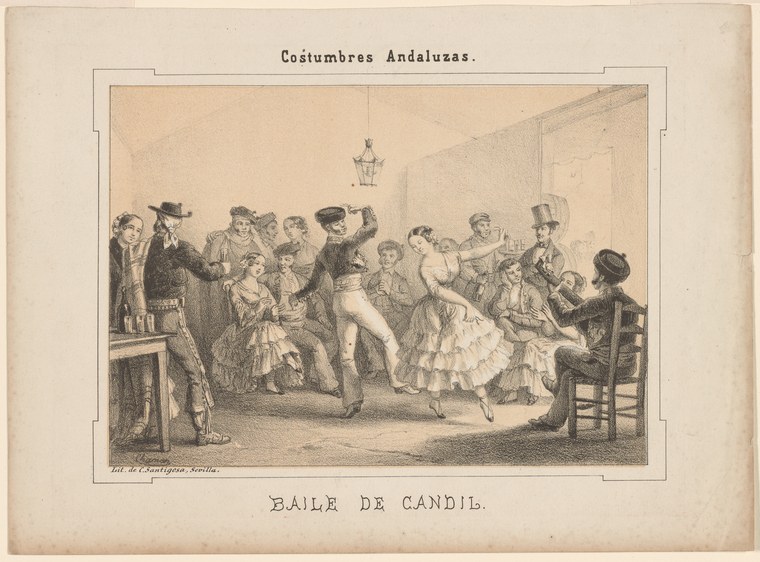
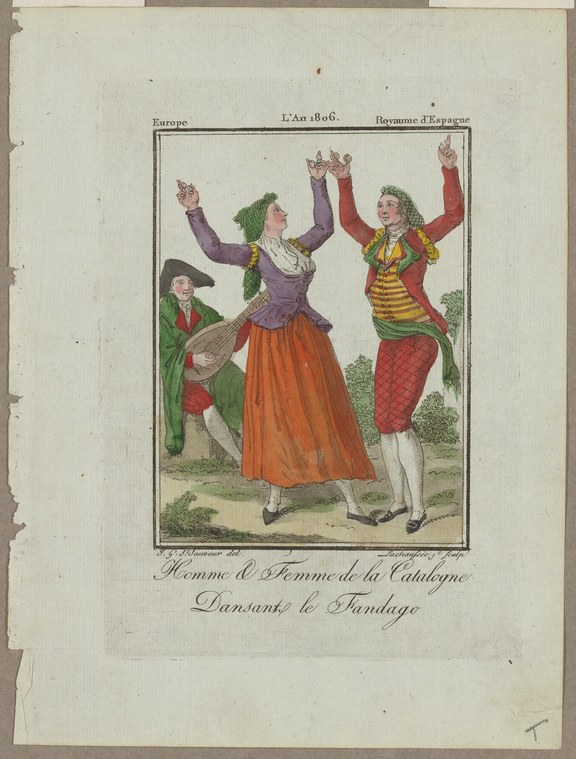
This is one of relatively few surviving images of Spanish social dance before the codification of flamenco in the 19th century, offering direct visual evidence of how regional Spanish dancers moved in the 18th century. The integration of musician and dancers, the freedom of the women's movement, and the open celebratory frame it captures are all historically significant for understanding vernacular Spanish dance outside the later formal tradition. For scholars and dancers, it is a rare primary source—not a posed portrait but an attempt to capture the energy and social function of dance as it was actually performed.
What you are looking at
Three figures in a lively outdoor setting dance in 18th-century European dress. The central woman wears a purple bodice with a full orange skirt, her arms raised high in exultant gesture, her body twisting in a dynamic pose. To her right stands a man in a striped yellow-and-red coat, similarly animated with raised arms, wearing knee breeches and stockings. On the left, a smaller figure—possibly a youth or musician—in a green coat plays a stringed instrument, likely a guitar or mandolin, while also caught in motion. The ground is marked with sparse vegetation, suggesting a village setting or countryside. The hand-coloring of this print is bright and emphatic, heightening the sense of festive movement and the warm southern European setting the title invokes.
The dancing
All three figures are captured mid-movement with raised arms and elevated energy. The central woman's torso twists while her skirts lift and flare around her legs—characteristic of a dancer with considerable freedom of movement in the lower body. Her arms reach high and outward in an exuberant, open frame. The man beside her mirrors this expansive arm position. The musician on the left is simultaneously playing and moving, suggesting an integrated performance in which dancer and musician are equally engaged. None of the figures adopts the formal closed holds or rigid posture of courtly dance; this is social, improvisational movement.
The dance depicted
This appears to depict Spanish folk or popular dance from the late 18th or early 19th century, most likely a regional Spanish dance such as Sevillanas or a related vernacular form rather than flamenco in its later codified sense. The raised arms, energetic body rotation, and the presence of a live musician are consistent with regional Spanish social dance traditions. The catalogue labels this as "Spanish dancing," which is appropriately generic, as the specific style cannot be determined from the image alone. The vibrant, unselfconscious exuberance suggests this is a social celebration rather than a staged performance or professional display.
How it was made
This is a hand-colored print—likely an engraving or etching given the fine line work and the era it depicts. The technique combines printed line work with applied watercolor or gouache in the secondary layer, evident in the flat, bright color fields and the way hues remain distinct without blending. This two-step process was economical for modest circulation and indicates a popular print intended for a broad audience rather than a collector's item. The French title and publication context suggest this is from a series documenting regional European customs and dances, a genre popular in the late 18th and early 19th centuries.
About this work
This hand-colored print documents a moment of Spanish popular dance in the late 18th or early 19th century, capturing three figures—a woman dancer, a male dancer, and a musician—in a state of joyful, energetic movement. The title "Homme & Femme de la Catalogne dansant le Tamlage" (Man and Woman of Catalonia Dancing the Tamlage) identifies both the regional origin and the specific occasion, though the nature of the "Tamlage" itself is now obscure. The print belongs to a family of European ethnographic documentation common in the era—visual curiosities about the customs and pleasures of different regions, created for a metropolitan audience. Its value lies not in technical sophistication but in its capture of an unguarded moment of physical joy and its evidence of how Spanish regional dance was perceived and represented in northern Europe during the Revolutionary and Napoleonic eras.
How to look at it
Attend to the raised arms and the twist of the woman's torso—this is not the upright carriage and closed frame of 18th-century courtly dance, but rather a fluid, rotational movement of the whole body. The musician is not a servant but a participant; note how his body echoes the rhythm of the dancers. The moment captured is neither a formal pose nor the peak of a jump, but a snapshot of continuous, joyful motion. The bright color and loose composition place this in the tradition of popular prints meant for quick consumption rather than sustained aesthetic study; the artist chose to convey energy and spirit rather than technical precision.
The period
This print was created during a period of intense European fascination with regional and 'exotic' customs, fueled by Enlightenment curiosity and the rise of travel literature. The 1790s-1810s saw a proliferation of illustrated ethnographic and costume albums documenting the dances and dress of different European regions and colonies. At the same time, Spanish dance and music were beginning to register in European urban culture, particularly in France. The later Romantic movement would intensify this interest, but prints like this one already show how Spanish dance had entered the visual imagination of northern European audiences as something energetic, sensual, and distinctly other.
Where it lives
The print is held in the New York Public Library collection and is sourced from their holdings. It forms part of the NYPL's collections of historical prints and engravings documenting European social customs and dance traditions.
Dance in this work
Questions about this work
What is the 'Tamlage' mentioned in the title?
The term is now obscure, though it appears in other 18th-century sources as a Catalan or Spanish regional dance. It may refer to a specific occasion or a generic festive dance. The title suggests it was familiar enough to contemporary audiences to need no explanation, but the meaning has not survived in the historical record.
Is this flamenco?
No. Flamenco as a codified tradition did not solidify until the mid-19th century. This print shows an earlier Spanish regional dance tradition—likely a Catalan or Andalusian popular form. It is an ancestor of later flamenco culture but belongs to a distinct historical moment.
Why is the woman's skirt so full?
The skirt is fashionable dress of the late 18th century, but its fullness also enabled the rotational and lifting movements visible in the dancer's body. Regional Spanish women's costume, with its layered skirts and freedom of hip and torso movement, was well-suited to vigorous social dance in a way that the tighter fashions of the north were not.
More Spanish/Flamenco artwork