10 works in this view — arrow keys or swipe to move between them.
Dance in Art
Fandango
Worth, Jean-Charles
- Dance:
- Spanish/Flamenco
- Era:
- 1920-1950 (Swing Era)
- Source:
- Victoria and Albert Museum
- Rights:
- Rights vary by item — check the source record before reusing this image. Source record ↗
- Recorded as:
- Check V&A creditLine
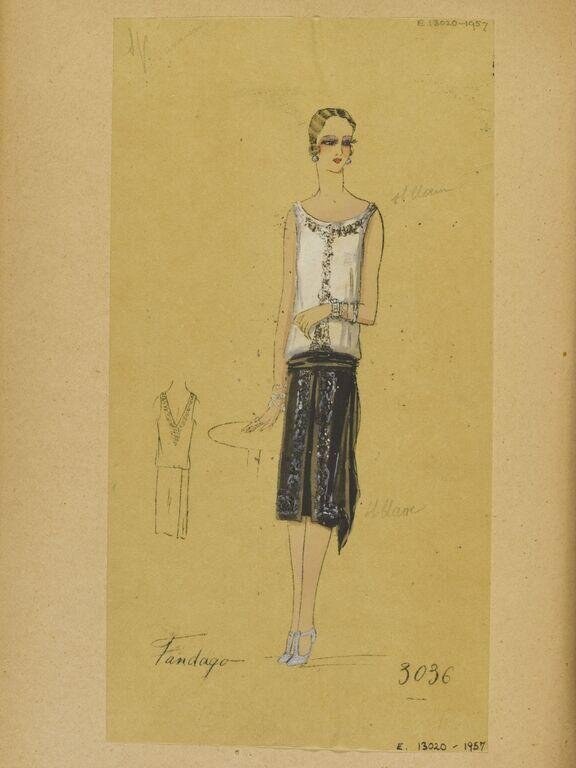
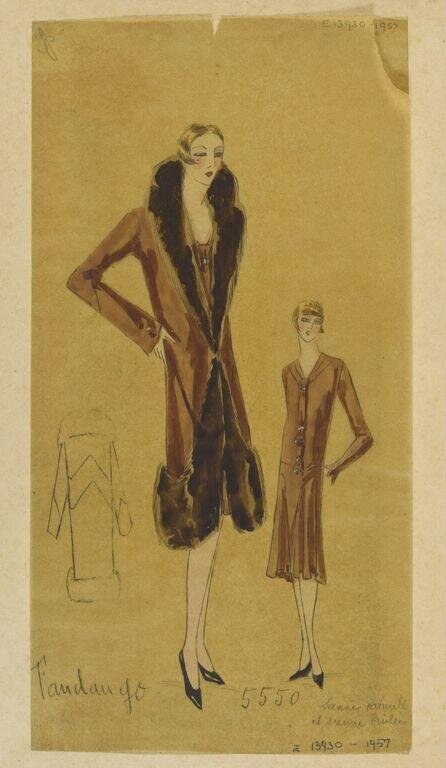
This work has no significance for dance history. It is a record of fashion design practice, not dance. Its presence in this collection suggests that the archive's cataloguing system may have conflated the title 'Fandango' (a Spanish dance, and possibly a garment name or collection theme) with actual choreographic or performance content.
What you are looking at
This is a fashion design sketch on tan paper showing two female figures in 1920s dress. The larger figure in the foreground stands with hand on hip in an elegant pose, wearing a long-sleeved rust-brown cardigan or coat dress with a deep fur collar and cuff, the garment hanging loosely to mid-calf over a knee-length skirt. A smaller, secondary figure behind her wears an identical coat in the same colorway, shown in smaller scale to indicate either the design in different sizes or a supporting ensemble member. Both figures have the characteristic long silhouette and dropped waistline of late 1920s fashion. The artist has used watercolor or gouache, with brown and rust tones predominating; the background is a uniform pale cream. On the lower left, a quick sketch of the dress form or pattern outline appears. The inscription reads 'Jean-Charles Worth' in script, and catalogue numbers appear at top right and bottom.
The dancing
The primary figure stands in a relaxed contrapposto with weight on one leg, her opposite hip jutting slightly forward—a pose of understated elegance common to fashion illustration of this period. Her arm rests casually at her side, the hand positioned near the hip. The secondary figure repeats this stance at smaller scale, echoing the lead without dancing. Neither figure shows active movement or dance position; the modeling is static and presentational, typical of haute couture display.
The dance depicted
This is not a depiction of dance. The work is a haute couture fashion design drawing, not a record of choreography or performance. The catalogue record's assignment to the dance era "Late 1800s (Victorian Ballroom)" and style "Spanish/Flamenco" appears to be a cataloguing error. While the fandango is indeed a Spanish folk dance, nothing in this image—neither the costume, the pose, the medium, nor the artistic intent—connects it to dance. The figure is modeled as a garment, not as a dancer moving.
How it was made
This is a watercolor or gouache sketch on paper, a standard medium for haute couture design in the 1920s. The technique is rapid and assured: the artist blocked in the silhouette and garment detail with minimal line work, suggesting confidence and professional routine. This is a design sketch intended for a client or atelier workshop, not a finished artwork for exhibition. The informality and working sketches visible on the page confirm its function as a working document within the fashion house's production process.
About this work
This is a 1920s fashion design by Jean-Charles Worth, the heir to the House of Worth, one of Europe's preeminent couture establishments. It shows an elegant coat dress in the fashionable silhouette of the late 1920s, with particular attention to the dramatic fur collar and cuff—signature details of luxury tailoring of the period. The work belongs in a fashion history collection as a primary document of haute couture practice, or in a museum of decorative arts; its inclusion in a dance archive appears to be a mistake in cataloguing.
How to look at it
This is a fashion design sketch, not a dance image. Look at the silhouette: the long, straight lines; the dropped waistline typical of 1920s fashion; the dramatic fur collar extending from the collarbone; the ease of the sleeve. The artist has emphasized the luxury and drape of the fabric through minimal but assured line work. The secondary figure shows scale and repetition of the design. The working sketches at lower left are part of the design process, showing the artist's method.
The artist
Jean-Charles Worth (1881–1962) was the son of Gaston Worth and grandson of Charles Frederick Worth, founder of the House of Worth in Paris. The House of Worth dominated European haute couture from the 1870s onwards and set standards for luxury fashion design. Jean-Charles took over the couture house alongside his brother and maintained its prominence through the 1920s and beyond. Design sketches such as this were part of the daily workflow of a major couture atelier, produced for clients, pattern makers, and tailors.
The period
The 1920s were the height of the Art Deco era and the interwar modernist moment in fashion. Women's silhouettes had lengthened and relaxed after the constraints of the Edwardian era, and hemlines rose to just below the knee. Luxury fabrics—silk, fur, and fine wool—were markers of wealth and status, and fur collars and cuffs were hallmarks of 1920s opulence. The House of Worth's clientele were among the wealthiest and most fashionable women in Europe, and designs like this coat dress would have been worn by society women, actresses, and nobility.
Where it lives
The work is held in the Victoria and Albert Museum collection, as indicated in the catalogue record. It is part of the museum's fashion design collection, which documents the practice of haute couture houses and the creative output of major European designers.
Questions about this work
Is this a record of a dance performance?
No. This is a fashion design sketch, not a depiction of dance. It shows a garment on a model figure, presented in the static, elegant pose conventional to haute couture illustration. The catalogue record's assignment to a dance era and style appears to be a cataloguing error.
Why is this in a dance archive if it is not dance?
The title 'Fandango' may have caused confusion: fandango is a Spanish folk dance, but in this context it is most likely the name of a garment line or collection theme. The metadata appears to have conflated the dance term with the actual content of the sketch.
Who was Jean-Charles Worth?
He was the son and heir of Gaston Worth, and grandson of Charles Frederick Worth, founder of the House of Worth. The House of Worth was the preeminent Paris couture establishment from the 1870s onward. Jean-Charles took over the house in the early 20th century and maintained its prominence through the 1920s and beyond.
More Spanish/Flamenco artwork