48 works in this view — arrow keys or swipe to move between them.
Dance in Art
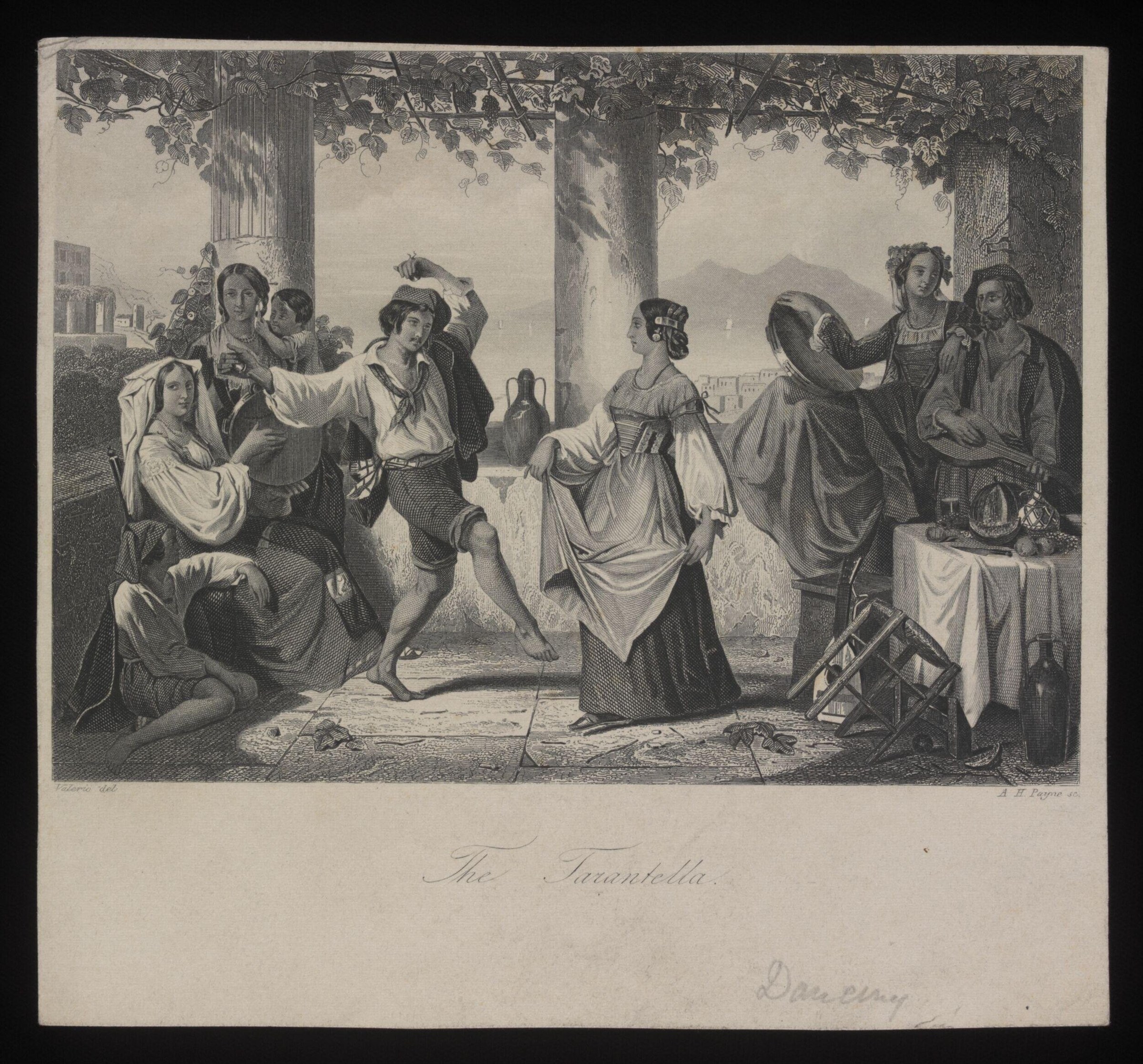
The Tarantella
Valerio
- Dance:
- Folk/Country
- Source:
- Victoria and Albert Museum
- Rights:
- Rights vary by item — check the source record before reusing this image. Source record ↗
- Recorded as:
- Check V&A creditLine
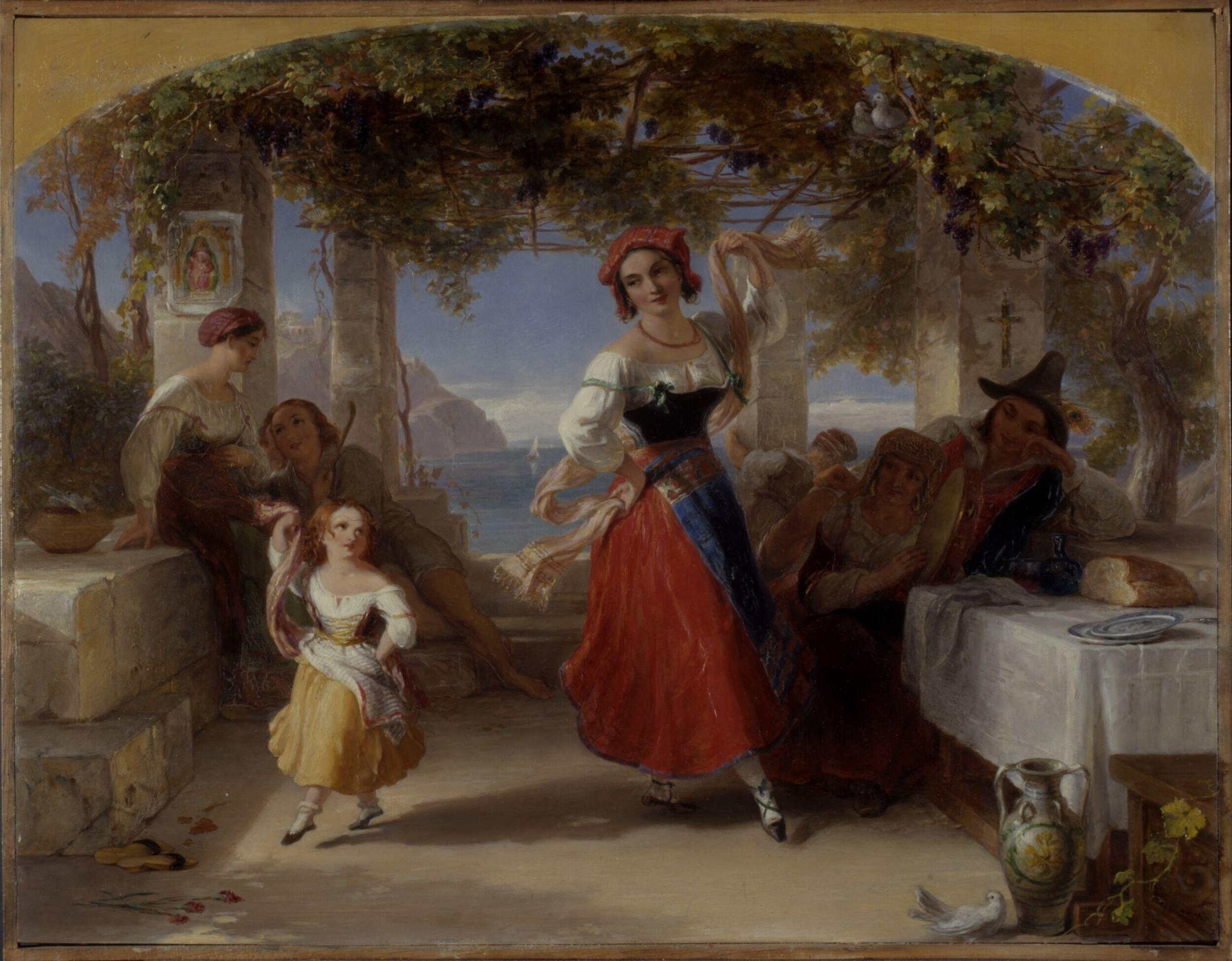
The Tarantella is a central dance tradition of Italian folk culture, yet it is rarely documented in visual form from this period. This engraving preserves both the physical vocabulary of the dance as understood in the 19th century and the social context in which it was performed and observed—as entertainment for educated spectators rather than purely as village ritual. For dancers and historians, it shows how a living vernacular tradition was being aestheticized and disseminated through fine art media.
What you are looking at
A lively outdoor gathering under a columned portico overlooking a sunlit Mediterranean landscape. A young woman in a pale chemise-style dress stands at the center, weight on one leg, arms raised and body angled in mid-movement. Around her stand six other figures—some seated on the ground in flowing garments, others standing or partially reclining—watching intently. The composition spreads across the width of the portico, with mountainous terrain and classical architecture visible in the hazy background. A tambourine lies on the ground in the foreground. The figures wear loosely draped classical or pseudo-classical dress: the central dancer's garment is translucent and simple, while the attendants wear darker, more heavily patterned fabrics and some wear wreaths or elaborate hairstyles. The light is soft and even, typical of Mediterranean afternoon.
The dancing
The dancing figure is shown in a single, isolated moment of motion: one leg appears to spring or lift, the torso twists, and her arms are raised—one higher than the other—with apparent ease and lift through the chest. Her pose suggests a dynamic ascending movement rather than a grounded step. The other figures are static observers, arranged in informal groupings that frame her centrality. The spatial relationship emphasizes the dancer's isolation and prominence; she is surrounded but not partnered.
The dance depicted
This is identified in the title as the Tarantella, the folk dance tradition of southern Italy and Sicily. The Tarantella is typically performed to rapid music in 6/8 time, often with a tambourine, and features quick footwork, spins, and arm gestures—as evidenced here by the raised arms and the tambourine lying nearby. The image shows a moment when the dance was understood as a solo performance by a woman for an audience of companions, rather than as a partnered or group dance. The painter has chosen a moment of lift and extension, emphasizing the dancer's spirited animation. The classical setting and quasi-mythological grouping of spectators suggest the dance is being presented as a picturesque folk entertainment observed by cultivated company.
How it was made
This is an engraving, identifiable from the fine hatching, tonal gradation, and monochromatic palette characteristic of 19th-century reproductive engravings. The technique allowed for wide circulation and modest cost, making such scenes accessible to middle-class viewers and collectors. The style and execution suggest professional production—likely engraved after a painting—with careful rendering of drapery folds, facial expression, and spatial recession through atmospheric perspective. The inscription at the base and the artist credits visible at the bottom indicate this was a published print, designed for portfolios or periodical reproduction.
About this work
This is an engraving depicting the Tarantella, the lively southern Italian folk dance, as performed by a solitary young woman before an assembled group of onlookers. The work dates from the 19th century, when European folk traditions were being codified, romanticized, and circulated to urban audiences through prints and illustrated books. The artist has chosen a moment of visible animation and grace—the dancer's lifted posture and raised arms—and placed her within a classical architectural frame that lends the scene dignity and artistic weight. The juxtaposition of Mediterranean landscape, pseudo-classical setting, and contemporary folk practice is typical of the era's fascination with picturesque regionalism.
How to look at it
Notice the dancer's asymmetry: her body is caught mid-turn or mid-spring, with one leg lifted and the torso twisted away from the viewer. Her arms are not held in a formal frame but are raised and released, suggesting the spontaneous, uninhibited quality the 19th century associated with folk dance. The scattered tambourine and the semi-recumbent poses of the spectators convey informality and pleasure rather than formal entertainment. The soft, engraved hatching creates an almost dreamlike quality, inviting the viewer to see the scene as a romantic ideal rather than a documentary record.
The artist
The artist is credited as Valerio in the engraving itself. Beyond the visible attribution, little is confirmed in the catalogue record. The quality of execution and the professional circulation of the print suggest Valerio was an accomplished reproductive engraver, likely working in the mid-to-late 19th century when illustrated books and periodicals on European manners, costumes, and folk traditions flourished.
The period
The 19th century saw intense European interest in folk dance and regional costume as markers of national or local identity. The Romantic movement elevated folk traditions as authentic expressions of the people, and travelers, collectors, and artists documented them with growing frequency. In Italy specifically, the Tarantella became emblematic of southern regional identity and was widely described in travel narratives and encyclopedic works. Simultaneously, the engraving industry was at its height, allowing such scenes to reach a broad audience of educated readers and amateur collectors.
Where it lives
The work is held in the Victoria and Albert Museum collection. It is catalogued as an artwork by Valerio; the museum's attribution and records are the source for this information.
Dance in this work
Questions about this work
What exactly is the Tarantella?
The Tarantella is a lively folk dance tradition from southern Italy and Sicily, typically performed to rapid 6/8 music and characterized by quick footwork, spins, and arm gestures. It was traditionally danced at celebrations, and was often performed by women as entertainment. The dance has many regional variations and remains popular today.
Why is the dancer shown alone?
In the 19th century, the Tarantella was often presented as a solo performance by a woman dancing for an audience of companions or guests. This format was popular in drawing rooms and at social gatherings among the educated classes. While the Tarantella can also be a partnered or group dance, this engraving shows it in its role as individual spectacle.
How do we know this is an engraving?
The technique is visible in the monochromatic palette, the fine parallel lines (hatching) used to create tone and shadow, and the overall aesthetic consistency with 19th-century reproductive engravings. The professional finish and the presence of artist credits and a printed title indicate this was a published print, circulated to a wide audience.
Why is the setting so classical?
The columned portico and idealized Mediterranean landscape reflect 19th-century taste for framing folk traditions within a classical or picturesque aesthetic. By placing the Tarantella in this refined setting, the artist and publishers elevated the folk dance to a subject worthy of fine art, appealing to educated collectors and readers.
More Folk/Country artwork