49 works in this view — arrow keys or swipe to move between them.
Dance in Art
The Tarantella
Montvoisin
- Dance:
- Folk/Country
- Era:
- Early 1800s (Waltz Revolution)
- Source:
- Victoria and Albert Museum
- Rights:
- Rights vary by item — check the source record before reusing this image. Source record ↗
- Recorded as:
- Check V&A creditLine
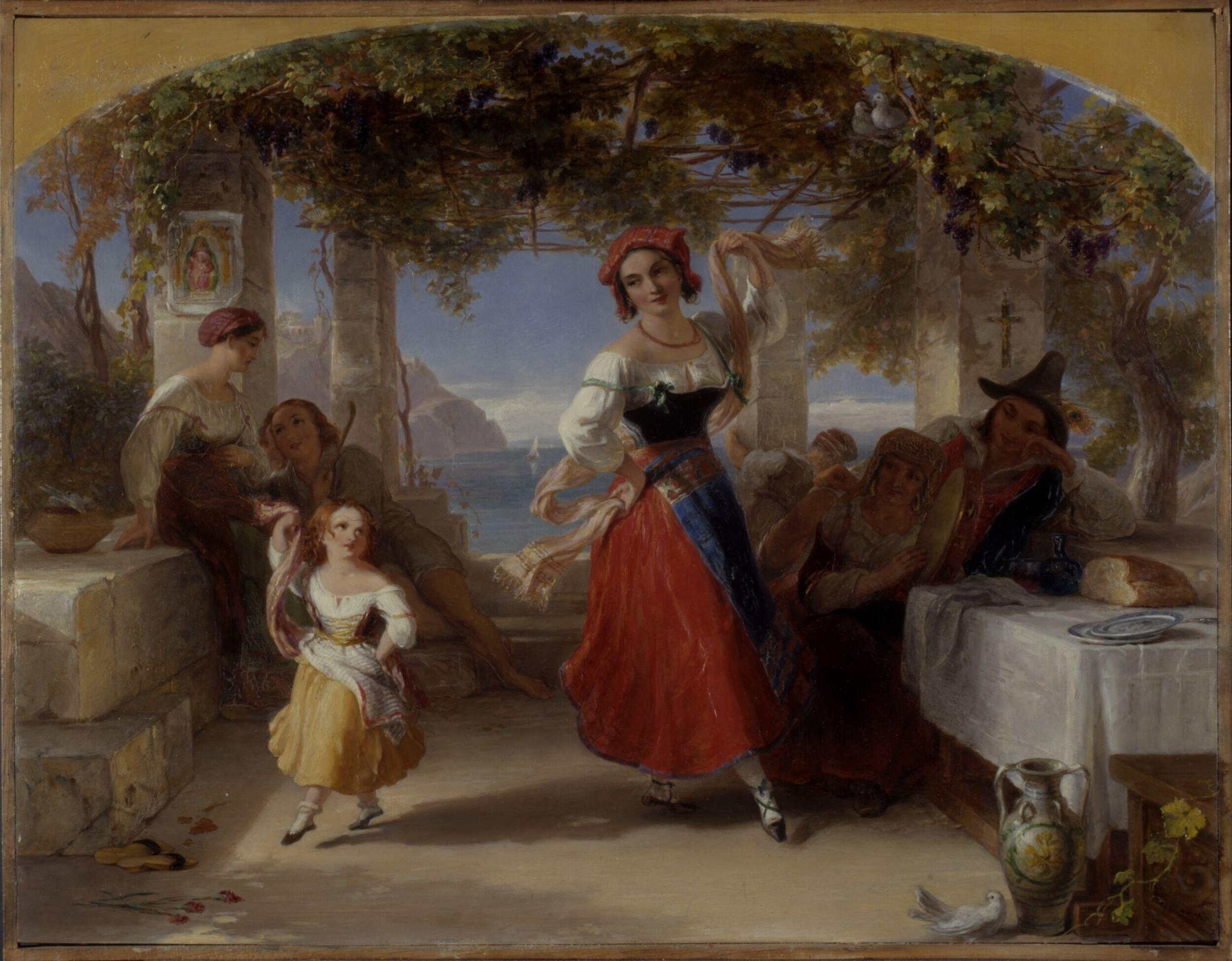
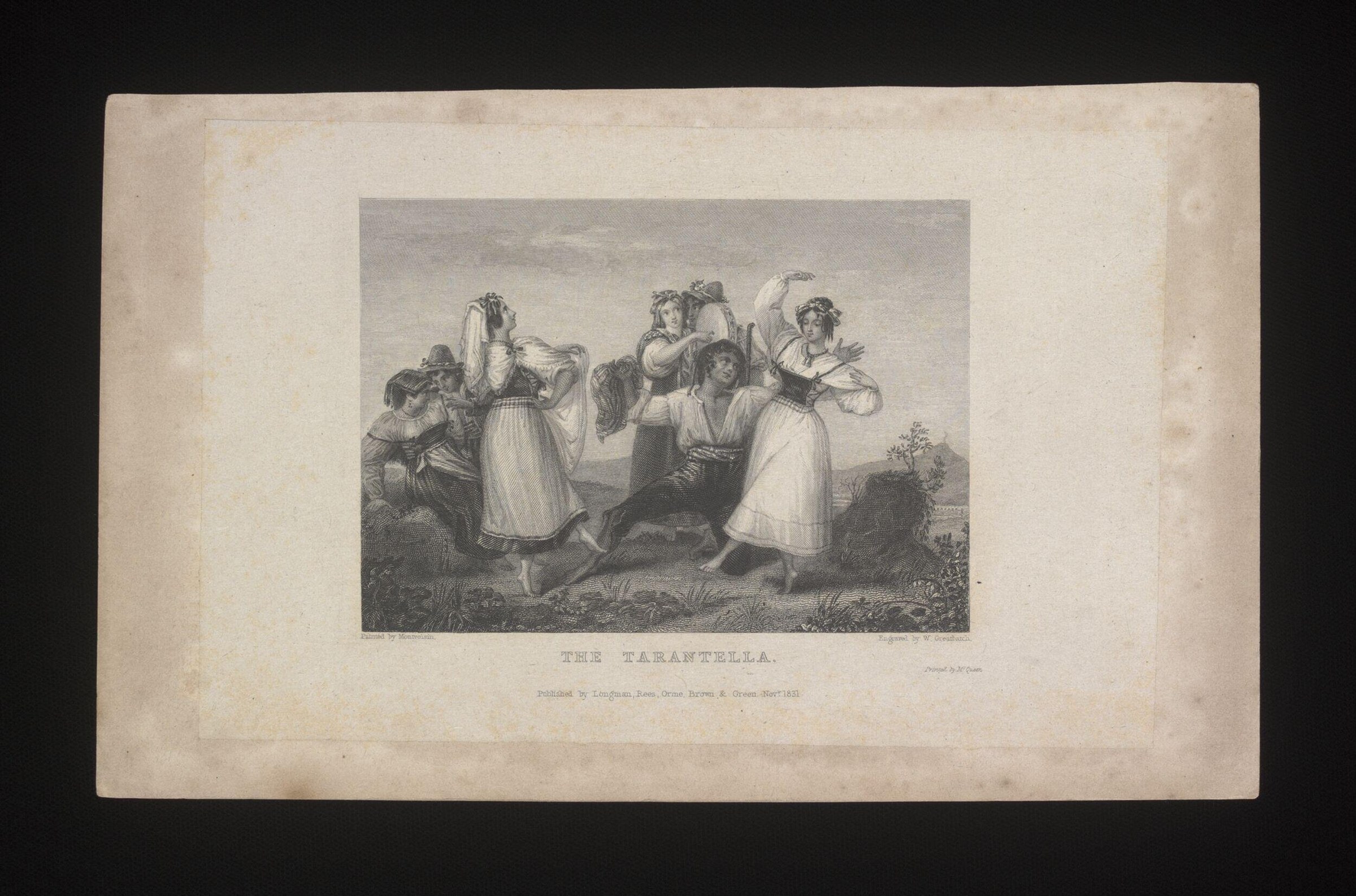
The tarantella was the Romantic era's favorite emblem of Italian authenticity and female vitality; this print shows how commercial urban audiences consumed and visualized the dance through prints and theatrical production. The image documents not the tarantella as it was danced, but the Romantic fantasy of what it represented: natural, sensual, unrestrained movement by young women, observed and aestheticized from outside.
What you are looking at
A group of seven young women in white muslin gowns and dark bodices dance outdoors on a hillside, their figures animated mid-movement. The composition arranges them in a loose circle or gathering, with some figures raising their arms expressively overhead and others with bodies turned or tilted as if in rapid rotation. The nearer figures are rendered in crisp detail—their high-waisted Empire silhouette dresses and dark hair adorned with flowers or ribbons are clearly legible—while those in the background dissolve slightly into atmosphere. The landscape is minimal: a grassy slope, distant hills, and a solitary shrub suggest an Arcadian setting far from city constraint. The light is diffuse and cool, creating a dreamlike quality. The moment captured is one of vivid, uninhibited motion: several dancers have their skirts caught mid-swirl, arms flung wide, heads tilted back in what reads as joy or frenzy.
The dancing
The dancers' bodies are in constant spiral and rotational motion rather than in strict formation. Several figures show arms raised and extended, shoulders back, faces lifted—a posture of abandon rather than formal control. The closest figure on the left appears to be turning rapidly, her skirt billowing. The bodies are lithe and youthful, rendered with anatomical understanding; the artist has grasped that the tarantella demands vigorous pivoting from the hips and legs, with upper bodies responding fluidly. The grouping is intimate and circular, with the dancers oriented toward one another rather than in a line or corps formation. The impression is of spontaneity and social rather than theatrical dance.
The dance depicted
This is the tarantella, the southern Italian folk dance that became a staple of Romantic-era visual culture and a marker of picturesque rural authenticity. The tarantella is traditionally danced by couples or groups in rapid 6/8 time, with rotating hip and leg movement and considerable arm freedom—all visible here. By the 1830s the tarantella had been adopted into theatrical ballet and prints, where it represented the untamed, natural energy of Italian peasant culture, especially women. The speed and swirling motion of the figures, their outdoor setting, and the absence of musical instruments visible here all align with the tarantella as a social dance rather than a staged performance, yet the composition and the very fact of its print medium insist on its picturesque appeal to urban audiences.
How it was made
This is a steel engraving, a process that allowed for fine tonal gradation, intricate linework, and multiple impressions. The technique is evident in the delicate cross-hatching that models the fabric of the skirts and the soft shadows that suggest volume and movement. Steel plates could withstand far more printings than copper, making this an economical format for distribution to the middle-class market in the 1830s. The inscription at the base identifies both the title and the publisher, confirming this as a commercial print intended for framing or album inclusion rather than a unique artwork. The medium's precision and reproducibility mark this as a work meant to circulate widely, bringing the spectacle of Italian folk dance into parlors across Europe.
About this work
This is a commercial steel engraving of the tarantella, the rotational folk dance of southern Italy that captivated Romantic audiences in the early 19th century. The print shows seven women in Empire-waist muslin dancing with visible speed and abandon on a hillside, their bodies spiraling and their skirts swirling—a image of natural, unschooled vitality that appealed powerfully to urban taste. The work belongs to a large body of prints and paintings that represented European folk and peasant dances as picturesque and authentic, often from the safety of distance and the authority of the frame. By depicting women as the primary dancers in a moment of joyful uninhibited motion, the print both celebrated and exoticized the tarantella, treating it as a spectacle for consumption rather than a living practice.
How to look at it
Observe the moment the artist chose: not a formal display but a snapshot of movement, with bodies mid-pivot and skirts caught in spiral. The artist has rendered the rotational energy of the dance through pose, drapery, and the informal grouping; look at how the nearest figure's skirt folds reveal centrifugal force. Notice how the print's technique—the fine gradations of tone created by engraving—gives the muslin dresses transparency and weight, making the motion legible. The outdoor setting and the naturalism of pose (no visible musicians, no theatrical framing) are key to how Romantic audiences read the image: as a glimpse of life rather than art, even though it is in fact a carefully composed and executed engraving.
The artist
Montvoisin was a French engraver active in the early 19th century whose practice centered on reproductive prints and popular illustrated subjects, including dance, literary scenes, and picturesque views of European life. Engravers of his generation supplied the growing market for affordable wall art and periodical illustration; their work mediated between fine art and mass culture.
The period
The tarantella reached peak popularity in European visual culture during the 1820s–1840s, the height of the Romantic movement, when peasant and folk practices were celebrated as repositories of authentic emotion and natural beauty. Italian culture, especially the south, was treated as exotic and picturesque by Northern European and British audiences. In the theater, the tarantella appeared regularly in ballet pantomimes and in mixed entertainments that staged the manners and dances of different nations. The 1831 date places this print at the heart of this fascination, when steel engraving had made fine reproductive prints economical enough to reach middle-class collectors and when Romantic Orientalism and exoticism were at their most intense.
Where it lives
This work is recorded in the Victoria and Albert Museum collection, where it sits among the museum's extensive holdings of 19th-century popular prints and dance imagery. The print's publication line, visible at the base, confirms its status as a commercial product by a London or Paris publisher.
Dance in this work
Questions about this work
Was the tarantella really danced like this?
The rotation and arm freedom are authentic to the tarantella, but this image is aestheticized for Romantic taste. Real tarantella was often danced more vigorously and at closer quarters, and frequently by couples in direct engagement. This print emphasizes the individual female body and the picturesque spiral of the skirt—elements that appealed to urban viewers but were shaped by the conventions of Romantic art rather than ethnographic truth.
Why did the tarantella become so popular in Europe?
The tarantella represented everything Romantic audiences found compelling: Southern European exoticism, apparently unschooled natural vitality, female sensuality, and the fantasy of authentic folk life untouched by industrial modernity. It appeared in ballet, prints, literature, and travelogues as a marker of Italian peasant authenticity and picturesque charm.
How do you know this is an engraving rather than a painting or lithograph?
The technique is visible in the image itself: the fine parallel lines (hatching and cross-hatching) that model form and create tone are characteristic of engraving. Lithography would show a different kind of grainy texture; a painting would have continuous color or visible brushwork. The precision and the way light and shadow are built up through line are diagnostic of steel or copper engraving.
More Folk/Country artwork