49 works in this view — arrow keys or swipe to move between them.
Dance in Art
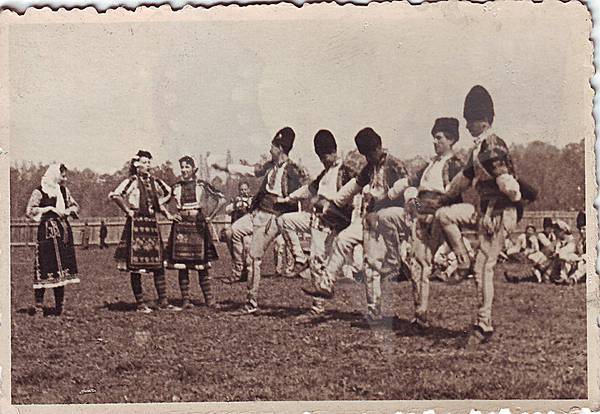
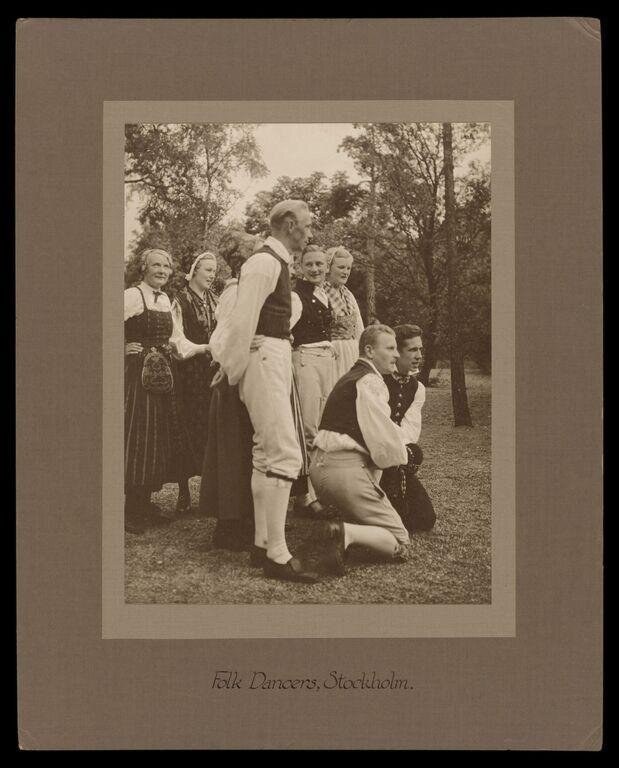
Folk dancers, Stockholm
Ashton, Ernest Russell
- Dance:
- Folk/Country
- Era:
- 1920-1950 (Swing Era)
- Source:
- Victoria and Albert Museum
- Rights:
- Rights vary by item — check the source record before reusing this image. Source record ↗
- Recorded as:
- Check V&A creditLine
The photograph documents folk dance at the point of transmission, showing how traditional knowledge passed from experienced dancers to younger learners in practice settings rather than formal stages. It is evidence of the folk revival movement in 1930s Scandinavia, a crucial period when rural dance traditions were being systematically collected and preserved before they could disappear. For dancers and historians, it provides visual proof of how Swedish folk dances were actually taught and learned in community settings.
What you are looking at
Seven people in traditional Swedish folk costume stand in a wooded clearing in what appears to be a formal posed arrangement. They wear embroidered vests, long skirts with aprons, and white stockings — the dress of rural Sweden. In the foreground, two younger men kneel or crouch, their bodies angled toward the standing figures; behind them, five adults — three women and two men — face the camera with composed expressions. The setting is a natural woodland with tall trees and grass underfoot. The light is soft and even, characteristic of early 20th-century outdoor photography. The composition suggests a moment of instruction or demonstration rather than active dancing, though the bodies of the kneeling figures show attentiveness and readiness.
The dancing
The kneeling men in the foreground have their bodies bent forward in positions of attention or receptiveness, their upper bodies angled toward the standing adults. The standing figures maintain upright, composed postures with their arms at rest or held naturally. No dancers appear to be in motion or demonstrating a step; instead, the arrangement reads as a teaching moment or formal documentation, with the younger figures positioned as learners and the older as knowledge-keepers. The vertical alignment of bodies and the symmetry of the group suggest a structured, deliberate pose rather than the capture of ongoing movement.
The dance depicted
This is almost certainly a documentation of Swedish folk dance tradition, likely recorded by a dance researcher or ethnographer. The formal costume, the outdoor woodland setting, and the pedagogical arrangement — with experienced dancers positioned to teach — are consistent with early 20th-century folk dance revival and documentation practices. Swedish folk dance is rooted in regional tradition and community celebration, and by the 1930s such dances were being actively collected and preserved. The image captures not a performance but a teaching or transmission moment, which was a crucial part of how traditional dances remained alive. Specific Swedish dances like the halling or springar often involved younger men learning from older practitioners, which may be what is documented here.
How it was made
This is a photograph, likely a gelatin silver print or similar photographic process from the 1930s. The soft tonal range, the even exposure, and the slight grain are consistent with professional documentary photography of that era. The photographer has chosen to work outdoors in natural light, which was necessary for folk dance documentation before reliable studio lighting became available, and which also emphasizes the rural, natural context of the tradition. This approach places the image in the context of anthropological and cultural documentation rather than commercial studio portraiture.
About this work
This is a photograph of Swedish folk dancers in traditional costume, posed in a woodland setting in a way that suggests instruction or transmission of dance knowledge rather than performance. The image dates from 1936 and forms part of the cultural documentation work that was widespread in Scandinavia during the folk dance revival of the early 20th century. It captures a moment of generational knowledge transfer — younger dancers learning from older keepers of tradition — and records the embodied practice of regional Swedish dance at a moment when such traditions were being actively preserved.
How to look at it
The photograph freezes a teaching moment rather than a moment of performance, which is unusual in dance imagery. Look at the postural difference between the kneeling figures in the foreground and the standing adults: the younger bodies are angled forward in attention, while the elders stand composed and upright. This compositional choice reveals how knowledge was transmitted — through direct attention, proximity, and the modeling of experienced bodies. The informal woodland setting, rather than a stage or studio, is essential to understanding what is being documented: this is tradition as lived practice, not dance as spectacle.
The artist
Ernest Russell Ashton was a photographer active in the early 20th century. The photograph is held in the Victoria and Albert Museum, suggesting it was part of a systematic documentation project, possibly in connection with the Museum's growing interest in vernacular culture and ethnographic material during this period.
The period
The 1930s were a crucial moment for folk dance revival across Northern Europe, particularly in Scandinavia. As industrial urbanization accelerated, cultural institutions and individual researchers undertook systematic efforts to document and preserve regional dance traditions before they disappeared. Sweden was at the center of this movement, with organizations dedicated to the study and teaching of folkdans (folk dance). Simultaneously, the photograph shows the influence of anthropological and ethnographic practice — the documentation of living culture as an academic and curatorial concern. The outdoor, naturalistic setting reflects a deliberate choice to photograph the tradition in its native context rather than on a theatrical stage.
Where it lives
The photograph is held in the collection of the Victoria and Albert Museum, London, one of the world's major repositories of design and material culture. Its presence in the V&A suggests it was acquired as part of the Museum's documentation of vernacular traditions and cultural heritage.
Dance in this work
Questions about this work
Is this a performance or a lesson?
It is a teaching moment or demonstration, not a performance. The arrangement of bodies — with younger dancers in positions of receptive attention and older ones composed and upright — and the deliberate pose for the camera indicate this is documentation of how folk dance knowledge was transmitted in practice. The photographer has captured the pedagogical structure of tradition rather than a moment of active dance.
What is Swedish folk dance?
Swedish folk dance, or folkdans, is a family of regional dances that developed in rural communities across Sweden, varying by province and season. By the 1930s, these dances were being actively preserved and revived as part of a broader Scandinavian cultural movement. Many Swedish folk dances are couple dances or group dances, often performed at celebrations and festivals.
Why photograph folk dancers in the woods rather than on a stage?
Outdoor, natural settings were chosen by ethnographic photographers to document traditions in their native context, rather than as staged performances. This approach reflected the serious, academic study of culture that characterized the folk revival movement. It also reflected practical necessity: early 20th-century photography outdoors in natural light was often more reliable than studio work.
More Folk/Country artwork