49 works in this view — arrow keys or swipe to move between them.
Dance in Art
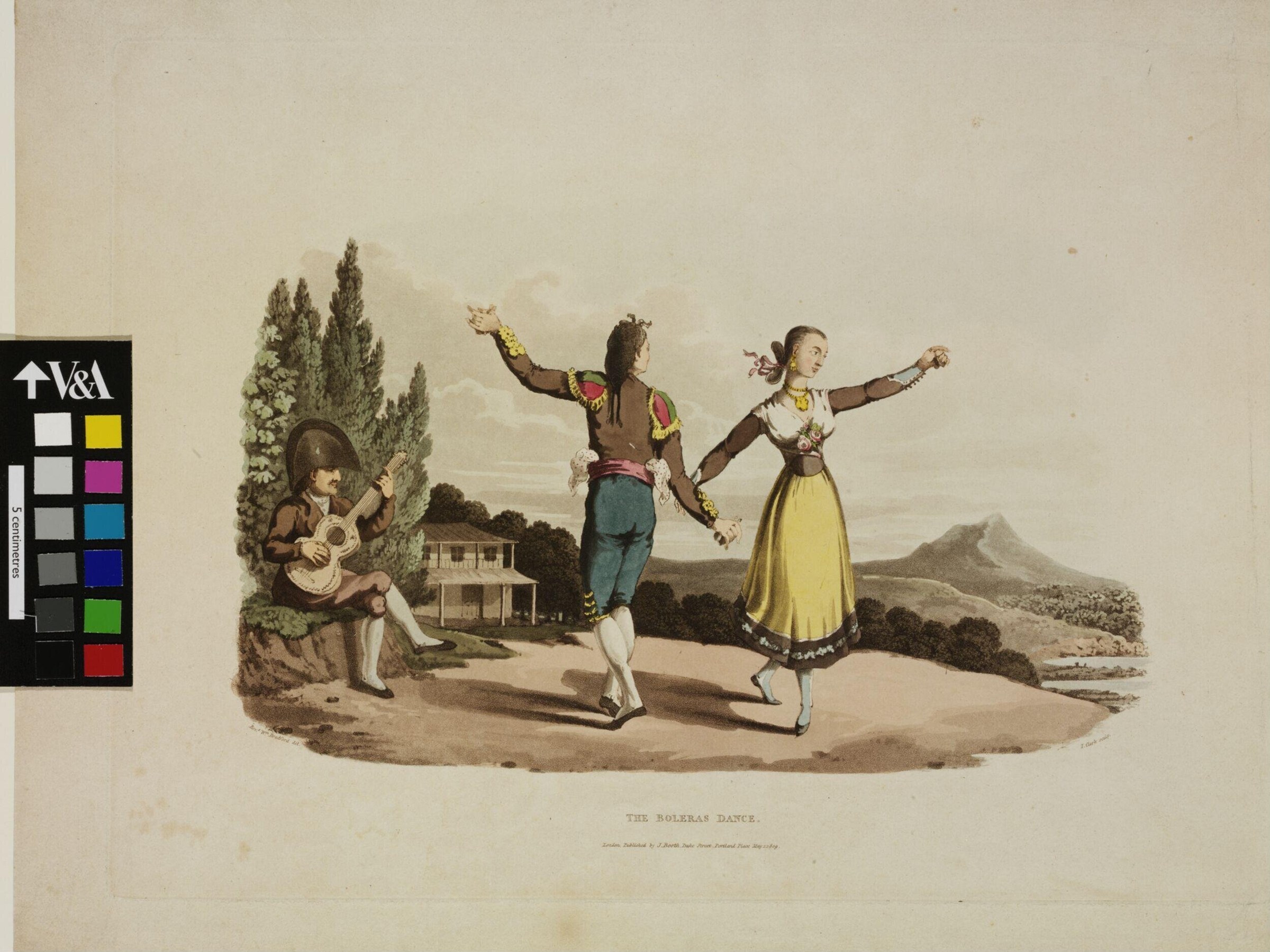
The Boleras Dance
Bradford, William (Reverend)
- Dance:
- Folk/Country
- Era:
- Early 1800s (Waltz Revolution)
- Source:
- Victoria and Albert Museum
- Rights:
- Rights vary by item — check the source record before reusing this image. Source record ↗
- Recorded as:
- Check V&A creditLine
This image is one of the few surviving visual records of the bolera in its original context, capturing arm technique, spacing, and accompaniment that illuminate how the dance differed from both ballet and folk practice. For historians of Regency culture and Spanish dance, it provides evidence of what a trained dancer was expected to produce and how the dance was represented to English-speaking audiences of the period.
What you are looking at
A hand-coloured engraving depicts a pair of Spanish dancers in a landscape setting, likely 1809 or shortly after. The man stands at centre-left in a brown jacket with yellow trim, his left arm raised high and bent, his right arm extended downward; his posture is animated and his gaze directed upward. The woman faces him in a yellow skirt with dark trim at hem and bodice, her arms raised and spread wide in a lifted frame, her body turned slightly away. Between them sits a young guitarist in light breeches, perched on the ground with his instrument. The setting is a Mediterranean or Spanish countryside: tall dark cypress trees frame the left side, a modest single-story building (possibly a cortijo or country house) sits in the middle distance, and a conical mountain or volcano rises on the horizon to the right, rendered in soft atmospheric perspective. The ground is sandy or dusty. The colour is applied selectively—the costumes glow against the pale paper—and the light falls as if late afternoon, with long shadows suggested by the placement of figures.
The dancing
The male dancer's weight appears to be on his back foot, his torso lifted, his raised arm creating a vertical line from elbow to fingertips that frames his face. The female dancer's frame is open and symmetrical, both arms lifted to shoulder height or above, her hands relaxed or slightly curved, suggesting a moment of display rather than partnering. The guitarist is stationary and grounded, his role purely accompaniment. There is no closed-position frame or partner contact; the dancers occupy the same space but perform independently, facing and mirroring each other across a small distance. The postures suggest a vocabulary of arm and torso work rather than footwork complexity.
The dance depicted
This represents the bolera, a Spanish court and social dance of the late 18th and 19th centuries. The bolera was typically performed by a couple in open formation, with rapid footwork and expressive arm movements, often accompanied by castanets and guitar. The independence of the two dancers here, their raised and extended arms, and the presence of a guitarist align with documented bolera practice. The bolera was distinct from flamenco (which was developing separately in Andalusia) and from folk regional dances; it circulated in urban centres and had an established technique and vocabulary. The image captures a moment of mutual display—the dancers engaging through gaze and gesture rather than through contact, which accords with contemporary descriptions of the dance's character as spirited and showy rather than intimate.
How it was made
This is a hand-coloured engraving, a reproductive print technique that allowed wide circulation of dance images to middle-class and aristocratic audiences. The engraver cut lines into a metal plate (steel or copper) to create the compositional framework and principal outlines, then hand-coloured the finished prints with watercolour or gouache. The technique permitted fine detail in costume and setting while maintaining reproducibility. The soft atmospheric perspective and the careful rendering of landscape suggest a significant degree of labour and skill, and the titled inscription at the base indicates this was a published commercial print rather than a private commission, suggesting a market for Spanish dance imagery in the early 19th century.
About this work
The Boleras Dance is a hand-coloured engraving that documents a specific Spanish social dance at a moment of high visibility in European high society and salon culture. The bolera was neither folk nor flamenco but a codified theatrical and ballroom form, and this print captures its characteristic visual grammar: open frame, lifted arms, mutual gaze, and rhythmic accompaniment. The work is both a document of dance practice and a product of the commercial print culture of the Regency era, when Spanish and exotic dance forms were fashionable subjects for prints, paintings, and narrative illustrations. It belongs to a moment when European interest in Spanish culture was at a peak, and when dance was understood as a signifier of national identity and aesthetic refinement.
How to look at it
Note the moment chosen: neither the beginning nor the climax of a movement phrase, but a moment of equipoise where both dancers are lifted and open, their arms and eyes engaged in mutual display. This is not a portrait of a single movement but of a *stance*—the way a trained dancer holds herself and projects herself to an audience. Observe the guitarist's placement at ankle height and the way the composition uses the landscape to frame the dancers' bodies. The atmospheric landscape is not mere decoration; it signals to a Regency viewer that this is a dance of cultivated society, not a rustic or primitive form. The print medium itself—the clean, reproducible line and the restrained hand-colouring—reinforces an air of polish and control.
The artist
Reverend William Bradford was an English clergyman and artist of the early 19th century. Little detailed information about his practice survives in standard sources, but his involvement in the production or commission of this dance print suggests familiarity with continental European subjects and the commercial print market. The title and execution suggest this may have been one of a series of dance and costume prints aimed at a genteel readership.
The period
The bolera rose to prominence in Spanish society in the late 18th century and became fashionable in European courts and salons during the Napoleonic Wars and Regency period (c. 1800–1820). As ballet was consolidating as a theatrical form with Romantic ballet emerging in the 1830s, Spanish and Mediterranean dances circulated as exotic, sensuous alternatives in print culture and on the London stage. The engraving's date of 1809 places it at the height of this enthusiasm. Spanish dancers and Spanish-themed dances were frequently advertised and illustrated in London periodicals and as commercial prints; this engraving participates in that market. The work predates the full flowering of Romantic ballet and represents a moment when ballroom and theatrical dance were more porous categories.
Where it lives
The work is held in the Victoria and Albert Museum, London. It is catalogued as a print from the Early 1800s (Waltz Revolution) era in the Museum's dance collection, which consists chiefly of theatrical and social dance imagery aimed at a middle and upper-class market.
Dance in this work
Questions about this work
Is this a dance in the flamenco tradition?
No. The bolera predates and is distinct from flamenco. The bolera was a courtly and fashionable dance, often performed in ballrooms and on theatre stages by trained dancers in formal dress. Flamenco developed separately in Andalusia and was associated with lower-class and Roma communities. The bolera has a different rhythmic structure, movement vocabulary, and social context. This print represents urban, middle to upper-class Spanish culture, not the folk or ethnic traditions from which flamenco emerged.
Did the bolera use castanets?
Yes, castanets were the typical percussion accompaniment to the bolera, though they are not visible in this image. The guitarist shown here would have been accompanied by a castanet player or the dancer herself may have carried castanets. The bolera's rhythm and choreography were designed to work in concert with castanet clicks and the dancer's footwork.
What does the open frame tell us about the dance?
The open frame—arms extended, bodies not in contact—indicates that the bolera was a dance of display and mutual regard rather than a dance of partnering through physical connection. The dancers engage through eye contact and symmetric or mirrored arm movement, creating visual symmetry and equality rather than lead-and-follow dynamics. This was quite different from the closed-frame ballroom dances (waltz, quadrille) that were becoming dominant in the same period.
Why is there a volcano in the background?
The distant conical mountain evokes the Spanish or Mediterranean landscape and reinforces the cultural context of the dance. For a Regency viewer, such landscape details signalled exoticism and authenticity—the sense that this was a dance rooted in a specific place and people. It is a visual convention of the period to set foreign or exotic dances in their 'native' or imagined setting.
More Folk/Country artwork