49 works in this view — arrow keys or swipe to move between them.
Dance in Art
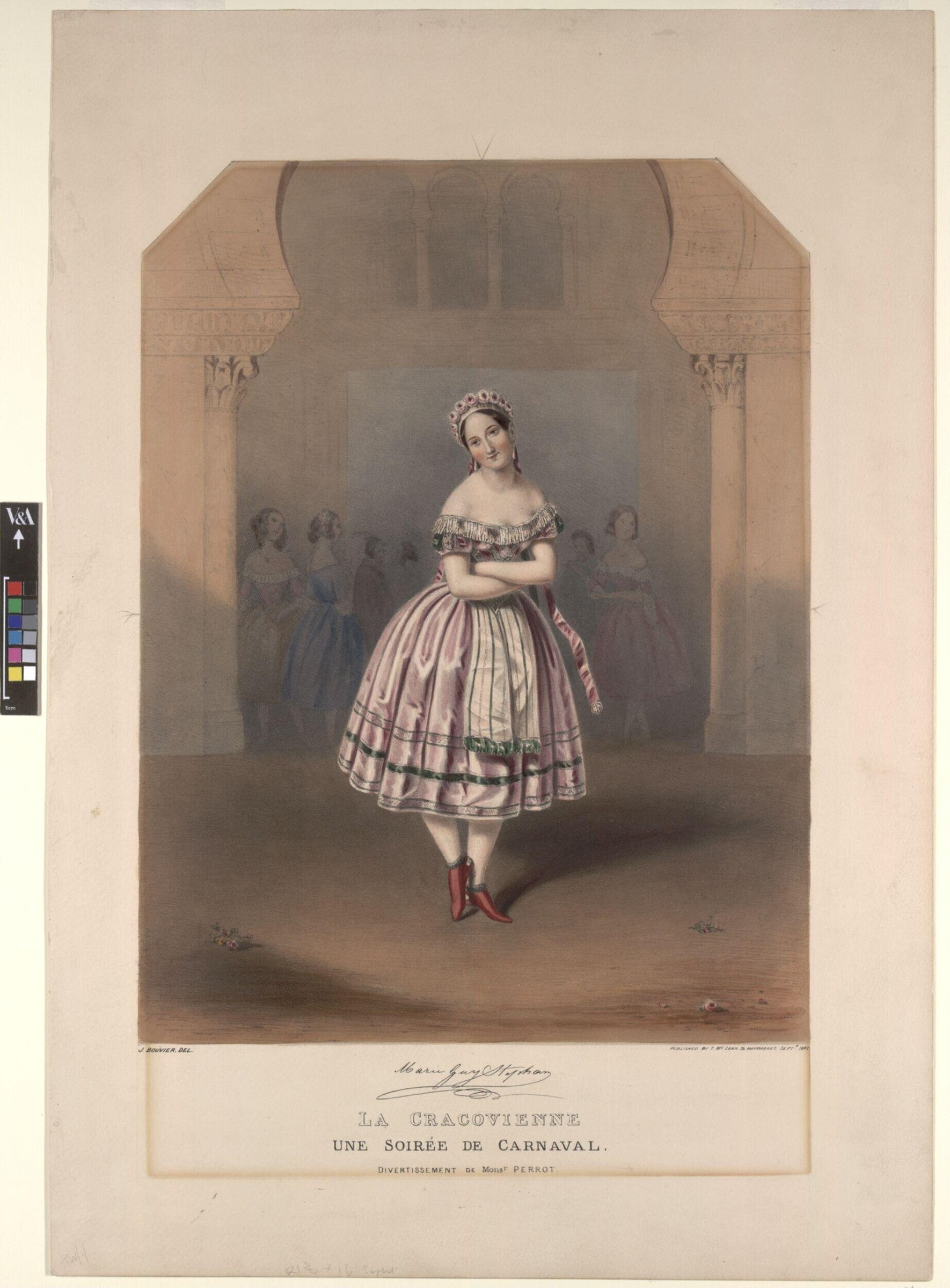
Marie Guy Stephan dancing La Cracovienne in Une Soireé de Carnaval
Bouvier, Jules
- Dance:
- Folk/Country
- Era:
- Mid 1800s (Polka Era)
- Source:
- Victoria and Albert Museum
- Rights:
- Rights vary by item — check the source record before reusing this image. Source record ↗
- Recorded as:
- Check V&A creditLine
The cracovienne was one of the major ballroom sensations of the 1830s–1840s, and this image is a primary document of how it was actually performed and consumed by European audiences—not as an ethnographic curiosity but as a fashionable entertainment for the urban middle class. For historians of dance and material culture, this lithograph reveals the mechanics of celebrity performance and commercial image-production in the early 19th century, and the process by which foreign folk dances became domestic ballroom fashion.
What you are looking at
A young woman in an elaborate pale pink ball gown stands center stage in what appears to be a grand interior with classical columns and a coffered vault visible in the background. She wears a jeweled tiara and off-shoulder dress with horizontal decorative bands and a deep flounce at the hem; her posture is upright and poised, one arm at her side, the other relaxed across her body. Behind her, rendered in softer focus, several other figures in formal dress occupy the shadowed space—attendants or observers. The lighting is theatrical, drawing the eye to the solitary dancer in the foreground while the architectural setting recedes into warm, neutral tones. This is a portrait of performance: the woman is captured between stillness and motion, her weight settled but her bearing alert.
The dancing
The primary figure stands in a relaxed upright stance with weight evenly distributed, arms held low and naturalistic rather than extended in the dramatic frames of classical ballet. Her shoulders are level and open; her head is held high but without the rigid carriage of formal court dance. The off-shoulder neckline and the cut of the gown allow full visibility of the arms and upper body. There is no partner; she is isolated in the space and framed as a soloist. The attendant figures in the background are too indistinct to assess in detail, but none engage with the primary dancer.
The dance depicted
The title identifies this as La Cracovienne, a Polish folk dance that became fashionable in European ballrooms during the 1830s–1840s. The cracovienne (or krakowiak) is a fast, energetic couple dance with a characteristic rhythm and syncopated steps, typically performed at celebrations and festivals. This image captures the dancer—identified as Marie Guy Stephan—in a moment of performance at a carnival ball (*Une Soirée de Carnaval*). The costume and staging indicate a theatrical or ballroom social context rather than authentic folk performance; this is the cracovienne as it was adopted and performed by European dancers of the era, often in fashionable indoor venues rather than in Poland itself. The moment chosen is one of display and composure rather than active footwork.
How it was made
This is a hand-colored lithograph, a medium that dominated popular theatrical and dance imagery in the 1840s. Lithography allowed for relatively rapid production of multiple impressions and wide circulation among middle-class audiences interested in theatrical novelties and fashionable entertainments. The artist has used lithographic stone to establish the architectural setting and the main figure, then applied color by hand—visible in the careful gradation of the pink gown, the jewel tones of the tiara, and the warm architectural tones. The technique permits both the precision of line in the architectural detail and the softer, atmospheric rendering of the background figures. This was a commercial object, produced for sale to theater-goers and dance enthusiasts.
About this work
This is a commemorative portrait of a specific performance: the dancer Marie Guy Stephan performing the cracovienne, a Polish couple-dance that swept through European ballrooms in the 1830s and 1840s. It is a hand-colored lithograph, a mass-produced theatrical souvenir from the height of the cracovienne's fashionable popularity. The work documents not the dance's folk origins but its transformation into a vehicle for virtuoso female performers in formal ballroom and theatrical settings. The composition—a solitary woman in an elaborate gown, framed by classical architecture and attended by unseen observers—treats the dance as an act of display and social performance rather than a couple-dance activity. It belongs to the visual culture of 19th-century ballroom fashion and the celebrity of individual dancers.
How to look at it
Attend to the deliberate stillness of the pose: this is not mid-motion but a moment of presentational poise, the dancer ready to perform rather than captured in action. The architectural setting—classical columns and coffered ceiling—elevates the cracovienne from a folk dance into a high-art context. The elaborate gown, jeweled tiara, and refined bearing of the soloist suggest that this is not documentary of folk practice but a stylized, Europeanized version shaped for theatrical and ballroom consumption. Notice also the absence of a partner: the cracovienne was traditionally a couple-dance, but here it is presented as a solo female display, a formal difference that reflects the prominence of female celebrity dancers in this era.
The artist
Jules Bouvier was a French lithographic artist active in the mid-19th century, specializing in theatrical and ballroom imagery. His work circulated widely as commercial prints and souvenirs, and he frequently documented dancers and dramatic moments from contemporary performance culture. The credit line 'Divertissement de Mme PERROT' suggests that this image may have been associated with or dedicated to a known performer or impresario of the era. Bouvier's practice is typical of the commercial lithographic studios that supplied the demand for dance and theater imagery among fashionable urban audiences.
The period
The 1840s were a period of intense enthusiasm for national dances and exotic rhythms in European ballrooms. The cracovienne's rise coincided with a broader vogue for Polish and Eastern European cultural material (partly driven by political interest in Polish independence). Simultaneously, Romantic ballet—with its emphasis on female soloists, ethereal movement, and spectacular costume—was at its height. The cracovienne occupied an interesting space between ballroom social dance and theatrical spectacle; it could be performed as a couple-dance by amateurs in private balls, but it was also a vehicle for professional dancers like Stephan to display technical skill and fashionable costume. The lithographic medium made such performance images accessible to a wide audience, creating a feedback loop between theatrical innovation and ballroom fashion.
Where it lives
The image is held at the Victoria and Albert Museum, one of the major institutional repositories of 19th-century theatrical and dance imagery. The V&A's collection of lithographed dance souvenirs and performance portraits is extensive and reflects the museum's historical focus on design, ornament, and material culture. This work is typical of the commercial theatrical prints that filled that collection.
Dance in this work
Questions about this work
What is the cracovienne and why was it popular?
The cracovienne is a fast, rhythmic Polish couple-dance that became a fashionable ballroom craze in Europe during the 1830s–1840s. Its appeal lay in its energetic character, distinctive syncopated rhythm, and association with Polish national identity (a politically charged topic at the time). It was performed at formal balls and in theatrical settings, often by celebrated dancers like Marie Guy Stephan, and could be learned and performed by amateurs as well.
Why is the dancer alone, if the cracovienne is a couple-dance?
This is a theatrical or promotional image, not a documentation of how the dance was ordinarily performed. By isolating the female dancer, the lithograph emphasizes her as a performer and celebrity, and frames the dance as a vehicle for individual virtuosity and fashionable spectacle. In ballrooms, the cracovienne would have been danced in couples, but for commercial prints and theatrical souvenirs, the solo female form was more marketable.
What does the lithographic medium tell us about this image's audience?
Lithography allowed for relatively quick, inexpensive production of multiple impressions in color, making this a mass-market object. It was affordable to middle-class theater-goers and ballroom enthusiasts, and likely sold as a souvenir after performances. This differs from unique paintings or sculptures; lithographs were designed to circulate widely and to reinforce fashionable trends and celebrity culture.
Who was Marie Guy Stephan?
The record identifies her as the dancer in this performance, but detailed biographical information is not readily available. She was clearly a celebrated enough performer to warrant a commercial lithographic souvenir, suggesting she was known to contemporary ballroom and theater audiences, but her broader career and biography would require archival research.
More Folk/Country artwork