49 works in this view — arrow keys or swipe to move between them.
Dance in Art
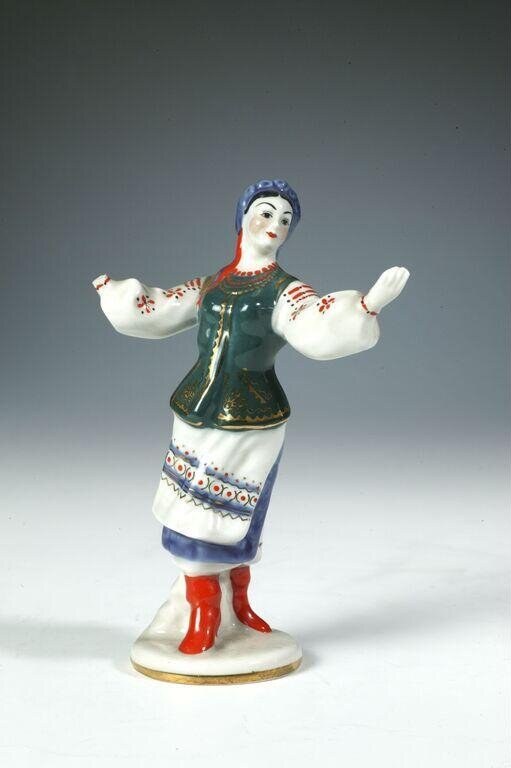
Dancing Ukrainian
Tregubova, Valentina
- Dance:
- Folk/Country
- Era:
- 1950-1980 (Rock & Roll / Disco)
- Source:
- Victoria and Albert Museum
- Rights:
- Rights vary by item — check the source record before reusing this image. Source record ↗
- Recorded as:
- Check V&A creditLine
This figurine documents how Ukrainian and Eastern European folk dance was visualized, standardized, and circulated as a symbol of Soviet cultural identity in the mid-twentieth century. For historians of dance and material culture, it reveals how movement traditions were translated into static, portable objects and what details (the vivid red boots, the raised arms, the smile) Soviet makers chose to emphasize when condensing a living tradition into porcelain.
What you are looking at
A porcelain figurine depicts a single dancer in Eastern European folk costume, captured in a moment of exuberant movement. The figure stands on a circular base, arms raised and extended outward in a celebratory gesture, body angled slightly forward with evident dynamism. She wears a dark green jacket with gold embroidery and trim over a white blouse with red embroidered details at the cuffs. A white apron or overskirt falls from the waist, decorated with blue patterning and red ornamental bands. Her legs are bare, and she wears bright red boots—the most striking color accent in the composition. A blue headscarf or kokoshnik crowns her head, and her face is rendered with characteristic porcelain delicacy, painted with defined features and a slight smile. The figurine appears to be fine domestic porcelain, hand-painted and finished with gilding on the base.
The dancing
The single dancer is depicted mid-leap or in an elevated moment, both arms raised symmetrically at shoulder height with elbows bent, palms open in a gesture of joy or celebration. The torso is upright but animated, and the positioning of the legs suggests the moment has been caught between beats—dynamic rather than static. The extended arms and open hand position convey the expansive joy characteristic of celebratory folk dance, while the forward tilt of the body and the evidence of rising movement (the floating quality achieved through the sculptor's modeling) suggest vigorous, unbounded movement rather than contained or formal technique.
The dance depicted
This is a Ukrainian folk dancer, as the title and costume make clear. The dress—the embroidered jacket, the kokoshnik headdress, the red boots, and the decorated apron—are consistent with Ukrainian traditional dance costume, likely from a particular region or festive context. The raised-arm gesture and the sense of exuberant upward movement are characteristic of many Eastern European folk dances, including the hopak, which features high leaps and energetic arm work, though the specific gesture here could belong to several related traditions. The figurine documents not the dance itself but a moment of its spirit—the joy and physical freedom it embodied—rather than precise steps or a formal sequence.
How it was made
This is a glazed and hand-painted porcelain figurine, likely Russian or Eastern European manufacture (given the artist's name, Valentina Tregubova, was a Soviet ceramicist). The piece was modeled in three dimensions and painted with underglaze or overglaze enamels, with gilt detailing on the base. Porcelain figurines of this kind were produced in Soviet factories as domestic decorative objects and souvenirs, allowing folk dance to be disseminated into homes as a symbol of national or regional cultural pride. The technique permits fine modeling of fabric folds, facial features, and ornamental detail, but the inherent formality of the glazed surface and the static base inevitably distance the piece from actual movement, creating instead a kind of crystallized memory of motion.
About this work
This is a Soviet-era porcelain figurine documenting Ukrainian folk dance tradition through costume and gesture. Created in 1957 by the Soviet ceramicist Valentina Tregubova, it represents a popular genre of decorative domestic wares that brought folk performance into everyday space. The dancer is shown not in the midst of a specific step or pattern, but in a generalized moment of joyful, energetic movement—arms aloft, body rising—that captures the emotional and physical character of the tradition without claiming documentary precision.
The figurine belongs to a larger practice of Soviet-era cultural representation in ceramics and decorative arts, where folk traditions from across the Soviet republics were collected, standardized, and domesticated as symbols of Soviet multiculturalism and socialist cultural achievement. The piece sits between two audiences: as a souvenir or gift object circulating among domestic consumers, and as evidence of how dance traditions were mediated and understood in their own time.
How to look at it
Look first at the costume: the porcelain maker has rendered every significant detail—the embroidered jacket, the kokoshnik, the red boots—in full color and gilding, suggesting these elements are what matter for recognition and identity. Then attend to the body: the raised arms, the forward tilt, the implied upward momentum capture a moment between stillness and motion, a gesture that conveys exuberance without depicting a specific step. The sculptor has chosen a moment of expansive joy rather than technical display, which reflects what Soviet folk culture prioritized—the emotional authenticity and celebratory spirit of the tradition rather than its formal choreographic content.
The artist
Valentina Tregubova was a Soviet ceramicist active in the mid-twentieth century, working in a period when Soviet factories and state-sponsored artisans produced large quantities of decorative porcelain figurines celebrating folk traditions, revolutionary heroes, and Soviet achievement. Her work is consistent with the output of Soviet ceramic studios in the 1950s, when folk dance figurines were a popular category of domestic decoration and export goods. The piece reflects the broader Soviet practice of codifying and celebrating regional folk cultures as expressions of socialist multiculturalism.
The period
In 1957, the Soviet Union was in the post-Stalinist thaw, a period of renewed interest in national and folk cultures as expressions of Soviet identity. Folk dance ensembles were celebrated as expressions of socialist culture, and figurines like this one brought those ensembles into domestic space as affordable souvenirs and decorative objects. In the wider history of porcelain figurines, the piece belongs to a long tradition of using ceramics to document and idealize dance and festive life, but it is distinctly Soviet in its codification of the costume and its presentation of joy as a state-sanctioned cultural value.
Where it lives
The work is held in the Victoria and Albert Museum collection and is catalogued as part of their ceramic and decorative arts holdings. It is identified in the catalogue record as Soviet-era manufacture, likely produced as a domestic decorative object or souvenir during the 1950s.
Dance in this work
Questions about this work
What dance is this?
The costume and title identify this as a Ukrainian folk dancer, but the figurine does not depict a specific named dance or step sequence. Instead, it captures a generalized moment of energetic, joyful movement characteristic of Ukrainian folk tradition—arms raised, body in upward motion—that could belong to several related dances including the hopak.
Who was Valentina Tregubova?
Tregubova was a Soviet ceramicist working in the mid-twentieth century, active during a period when Soviet state factories produced large quantities of porcelain figurines celebrating folk traditions and national cultures. Her work is consistent with official Soviet decorative arts practice of the 1950s.
Why are the boots so red?
The vivid red boots are a signature element of Ukrainian folk costume and are one of the most visually striking details in the figurine. The maker has rendered them in bold color to ensure immediate recognition and visual impact, making the dancer's nationality and tradition instantly legible to the viewer.
Is this a toy or a decorative object?
This is a decorative figurine intended for display in domestic space, part of a broader Soviet practice of bringing folk culture into homes as portable, affordable objects. It was likely sold as a souvenir or gift, not as a toy for children, though the boundary between these categories in Soviet mass production was often blurred.
More Folk/Country artwork