35 works in this view — arrow keys or swipe to move between them.
Dance in Art
The Dancing Lesson, The Sailors Hornpipe
Cruikshank, George
- Dance:
- Ballroom
- Era:
- Mid 1800s (Polka Era)
- Source:
- Victoria and Albert Museum
- Rights:
- Rights vary by item — check the source record before reusing this image. Source record ↗
- Recorded as:
- Check V&A creditLine
The image documents the material practice of 19th-century dance instruction and the social status of the hornpipe at a moment when it was being codified and taught formally. For historians of dance pedagogy, it shows the role of the master demonstrator and the emphasis on imitation and held positions. For students of Cruikshank's work, it exemplifies his use of exaggerated physicality to comment on social conventions and bodily discipline.
What you are looking at
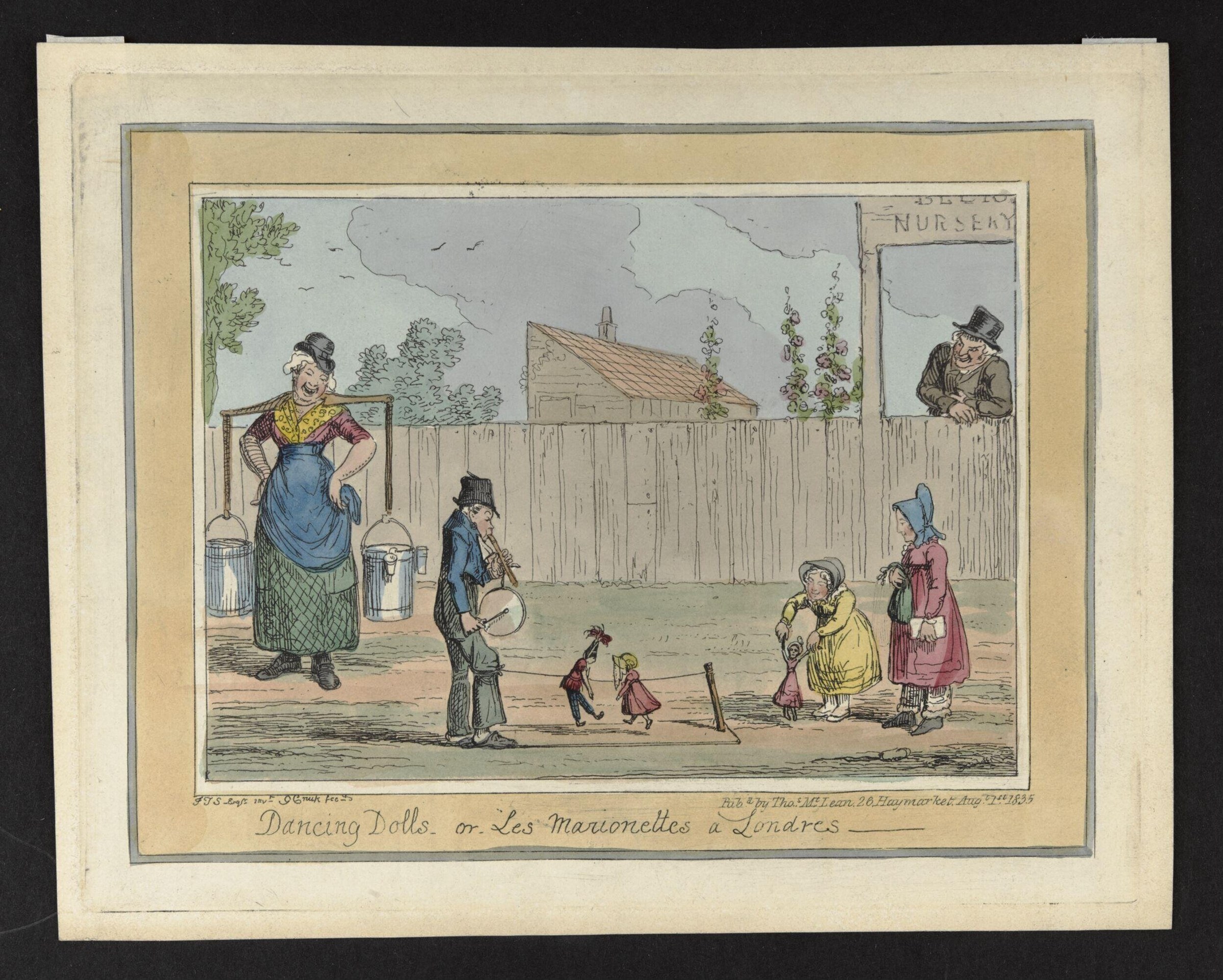
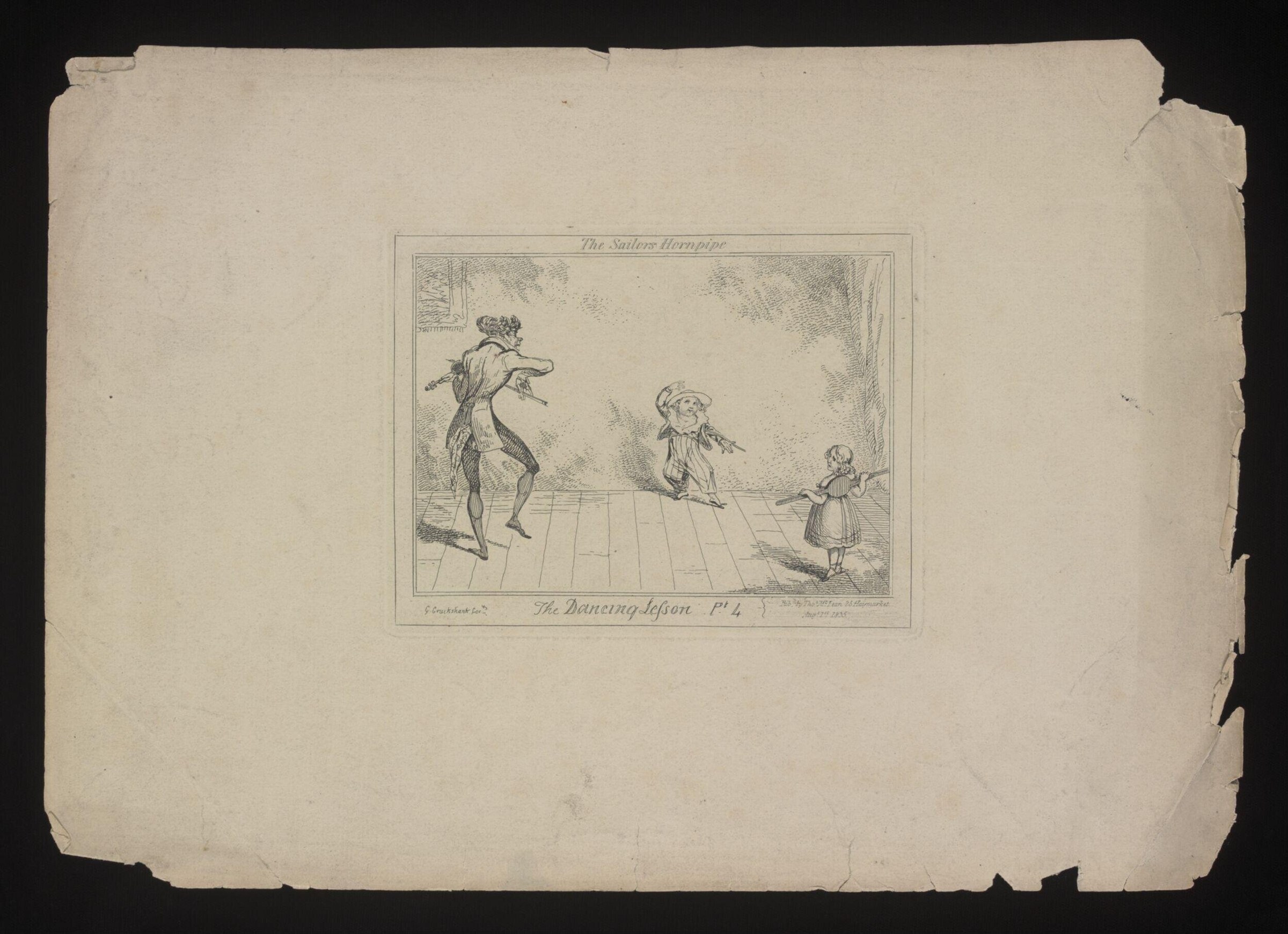
A satirical engraving depicting an instructor teaching dance to two young pupils in an interior space. The master, a thin man in fashionable dress, stands on the left with one leg raised high and arms spread in an exaggerated pose, demonstrating a step. A young boy in the center attempts to mirror the pose with similar energy, while a small girl on the right watches or waits her turn. The floor is rendered with perspective lines suggesting a wooden dance floor or studio. The composition is tight and focused, with cross-hatching used to create shadow and depth, particularly in the background drapery. The scene captures a moment of instruction, with the master's theatrical posture suggesting both the absurdity of learning and the formality of the period's dancing manuals.
The dancing
The master demonstrates an elevated leg position with torso upright and arms raised or extended, suggesting a step from a formal dance vocabulary. The boy imitates this posture closely, indicating instruction-by-imitation. The girl stands more passively, positioned lower in the frame. All three figures are upright and formally composed rather than in organic movement; the poses are held rather than captured mid-flow, which is typical of didactic or satirical treatment. The spatial relationship—instructor center-left, pupils spaced around—follows the composition of a dance lesson scene.
The dance depicted
The title identifies this as instruction in the hornpipe, a sailor's dance. The hornpipe was a popular English social dance in the 18th and 19th centuries, performed both as a solo entertainment and in ballroom settings, and often associated with maritime culture. The elevated leg position and formal stance shown here align with the hornpipe's characteristic lifted, energetic footwork. However, the satirical intent and exaggerated poses suggest Cruikshank may be mocking both the dance itself and the formality of period dancing instruction. The scene documents how such dances were taught in domestic or studio settings, with the master as demonstrator and arbiter of correct form.
How it was made
This is an engraving, identifiable from the fine parallel lines (hatching and cross-hatching) used to build tone and shadow, the crisp linear definition of forms, and the overall monochromatic appearance. The technique allowed for precise representation of costume detail and facial expression while supporting the satirical exaggeration of gesture. Engravings were a primary medium for social and political satire in 19th-century Britain, affordable to reproduce and distribute, making them accessible to middle-class audiences. This work's small scale and refined detail suggest it was intended for a bound series or periodical.
About this work
This engraving records a moment of dance instruction in the Georgian or early Victorian period, capturing the teaching of the hornpipe—a vigorous sailor's dance that was a staple of English ballroom and popular culture. Cruikshank, known for his satirical social commentary, uses the formal poses and exaggerated gestures of the instructor to both document the period's approach to dance pedagogy and gently mock its rigid formality. The scene sits at the intersection of social history and artistic satire, offering evidence of how dances were learned and transmitted, who taught them, and how the period viewed the body in motion and discipline.
How to look at it
The viewer should note the contrast between the master's deliberate, exaggerated posture—meant to demonstrate—and the pupils' earnest attempts to replicate it. The elevated leg and extended arms are held as a position to be studied, not as a moment within flowing movement. The spatial arrangement and the instruction-by-imitation format reveal the period's pedagogical assumption that dance was learned through observation and repetition. The satirical edge lies in the formality and rigidity of the pose; Cruikshank invites us to see both the absurdity of such formal instruction and its actual place in fashionable society.
The artist
George Cruikshank (1792–1878) was a prolific English satirical artist, printmaker, and illustrator, celebrated for his sharp social commentary on politics, manners, and morality. Working primarily in engraving and etching, he created hundreds of satirical prints documenting early 19th-century British life. His work was widely distributed and collected, influencing the development of comic illustration and caricature. Cruikshank frequently depicted scenes of instruction, folly, and social aspiration, and his treatment of dance and popular entertainments combined observational accuracy with exaggeration for comic and critical effect.
The period
The early 19th century saw a codification and formalization of social dance in Britain, driven by the rise of the ballroom and the influence of dance masters who published instruction manuals. The hornpipe, rooted in folk and maritime tradition, was being absorbed into fashionable social dance alongside waltzes, quadrilles, and country dances. Simultaneously, satire and caricature flourished as art forms in the Georgian and Regency periods, with prints serving as a primary medium for social criticism. Cruikshank was working at the height of this satirical tradition, documenting social life even as he mocked it.
Where it lives
The work is held in the Victoria and Albert Museum collection, a major repository of 19th-century British prints and decorative arts. The record indicates the source as 'va' (Victoria and Albert). As a satirical engraving from Cruikshank's practice, it was likely issued as a single print or as part of a published series of social satires.
Dance in this work
Questions about this work
What is a hornpipe?
The hornpipe is an English dance with roots in maritime and folk tradition, performed as both a solo showcase and a social ballroom dance. It is characterized by lively, lifted footwork and upright posture. The name derives from the musical instrument that often accompanied it. By the 19th century it had been formalized into a dance taught and performed in polite society, though its popular and sailor associations remained.
Why is this image satirical?
Cruikshank exaggerates the master's pose to an absurd degree—the stretched leg and spread arms are more extreme than practical instruction would require—mocking both the formality of period dance pedagogy and the pretension of aspiring dancers. The scene invites us to laugh at the earnest rigidity of social dance training, a common target of Cruikshank's satire on manners and social climbing.
How do we know this is an engraving?
The technique is visible in the fine parallel lines (cross-hatching) used to build shadow and tone, the crisp linear edges, and the monochromatic appearance. These are hallmarks of the engraving process, in which an image is cut into a metal plate and then inked for printing. Engravings allowed for fine detail and precision, ideal for Cruikshank's work.
Who would have seen this print?
Cruikshank's satirical prints were widely distributed and affordable, reaching middle-class audiences in Britain. They were purchased individually, bound into collections, or published in periodicals. This image would have circulated among educated, literate audiences familiar with current social commentary and fashionable dancing.
More Ballroom artwork