49 works in this view — arrow keys or swipe to move between them.
Dance in Art
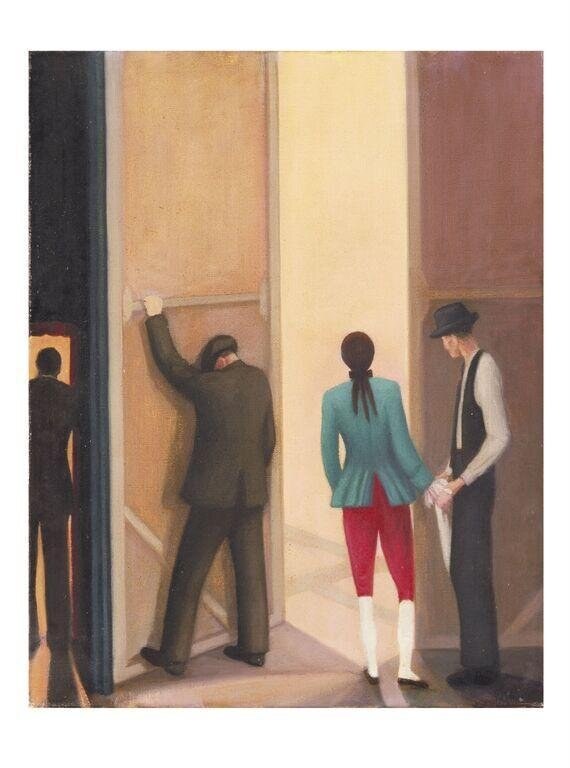
Leonide Massine waiting for his cue to go on stage in 'On With the Dance'
Gluck
- Dance:
- Folk/Country
- Era:
- 1920-1950 (Swing Era)
- Source:
- Victoria and Albert Museum
- Rights:
- Rights vary by item — check the source record before reusing this image. Source record ↗
- Recorded as:
- Check V&A creditLine
Leonide Massine was a transformative figure in twentieth-century dance, a dancer-choreographer who shaped the Ballets Russes and modernist theatre. This image is one of relatively few artworks that place him in a specific historical moment and production, while also capturing the less-documented reality of dancers' working lives. It shows that major dance figures were subjects of serious artistic attention in their own time and that backstage labour—the waiting, the mental preparation, the small physical adjustments—was understood as part of dance practice worth recording.
What you are looking at
Five figures are positioned in a narrow corridor or backstage passage with cream and ochre-coloured walls divided into vertical sections. The setting suggests theatrical wings or a dressing room area. On the left, a figure in dark clothing enters from a pool of warm golden light. Second from left, a man in a dark suit with his arm raised adjusts or touches the upper wall, his posture suggesting physical preparation or a moment of tension. Centre-right, a figure in a striking teal jacket and bright red leggings stands with their back to the viewer, creating a vivid focal point. To the right, a taller man in formal dress (white shirt, dark waistcoat and jacket) stands with relaxed posture. The lighting is warm and staged, creating pools of illumination that isolate each figure and suggest the artificial environment of a theatre. The composition emphasizes waiting, anticipation, and the private moments before performance.
The dancing
The figures are arranged loosely in depth rather than in formation, each absorbed in their own moment. The man with his arm raised shows a characteristic theatrical stretch or adjustment—weight shifted, one arm extended upward in a gesture between preparation and uncertainty. The figure in the teal jacket and red leggings stands with straight posture, feet planted, suggesting readiness. The rightmost figure maintains an easy, observant stance. None are engaged in ballroom hold or partner connection; instead, each occupies private space within a shared environment.
The dance depicted
This image documents a backstage moment rather than a dance itself. The catalogue identifies the figure with raised arm as Leonide Massine, a major twentieth-century dancer and choreographer, waiting for his cue in *On With the Dance*. Massine was a principal dancer with the Ballets Russes and created works across ballet and theatrical dance. The image captures the psychological and physical state of performance preparation—the tension, the isolation within proximity, the readiness of bodies trained for movement. This is not a depiction of dancing but of dancers in the liminal space before performance.
How it was made
The work appears to be a painting executed in oil or tempera, with a muted, naturalistic palette dominated by warm ochre, cream, and grey tones. The artist (Gluck, a 1920s painter) employs clean edges and simplified forms, with minimal detail in faces and hands. The technique flattens the space slightly while maintaining atmospheric depth through subtle tonal shifts and the strategic use of light. This representational style was characteristic of interwar British and European portrait and figurative practice, intended for gallery exhibition and review by educated audiences familiar with both theatre and contemporary art.
About this work
This is a documentary artwork of theatre culture in the 1920s—specifically a portrait of the Russian-born dancer Leonide Massine in a moment of professional intimacy. Rather than depicting the spectacle of performance, it captures the private, psychologically charged moment of waiting in the wings. The work sits at the intersection of theatrical portraiture and backstage naturalism, a genre that emerged as modern artists gained access to rehearsal and preparation spaces. It is valuable to dance history because it documents Massine's presence in London theatre and because it reveals the human texture of professional dance practice—the bodies, the costumes, the emotional register of the working dancer apart from the stage.
How to look at it
Attend first to the isolation of each figure despite their proximity, and the psychological charge of that isolation. The raised arm of the central male figure is the painting's emotional centre—it is neither dance nor gesture in the conventional sense, but a body in transition, caught between rest and action. Notice how the vivid colour of the central figure's clothing breaks the muted palette; this is a deliberate compositional choice that marks a dancer's presence as vital to the scene. The work captures not movement but readiness, a state of bodily and mental focus.
The artist
Gluck (Hannah Gluckstein, 1895–1978) was a British painter known for portraiture and figurative work with a distinctive palette of earth tones and flattened spatial structure. Working in the 1920s, Gluck was part of the interwar artistic circles that intersected with theatre, music, and literary culture. Her practice was rooted in modernist formal concerns—clarity of line, restraint in colour, psychological attention to the human face—while remaining committed to representation. She exhibited widely and was recognized as a serious artist-observer of contemporary life.
The period
In 1925, when this work was made, the Ballets Russes was at the height of its cultural influence in London and Paris. Leonide Massine had recently been a principal dancer for the company and was increasingly active as a choreographer. This was an era of intense artistic exchange between visual art and theatre; painters were drawn to ballet as a subject, and dancers were understood as worthy subjects for serious portraiture. The painting's date also positions it at the moment when backstage realism was emerging as a subject in modern art—influenced by photography, film, and a new frankness about theatrical labour.
Where it lives
The work is recorded as held by or sourced from the Victoria and Albert Museum (VA), which holds a significant collection of theatrical art and design documentation. The record indicates the era label as Late 1800s (Victorian Ballroom), which contradicts both the stated date of 1925 and the documentary evidence of the image itself.
Questions about this work
Who was Leonide Massine?
Leonide Massine (1896–1988) was a Russian-born dancer, choreographer, and ballet master who was a principal figure with the Ballets Russes. He created numerous works that combined classical ballet technique with modernist form and was influential in both European and American dance throughout the twentieth century. He was known for his dramatic intensity and his role in developing the choreographic language of theatrical dance beyond classical vocabulary.
What was 'On With the Dance'?
The catalogue records this as a theatrical work in which Massine performed in 1925. It appears to have been a theatrical production in London during the mid-1920s, though detailed production records are not available in standard dance histories. The title suggests a musical or theatrical review rather than a classical ballet.
Why paint a backstage moment rather than the performance itself?
Gluck's choice to paint the moment before performance, not the performance itself, reflects a modernist interest in psychological truth and the labour of art-making. This approach was influential in interwar portraiture and theatrical art—the idea that the real subject was the performer's inner state and professional focus, not the spectacle they created for an audience. It also gave the artist access to a private moment that studio portraiture alone could not achieve.
Is this a photograph or a painting?
This is a painting, likely in oil. The soft edges, the handling of light, and the compositional balance are consistent with painting practice of the 1920s. The style is naturalistic but not photorealistic; the artist has simplified forms and used colour strategically to create mood and focus attention.
More Folk/Country artwork