45 works in this view — arrow keys or swipe to move between them.
Dance in Art
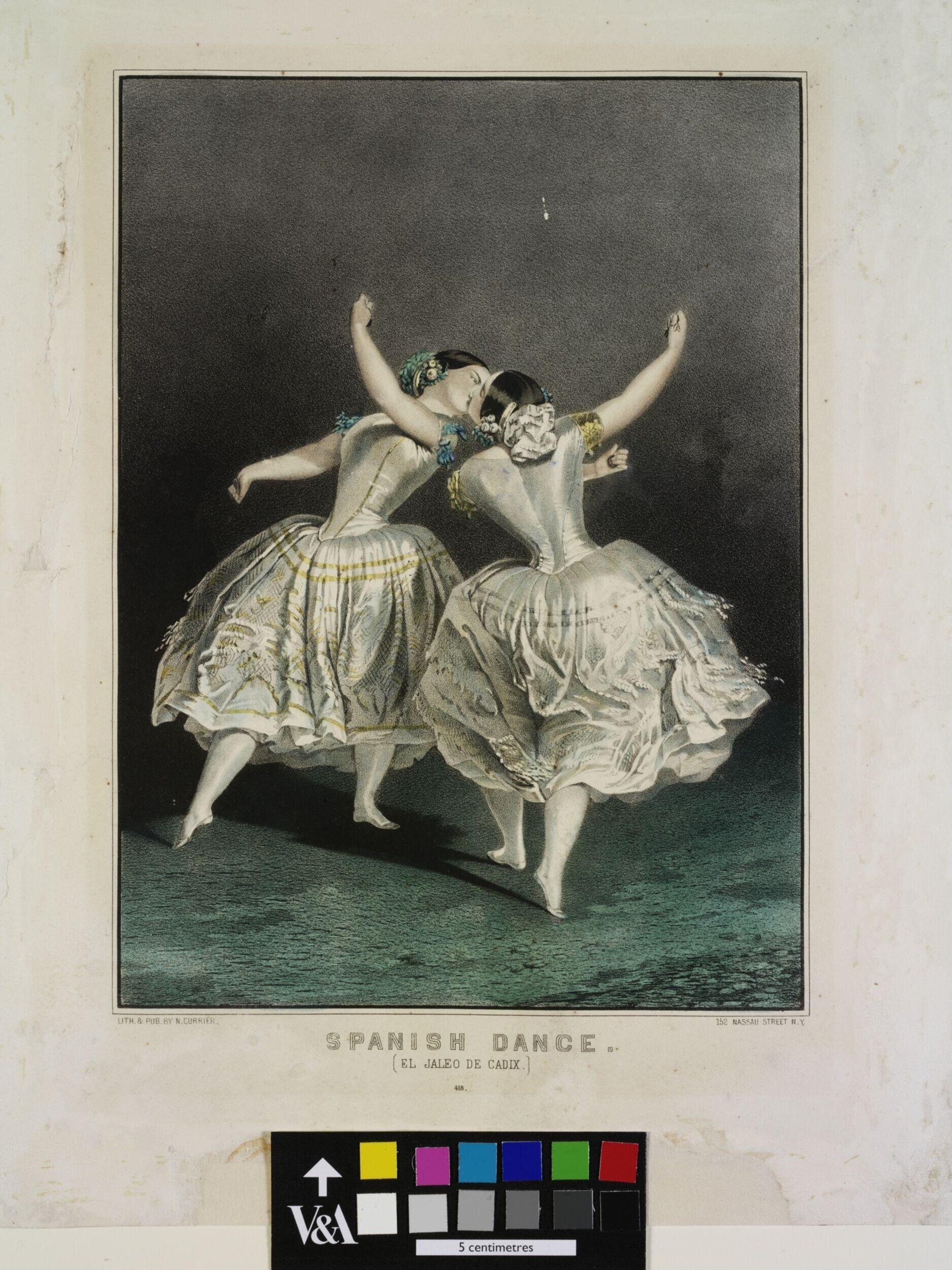
Spanish Dance. (El Jaleo de Cadix.) (sic)
Currier, N.
- Dance:
- Folk/Country
- Source:
- Victoria and Albert Museum
- Rights:
- Rights vary by item — check the source record before reusing this image. Source record ↗
- Recorded as:
- Check V&A creditLine
This print shows how European and global dance traditions were packaged and distributed to American audiences through mass-produced imagery, often emphasizing spectacle and exoticism over accuracy. The work is a primary document of 19th-century American visual culture and the circulation of dance imagery beyond the theater.
What you are looking at
Two female dancers in mid-leap face each other against a dark background, their bodies in near-mirror symmetry. Both wear voluminous light-colored skirts with decorative borders and darker bodices, their pale arms raised high. The dancer on the left wears what appears to be a head covering or ornament; the one on the right's face is obscured as she turns her head. Their skirts billow and swirl around them, caught in the moment of dynamic movement. The floor beneath them is rendered in greenish tones. The composition emphasizes vertical lift and energy, with both dancers appearing weightless and suspended.
The dancing
Both dancers are in mid-air with legs bent and extended, arms raised symmetrically above shoulder height in a celebratory or ecstatic gesture. Their bodies face each other across the vertical center line of the image, creating a mirror-like composition. The dancers' weight appears distributed between extended and bent legs, suggesting vigorous, explosive movement. Their raised arms and lifted posture convey exuberance and abandon rather than formal technique.
The dance depicted
This is titled as a Spanish dance, specifically 'El Jaleo de Cadiz,' a traditional Spanish dance associated with Cádiz in Andalusia. The composition and energy suggest a folk celebration rather than formalized theatrical dance. The dancers' gestural vocabulary—raised arms, dynamic leaping, abandonment of constraint—is consistent with Spanish regional dance traditions, though the stylized, symmetrical composition is more a product of the printmaker's aesthetic than documentary evidence of the actual dance form. The title references a specific regional tradition, but the visual treatment romanticizes and theatricalizes it.
How it was made
This is a hand-colored engraving or aquatint, a reproductive print medium that allowed wide circulation of dance imagery. The technique required careful line work to define the figures and their drapery, followed by selective hand-coloring to add vibrancy—note the subtle modeling of flesh tones, the detailed patterning on the skirts, and the atmospheric dark background. The signature line at the bottom reads 'Lith & Pub by N Currier' on the left and '152 Nassau Street N.Y.' on the right, identifying this as a Currier print (likely Nathaniel Currier, before the Currier & Ives partnership). This was popular commercial art for a mass audience.
About this work
This hand-colored Currier print depicts two female dancers in the Spanish regional tradition, captured mid-leap in symmetrical composition against a dark ground. The printmaking technique—engraving with hand-coloring—was the standard method for producing affordable, widely distributed dance imagery in mid-19th-century America. The work presents Spanish folk dance as exotic spectacle, theatricalized through formal composition and the conventions of fine-art printmaking. Currier & Ives prints were ubiquitous in American homes and businesses, making this the kind of dance image most people would have encountered, even if they never saw the dance live.
How to look at it
Notice the moment the printmaker chose: the peak of the leap, when the dancers are most weightless and the skirts most dramatically swirling. The symmetrical composition is not accidental—it reflects 19th-century aesthetic principles of harmony and balance, not the unstructured energy of actual folk dance. Observe how the hand-coloring differentiates the dancers' ornaments and bodices from the pale, billowing skirts, drawing attention to the visual spectacle of movement and fabric. The dark background throws the figures forward and emphasizes the dynamic contrast of their raised, energetic bodies.
The artist
Nathaniel Currier (1813–1888) was a pioneering American printmaker and publisher who established his firm in New York in 1834. His prints ranged from popular scenes of daily life, patriotic subjects, disasters, and entertainment—including theater and dance scenes—to sentimental and comic subjects. Currier's business model emphasized affordability and rapid production to reach a broad middle-class market. His partnership with James Merritt Ives, formed in 1857, became the famous Currier & Ives firm; this print predates that partnership and carries only Currier's name.
The period
The mid-19th century saw explosive growth in the circulation of theatrical and exotic imagery through mass-produced prints. Dance was a popular subject—from ballet at the opera house to folk traditions of colonized and 'foreign' lands. Spanish dance, in particular, enjoyed vogue in European and American culture during this period, often presented through a lens of Romanticism that emphasized passion, abandon, and otherness. This print belongs to a moment when commercial printmaking was democratizing access to cultural imagery, even as that imagery frequently exoticized and simplified the traditions it depicted.
Where it lives
The work is held in the Victoria and Albert Museum collection. The museum's label at the bottom indicates it is a Currier print from New York, confirming its status as a commercial product intended for mass distribution.
Dance in this work
Questions about this work
What is 'El Jaleo de Cadiz'?
Jaleo refers to a festive, energetic Spanish celebration or revelry; 'El Jaleo de Cadiz' specifically refers to the lively traditions of Cádiz in Andalusia. However, this print takes considerable artistic liberty with the actual form. The symmetrical, theatrical composition tells us more about 19th-century printmaking aesthetics than about the historical dance itself.
Who was Nathaniel Currier?
Currier was a pioneering American printmaker whose firm produced thousands of affordable hand-colored prints for the mass market. He specialized in accessible, topical imagery—from disaster scenes to entertainment. Before his 1857 partnership with James Merritt Ives (which created the famous Currier & Ives brand), he ran a successful independent business producing prints like this one.
How were these prints made and sold?
Prints were engraved or lithographed, then hand-colored by teams of workers (often women), making them relatively inexpensive compared to original paintings. They were sold individually or in series through print shops, newspapers, and peddlers, reaching into homes and businesses across America. They were the mass media of their era.
Why are the two dancers posed identically?
The mirror-image symmetry reflects 19th-century aesthetic ideals of balance and harmony, not the actual structure of Spanish folk dance. It transforms a regional tradition into a formalized, theatrical composition, emphasizing visual spectacle and symmetry over documentary accuracy.
More Folk/Country artwork