44 works in this view — arrow keys or swipe to move between them.
Dance in Art
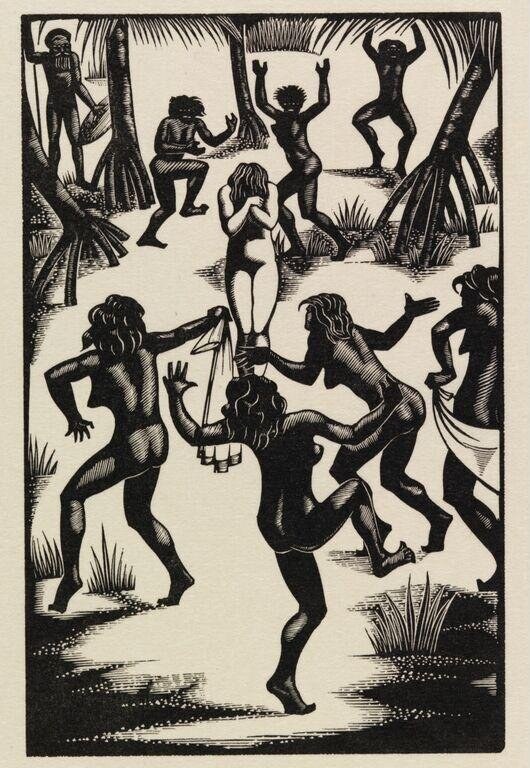
Sacrificial Dance
Robert Gibbings
- Dance:
- Folk/Country
- Era:
- 1920-1950 (Swing Era)
- Source:
- Victoria and Albert Museum
- Rights:
- Rights vary by item — check the source record before reusing this image. Source record ↗
- Recorded as:
- Check V&A creditLine
This work matters because it demonstrates how early 20th-century European artists used dance—especially non-Western sacred dance—as a vehicle for formal experiment and claims about authenticity and the primitive. For dance historians, it is a record of how dance was visualized, mythologized, and appropriated in high modernism. For critical viewers, it exemplifies the visual politics of primitivism: the work's formal power is inseparable from its problematic framing of African bodies and ritual as objects of aesthetic consumption.
What you are looking at
A woodcut depicts a ceremonial or ritualistic gathering in a dense tropical or jungle setting, with large palm trees framing the composition. Multiple nude or lightly dressed figures, rendered in silhouette, are arranged in dynamic poses throughout the scene. The central figure—a woman standing upright with raised arms—commands the composition, while others crouch, leap, and gesture around her. The ground is marked with sparse vegetation and dotted patterns suggesting sand or cleared earth. The figures' body language is vigorous and unselfconscious: some appear to be in mid-leap, others bend forward in postures of supplication or trance. The entire scene radiates movement and spiritual intensity, with the bold blacks of the woodcut medium creating stark, almost expressionistic forms against the white ground.
The dancing
The bodies display extreme freedom of movement across the frame, with no formal holds or ballroom positioning. Weight is distributed unevenly—some figures are airborne or caught mid-stride, others are grounded but actively twisting. Arms are held aloft, swept across the body, or extended in reaching gestures. The central woman's raised arms and upright stance create a focal point of control amid surrounding chaos. Approximately eight to ten figures populate the scene, moving independently rather than in couples or lines; they relate to one another through spatial proximity and apparent collective energy rather than partnered technique.
The dance depicted
The work depicts ceremonial or ritualistic dance rather than any European ballroom or theatrical form. The nudity, jungle setting, ecstatic body positions, and the apparent spiritual intensity suggest a non-Western sacred or fertility ritual. The raised-arm postures and leaping figures are consistent with documented Sub-Saharan or Pan-African ceremonial practices, though the work's primitivist aesthetic and the artist's perspective distance it from ethnographic documentation. Without identifying marks or inscription, the specific dance tradition cannot be determined with confidence, but the formal vocabulary points toward global-african sacred-ceremonial dance or a European artist's interpretation of it.
How it was made
This is a woodcut or wood engraving, identifiable by the bold line work, high-contrast blacks and whites, and the characteristic texture of carved wood blocks. The technique enforces simplification and expressive distortion—anatomical detail is sacrificed for gestural clarity and emotional impact. Woodcut was a deliberate choice for this subject: the medium's stark, graphic quality amplifies the sense of primal energy and removes the work from realistic representation toward something more symbolic. The technique allowed broad circulation through prints and positioned this as a work for educated viewers interested in modernist and primitivist aesthetics.
About this work
Robert Gibbings (1889–1958) was an Anglo-Irish sculptor, engraver, and writer known for travels in Africa and the Caribbean, which deeply informed his artistic practice. This woodcut, titled Sacrificial Dance and dated to 1937, represents a moment of high modernist engagement with non-Western ritual and the body. Gibbings worked in the tradition of European primitivism—a movement that looked to African, Pacific, and Indigenous art forms as sources of formal innovation and spiritual authenticity. His woodcuts, in particular, draw on both German Expressionism and a romantic vision of African ceremony. This work sits at the intersection of artistic modernism, ethnographic interest, and a colonial-era aesthetic that claimed authority over the representation of non-Western peoples.
How to look at it
Attend first to the central female figure and her command of the composition through verticality and raised arms, then trace how the surrounding figures echo and amplify her energy through their own gestures and leaps. Notice how the woodcut medium—with its absolute blacks and whites—creates visual intensity and eliminates the nuance of modeling or shading; this formal choice reinforces the sense of raw, unmediated power. The framing palms and ground markings situate this as 'elsewhere'—a space apart from European civilization. Ask yourself what the artist chose to emphasize: not static beauty or formal correctness, but movement, ecstasy, and collective energy.
The artist
Robert Gibbings (1889–1958) was a wood engraver, sculptor, and author whose creative practice was shaped by extensive travel in Africa (particularly West Africa and the Congo) and the Caribbean. He was trained at the Slade School and worked in London's avant-garde circles before turning increasingly to travel writing and graphic documentation of non-Western cultures. His engravings and woodcuts combine technical mastery with a romantic primitivism characteristic of his era; he sought in African and Caribbean life sources of vitality and spiritual depth he felt were absent from industrial Europe. His later work included illustrated travel books and nature writing. Gibbings represents a strand of early modernist practice in which formal innovation was pursued through the aestheticization of non-Western cultures.
The period
In the 1930s, primitivism was at its height as a modernist aesthetic movement. European artists and intellectuals, responding to the perceived sterility of rationalism and industrialization, idealized African, Pacific, and Indigenous art and ritual as sources of authenticity, spiritual power, and formal innovation. The decade also saw the rise of Surrealism, which similarly drew on non-Western sources and the languages of the unconscious. In dance, this era witnessed growing European interest in 'exotic' dance forms—both through ethnographic documentation and through primitivist choreography. However, this fascination was inseparable from colonial hierarchies: non-Western cultures were imagined as repositories of a lost or suppressed human nature rather than as complex, contemporary societies. Gibbings' work, made in 1937, reflects these contradictions at their height, just before the Second World War would reshape cultural politics.
Where it lives
The work is held in the Victoria and Albert Museum collection, a major repository of design, craft, and fine art in London. Its presence in a design and decorative arts museum (rather than a fine art collection) reflects the status of woodcut and printmaking in early modernism and the V&A's mandate to document visual culture across media.
Dance in this work
Questions about this work
Is this really 1937? The catalogue says 'Late 1800s (Victorian Ballroom)'.
The style, technique, and subject matter strongly suggest the 1930s, not the Victorian era. The primitivist aesthetic and modernist approach to the woodcut are products of early 20th-century avant-garde practice, not Victorian design. The catalogue record's era label appears to be an error, possibly a system-wide misattribution, and does not reflect the artwork's visual evidence.
What dance is this, specifically?
The specific tradition cannot be determined from the image alone. The work reflects a European artist's imaginative response to African ceremonial life rather than a documented ethnographic record. The raised arms, ecstatic postures, and apparent ritual context suggest sacred or fertility dancing, but without additional documentation, we cannot name a specific dance form.
Why is everyone nude?
Nudity or minimal dress was a trope of European primitivism—a way to suggest authenticity, naturalness, and the absence of 'civilized' constraint. For Gibbings and his contemporaries, the unclothed body signaled both spiritual freedom and a imagined closeness to nature. This reflects colonial-era assumptions about non-Western peoples, not historical or contemporary reality.
Is this a fair representation of African dance?
No. This is a modernist artist's formal interpretation, shaped by primitivist ideology and European aesthetic interests. It privileges emotional and spiritual intensity over accuracy or respect for specific traditions. While it may capture something about ecstatic ritual movement, it does so through a colonial gaze and should not be treated as ethnographic documentation.
More Folk/Country artwork