43 works in this view — arrow keys or swipe to move between them.
Dance in Art
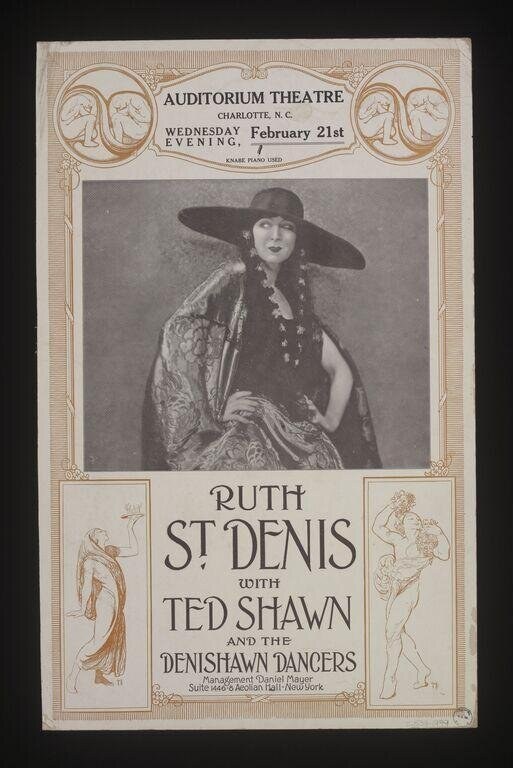
Poster advertising Ruth St. Denis with Ted Shawn and the Denishawn Dancers
Unknown
- Dance:
- Folk/Country
- Era:
- 1920-1950 (Swing Era)
- Source:
- Victoria and Albert Museum
- Rights:
- Rights vary by item — check the source record before reusing this image. Source record ↗
- Recorded as:
- Check V&A creditLine
This poster documents a key moment in American dance history: the touring career of Ruth St. Denis, whose interpretive modern dance and fusion of Western and Asian movement vocabularies shaped the development of twentieth-century dance. It also reveals how early modern dance was marketed and consumed—through star performers, exotic costuming, and theatrical presentation—and shows the geographic reach of Denishawn's influence, bringing innovative dance to regional cities. For historians of dance marketing and publicity, the poster exemplifies the visual language used to attract audiences to experimental performance in an era before film and electronic media.
What you are looking at
A theatrical poster announces Ruth St. Denis performing with Ted Shawn and the Denishawn Dancers at Charlotte's Auditorium Theatre on Wednesday evening, February 21st. The poster's upper half is dominated by a black-and-white photograph of St. Denis in a three-quarter pose, gazing toward the viewer's left. She wears a wide-brimmed hat adorned with feathers or plumes and a richly patterned garment—a cape or shawl of intricate design—draped loosely over her shoulders and across her body. The photograph captures her in a moment of theatrical repose rather than active dance; her posture is upright and composed, suggesting the dramatic presence of a star performer. The ornamental border of the poster—with its art nouveau style flourishes and classical figures in the corners—frames both the photograph and the text with elegant restraint, typical of early twentieth-century theatrical advertising.
The dancing
St. Denis is shown in a solo portrait pose rather than in active dance movement. Her body is upright and still, her head turned slightly, her gaze distant. There is no visible footwork or dynamic hold—this is a publicity image designed to present the star's charisma and elegance rather than to document her dancing technique. The photograph emphasizes her costume and theatrical presence over the physicality of dance.
The dance depicted
This is a promotional poster for a theatrical dance performance by Ruth St. Denis, the pioneering American dancer and choreographer who, with her husband Ted Shawn, founded the Denishawn School and Company—one of the most influential dance institutions of the early twentieth century. The poster does not depict the dance itself but rather presents St. Denis as a star performer to draw audiences to a live performance. The Denishawn company was known for blending interpretive modern dance with influences from non-Western dance traditions, particularly Asian dance forms. The poster's focus on St. Denis's exotic costume and theatrical presentation reflects the orientalist aesthetics that characterized much of her work.
How it was made
This is a printed theatrical poster, likely lithographed or photolithographed, a common and economical method for distributing performance announcements in the early 1920s. The integration of a photographic portrait with typographic text and decorative borders required careful registration and color separation. The quality of the photograph—sharp, well-lit studio portraiture—suggests professional theatrical documentation, while the art nouveau border design places the work firmly in the aesthetic conventions of the 1910s-1920s. Such posters were meant for public display on walls and bulletin boards, reaching broad audiences in cities where performances were scheduled.
About this work
This is a theatrical poster advertising a performance by Ruth St. Denis and the Denishawn Dancers, dated 1923, promoting a single evening at an auditorium in Charlotte, North Carolina. St. Denis appears in a glamorous studio portrait wearing an ornate costume with an elaborate hat and patterned shawl, positioned within an art nouveau-influenced decorative frame. The poster represents the commercial apparatus of early twentieth-century modern dance performance—the star system, the theatrical touring circuit, and the use of photography and graphic design to market live performance to paying audiences.
How to look at it
Observe the costume: the wide-brimmed hat, the patterned cape or shawl with what appears to be Asian or Middle Eastern motifs, the sense of exotic theatricality. Note St. Denis's composed, portrait-like pose—this is not a moment of active dance but a presentation of the performer as a glamorous star. The art nouveau border signals the aesthetic world of early twentieth-century theatrical modernism, distinct from both classical ballet tradition and later twentieth-century abstraction. The photograph's high quality and professional lighting emphasize St. Denis's beauty and stage presence; this is promotional material designed to attract paying audiences through the allure of the performer and the promise of an artistic spectacle.
The period
Ruth St. Denis (1879–1968) emerged as a major figure in American modern dance during the 1900s–1920s. She pioneered interpretive dance as an artistic form distinct from classical ballet and commercial entertainment, drawing inspiration from ancient Greek sculpture, Japanese theater, Indian classical dance, and Egyptian imagery. Her 1906 solo *Radha*, performed to a musical score rather than to accompany live music, established her as an innovator. In 1915, she married dancer and choreographer Ted Shawn, and together they founded the Denishawn School (Los Angeles, 1915; New York, 1927) and company. Denishawn became the dominant institution for modern dance training and performance in America during the 1920s and early 1930s, touring extensively across the United States and internationally. The company disbanded in 1931, but its influence persisted through its alumni—including Martha Graham and Doris Humphrey—who would develop further revolutionary approaches to modern dance. The Denishawn aesthetic combined narrative structure, exotic settings and costumes, music visualization, and an emphasis on the dancer's individual interpretive power, quite different from the abstraction that would characterize later modernism. By 1923, when this poster was issued, St. Denis was an established star with a national touring circuit; the appearance in Charlotte, North Carolina, testifies to the breadth of her reach.
Where it lives
The poster comes from the Victoria and Albert Museum collection, one of the world's major institutions for the study of design, theater, and visual culture. The museum's holdings of theatrical posters, playbills, and related materials document the history of performance and the evolution of graphic design for public advertising.
Questions about this work
Who was Ruth St. Denis?
Ruth St. Denis (1879–1968) was an American dancer, choreographer, and pioneer of modern dance. She created a new form of dance theater that blended interpretive movement, exotic costumes and settings, and music visualization. With her husband Ted Shawn, she founded the Denishawn School and Company, which became the dominant institution for modern dance training and performance in America in the 1920s. Many of the most important American modern dancers of the twentieth century—including Martha Graham and Doris Humphrey—trained at Denishawn.
What does this poster tell us about how St. Denis performed?
The costume visible in the photograph—the patterned cape, the exotic hat—reflects St. Denis's signature approach to dance: the creation of narratives and settings inspired by non-Western cultures, particularly Asian dance and design traditions. Her work was theatrical and visually ornate, quite different from the abstract modern dance that would develop later in the twentieth century. She was a star performer whose name and image sold tickets, and her company toured widely across America.
Why would Denishawn tour to Charlotte, North Carolina?
By the 1920s, Denishawn had become a major commercial touring enterprise, bringing innovative modern dance to paying audiences across the United States. Regional cities like Charlotte had auditoriums built to host touring theatrical companies, and St. Denis's company would book performances in those venues as part of national tours. This poster is evidence of how modern dance, once confined to major urban centers, became distributed as a commercial entertainment product across the country.
What is the style of the poster's design?
The decorative border, with its curved organic forms and classical figures, is characteristic of art nouveau design, which flourished in the early twentieth century. The combination of photographic portraiture with ornamental typography and borders was typical of theatrical posters of the 1910s-1920s. The poster exemplifies how graphic design and photography were used together to market performance to broad audiences.
More Folk/Country artwork