28 works in this view — arrow keys or swipe to move between them.
Dance in Art
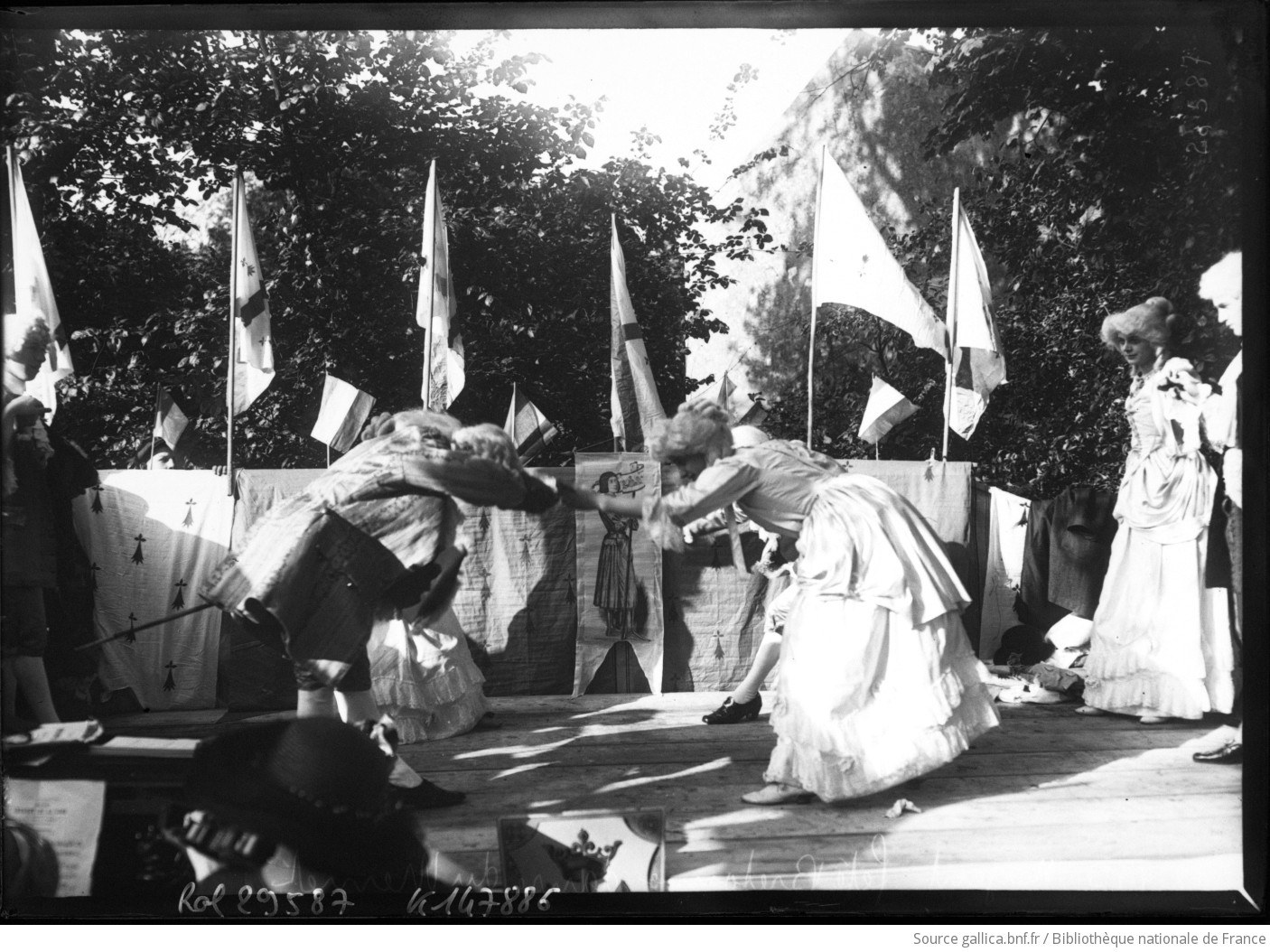
18-5-13, Nogent, fête bretonne, danse du menuet : [photographie de presse] / [Agence Rol]
Agence Rol. Agence photographique (commanditaire)
- Dance:
- Minuet
- Era:
- 1900-1920 (Ragtime/Early Jazz)
- Source:
- Bibliothèque nationale de France (Gallica)
- Rights:
- Public domain — free to use, share and adapt.
- Recorded as:
- domaine public
This image provides direct visual evidence of how the minuet—a dance form from the 18th-century ballroom—was being re-interpreted and performed in early 20th-century regional French culture as a marker of heritage and local identity. It shows that historical dances were not merely archival curiosities but active cultural practices, revived and performed in public ceremonial contexts. The photograph documents the social and spatial conditions of early regional cultural festivals, which would shape dance preservation and folk revival movements throughout the 20th century.
What you are looking at
A festive outdoor gathering in a wooded setting, likely a Breton village celebration in early summer daylight. Multiple tall flagpoles bearing French flags are arranged in a semi-circle behind a wooden platform or stage. A group of people in light-coloured period dress—the women in long white or pale dresses, the men in lighter clothing—are arranged across the platform. At the centre, two figures in white are captured mid-movement, their bodies leaning and arms extended in what appears to be an active dance gesture. Spectators in darker dress line the sides, watching the performance. The composition suggests a documentary moment from a regional festival, with the flags indicating official sanction and the gathered crowd suggesting this was a public event of some importance.
The dancing
Two central dancers in pale dress occupy the compositional focus, their bodies inclined toward each other with arms extended in a symmetrical, mirrored posture. The position suggests a couples dance rather than solo performance. Their weight appears to be shifting, with the dynamic lean and arm extension suggesting they are in a turning or revolving phase of the movement. Several other figures in white stand around them, apparently waiting their turn or participating in a group formation. The overall frame suggests orderly, structured movement rather than freestyle or improvisational dancing.
The dance depicted
The catalogue identifies this as a Breton minuet (menuet). The minuet by 1913 was primarily a historical or ceremonial dance, revived for regional festivals and cultural celebrations rather than performed in its original 18th-century ballroom context. The outdoor setting, flags, and public gathering indicate this is a deliberate restoration or preservation of traditional Breton dance culture during a regional fête. The formal dress, paired dancers, and structured group arrangement are consistent with minuet convention, though the Breton context suggests this may be a local variant or regional interpretation of the historical form.
How it was made
This is a press photograph, likely taken by a photographer working for Agence Rol (Agence photographique), a major French news and documentary photography agency active from the early 1900s. The medium is gelatin silver print or similar period photographic stock. The image shows the clarity and composition typical of early 20th-century press photography intended for newspaper reproduction—sharp enough to read the scene clearly, with careful attention to framing the action and gathering. The presence of professional documentation suggests the event held sufficient cultural or news interest to warrant coverage.
About this work
This is a press photograph documenting a minuet performance at a Breton village festival (fête bretonne) on 18 May 1913. The image captures an outdoor dance celebration in a wooded setting, with formal flags and a gathered crowd witnessing what appears to be a deliberate revival or preservation of a historical dance form as part of regional cultural identity. The photograph is notable as evidence of early 20th-century French regional cultural movements—the use of historical dances as markers of local tradition and identity during a period of rapid modernisation. It documents not only how the minuet was performed in this context, but also the social and ceremonial framework in which historical dances were being revived and celebrated.
How to look at it
The photographer has captured the dance at a moment of clear directional movement and symmetry—the two central figures leaning and reaching toward each other in a way that reads immediately as active, partnered dancing. Notice how the formal arrangement of the flags, the orderly gathering of onlookers, and the platform stage all frame this as a deliberate, official cultural performance rather than casual festivity. The composition emphasises both the historical formality of the dance (the paired figures, the structured positioning) and its public, communal character (the gathered witnesses, the ceremonial setting). The choice to photograph the moment of turning and engagement, rather than a static pose, conveys something of the minuet's character as a moving, revolving dance.
The artist
Agence Rol was one of the major French photographic news agencies of the early 20th century, established to provide images for newspapers and illustrated magazines. The agency employed numerous photographers to document events of cultural, social, and political interest across France. Press photography at this period was beginning to shift from studio-based portraiture to location-based documentary work, capturing public events and moments of cultural significance. The agency's systematic coverage of regional celebrations and festivals reflects the growing journalistic interest in French regional identity and cultural preservation.
The period
The early 20th century saw a widespread revival of historical and regional dance forms across Europe, particularly in France. This movement was partly driven by nostalgia for pre-industrial culture, partly by nationalist interest in regional identity as France modernised, and partly by the emerging discipline of folklore studies and ethnography. Regional fêtes and cultural festivals became important venues for performing and celebrating local traditions. The minuet, as the quintessential dance of the ancien régime French court, held particular symbolic weight as a marker of French cultural heritage. Press photography was increasingly being used to document these cultural events, creating a visual archive of regional celebrations and making them available to a national audience through newspapers and illustrated magazines.
Where it lives
This photograph is held in the Bibliothèque nationale de France (BnF) and is accessible through Gallica, the BnF's digital library. It is catalogued as a press photograph created by Agence Rol, one of the major French photographic news agencies. The archive number and source attribution indicate this was a professional news image, likely distributed to newspapers and illustrated magazines at the time.
Dance in this work
Questions about this work
Why would anyone be dancing a minuet in 1913?
By the early 20th century, the minuet had been out of fashion as a living social dance for over a hundred years. However, it became a focus of regional cultural revival movements in France, performed at village festivals and celebrations as a marker of local heritage and historical identity. Regional fêtes used historical dances to assert cultural distinctiveness and to connect contemporary communities to their past. This was part of a broader European movement to preserve and celebrate folk and historical dance traditions.
How do we know this is a minuet and not another dance?
The catalogue record explicitly identifies this as a 'danse du menuet' (minuet dance) at a Breton fête. The formal paired structure, the symmetrical arm positions, and the outdoor ceremonial setting with flags and gathered witnesses are all consistent with minuet performance in this period. However, the Breton context may mean this is a local regional interpretation of the minuet form rather than a strict recreation of 18th-century ballroom minuet steps.
Was Agence Rol a government agency?
No, Agence Rol was a private photographic news agency that supplied images to newspapers and illustrated magazines. However, the presence of official flags and the ceremonial framing of this event suggest it was a public or semi-official cultural celebration, which is why the agency considered it newsworthy.
What is Brittany's connection to the minuet?
The minuet originated in France and was the dominant court dance of the ancien régime. By the 20th century, Breton cultural identity was increasingly expressed through historical and regional dance forms. This 1913 minuet performance represents Brittany asserting its connection to French cultural heritage while also marking local identity through the choice to revive and celebrate this particular historical form.
More Minuet artwork