27 works in this view — arrow keys or swipe to move between them.
Dance in Art
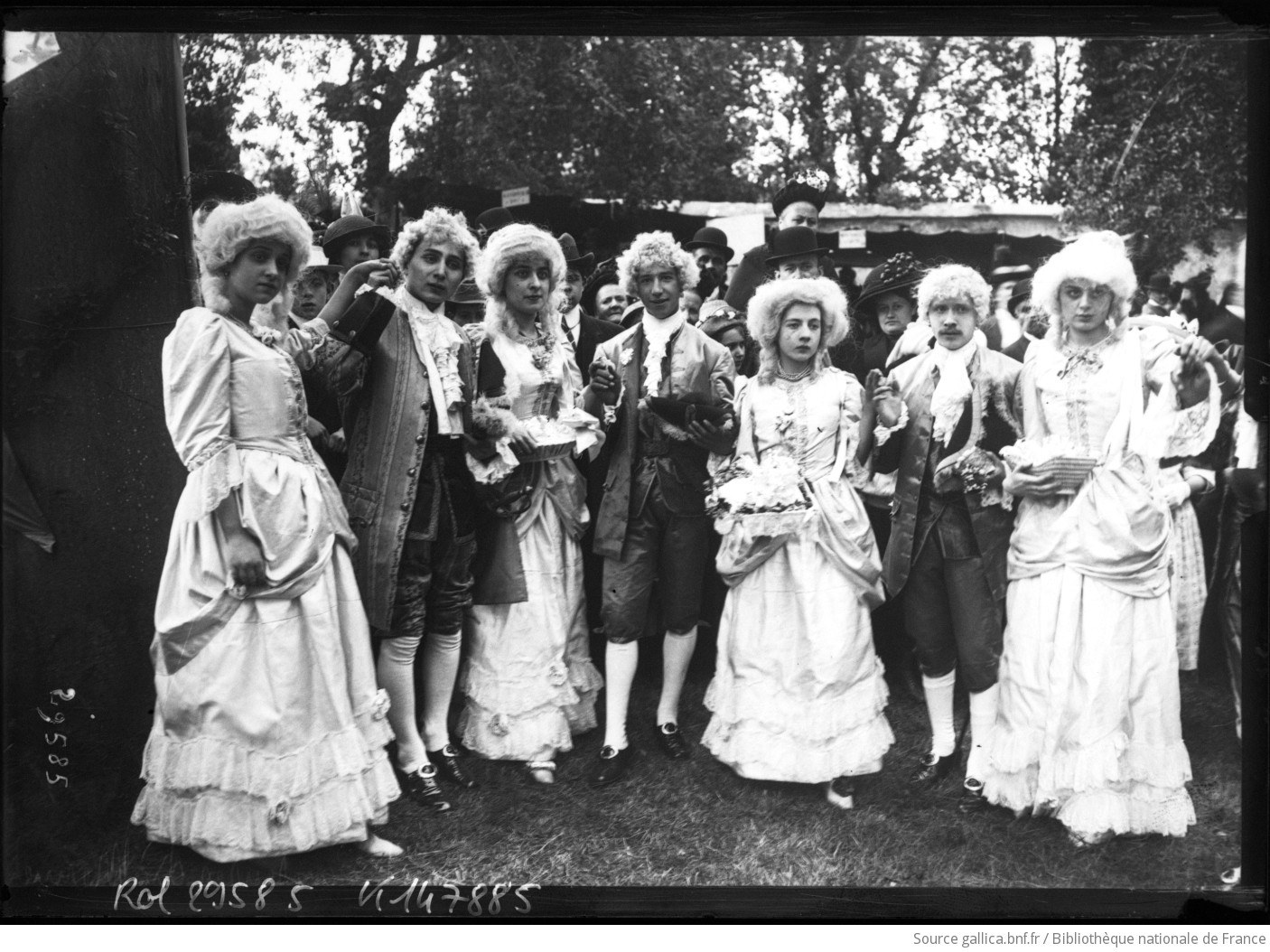
18-5-13, Nogent, fête bretonne, danseurs et danseuses du menuet : [photographie de presse] / [Agence Rol]
Agence Rol. Agence photographique (commanditaire)
- Dance:
- Minuet
- Era:
- 1900-1920 (Ragtime/Early Jazz)
- Source:
- Bibliothèque nationale de France (Gallica)
- Rights:
- Public domain — free to use, share and adapt.
- Recorded as:
- domaine public
The image is rare documentary evidence of how the minuet was performed and understood in the early 20th century, after its original context in the court had vanished. It shows the dance not as a living courtly practice but as deliberate historical recreation and public spectacle, revealing the shift from functional courtly activity to heritage performance. For historians of dance and of festival culture, it documents a specific moment in the revival and museumification of aristocratic dance forms.
What you are looking at
A press photograph documents a Breton festival celebration at Nogent in 1913, capturing a formal group portrait of minuet dancers arranged in a line across an outdoor setting. The dancers wear elaborate period costume: the women in white muslin gowns with full skirts, fitted bodies, and white powdered wigs styled in the 18th-century fashion; the men in dark formal coats, breeches, and matching white wigs. The group stands on grass with spectators and what appears to be carnival or fair infrastructure visible in the soft-focus background—trees, structures, and crowds suggest an official public celebration rather than a private event. The lighting is even and naturalistic, typical of outdoor daytime photography. The dancers stand at rest, not mid-movement, positioned as if for documentation rather than captured in the moment of the dance itself.
The dancing
The dancers are arranged in a formal line, standing upright in the posture of 18th-century courtly deportment. The women's posture is characterised by upright carriage and the voluminous white skirts dominating the visual composition; their arms are held at their sides or resting loosely. The men stand beside them in fitted dark coats with visible breeches and stockings, presenting the formal silhouette of aristocratic court dress. There are approximately 8–10 figures visible as the primary dancers, with additional costumed figures and spectators surrounding them. The group does not display active partnering or closed holds; they present themselves as a formal ensemble at rest.
The dance depicted
The catalogue identifies this as a minuet (menuet), and the dress is consistent with 18th-century court minuet costume. The minuet was the dominant courtly dance of the Baroque and Classical periods, performed in formal, stately manner with highly codified steps and positions. This image documents a revival or folkloric recreation of the minuet at a Breton festival in 1913, part of the broader early-20th-century nostalgia for historic regional and courtly traditions. The photograph shows the dancers in costume and formal arrangement but does not capture the actual footwork or movement patterns; we see preparation or presentation rather than the dance in motion.
How it was made
This is a gelatin silver or comparable photographic print from a press agency negative, made by Agence Rol, a major French photography agency of the early 20th century. The technical clarity and even exposure suggest a professional camera and daylight shooting; the composition and framing are consistent with press photography practice—a straightforward documentary record rather than artistic composition. The medium allowed rapid distribution of images to newspapers and illustrated journals, making this a tool of public information and cultural documentation. The agency attribution indicates this was taken as a news photograph to document and publicize the festival event.
About this work
This is a press photograph of a minuet ensemble in 18th-century revival costume, documenting a Breton cultural festival held in Nogent in 1913. It records a moment in the early-20th-century revival of historic courtly dances, when regional festivals and historical societies across Europe began to reconstruct and perform the formal dances of the ancien régime. The minuet, once the universal marker of aristocratic refinement, had become an object of historical and folkloric interest by the Edwardian era, performed at public celebrations and festivals as a way of asserting regional cultural identity and historical continuity. This photograph is part of the visual archive of that revival—evidence of how dancing bodies were mobilised to perform history.
How to look at it
Observe the formal, static arrangement of the group—this is not a candid moment of active dancing but a posed documentary photograph, designed to show the costume and ensemble in full. The photograph's value lies in what it reveals about how the minuet was understood and performed in revival contexts: the importance of correct historical costume, the presentation of the dance as a formal, dignified ensemble activity, and the participation of the whole community (note the spectators and fair setting). The powdered wigs and white gowns signal historical authenticity as it was understood in 1913, which itself is historically interesting—this is a document of period ideas about the past, not necessarily of how the minuet was actually performed in the 18th century.
The artist
Agence Rol was a major French photographic agency founded in the late 19th century, known for rapid photojournalism and news documentation. The agency maintained a vast archive of images of public events, cultural ceremonies, and social occasions, distributed to newspapers and illustrated magazines across France and internationally. Press photographers working for Agence Rol were systematic documentarians of French public life, capturing festivals, ceremonies, and civic events without the artistic intervention typical of art photography.
The period
The early 1910s saw an intense European fascination with the recovery and performance of pre-revolutionary courtly culture. This was driven partly by nostalgia for the aesthetic and social forms of the ancien régime, partly by emerging movements in folklore studies and cultural preservation, and partly by the theatrical and ballet world's engagement with historical sources. Fokine and the Ballets Russes had only recently reinvigorated stage interest in courtly dance forms; simultaneously, regional festivals and historical societies across France were reconstructing minuets, pavanes, and other Renaissance and Baroque dances for public performance. This photograph sits at the intersection of popular festival culture, press documentation, and the broader cultural preoccupation with lost courtly worlds.
Where it lives
The image is held in the Bibliothèque nationale de France's Gallica digital collection, where it is catalogued as a press photograph by Agence Rol. The original is part of Agence Rol's vast news archive, which is among the most important visual records of early-20th-century French public life.
Dance in this work
Questions about this work
Is this a real minuet or a costume recreation?
It is a deliberate historical recreation, performed at a public festival in 1913. The minuet as a living courtly practice had disappeared by the late 18th century; what we see here is an early-20th-century revival, driven by historical interest and cultural nostalgia. The dancers are wearing reconstructed 18th-century costume and performing the dance for public documentation and celebration.
What is a minuet and why was it important?
The minuet was the dominant social and courtly dance of the 17th and 18th centuries, performed throughout the courts of Europe as the essential marker of aristocratic refinement and good breeding. It was a highly codified, stately dance in triple time, performed in pairs in formal dress. By the 19th century it had become historically obsolete, but by 1913 it was being revived as a symbol of European cultural heritage.
Who were Agence Rol and why did they photograph festivals?
Agence Rol was one of the major photographic news agencies of early-20th-century France, supplying images to newspapers and illustrated magazines. They systematically documented public events—festivals, ceremonies, political gatherings, social occasions—as part of the emerging mass media industry. This photograph is part of their archive of French civic and cultural life.
Why are they wearing wigs?
The powdered wig was the essential marker of 18th-century aristocratic dress, and wearing one was part of the historical authenticity that the festival dancers were aiming for. The wig signals 'this is a costume from the past,' making the historical reference explicit to the contemporary audience.
More Minuet artwork