25 works in this view — arrow keys or swipe to move between them.
Dance in Art
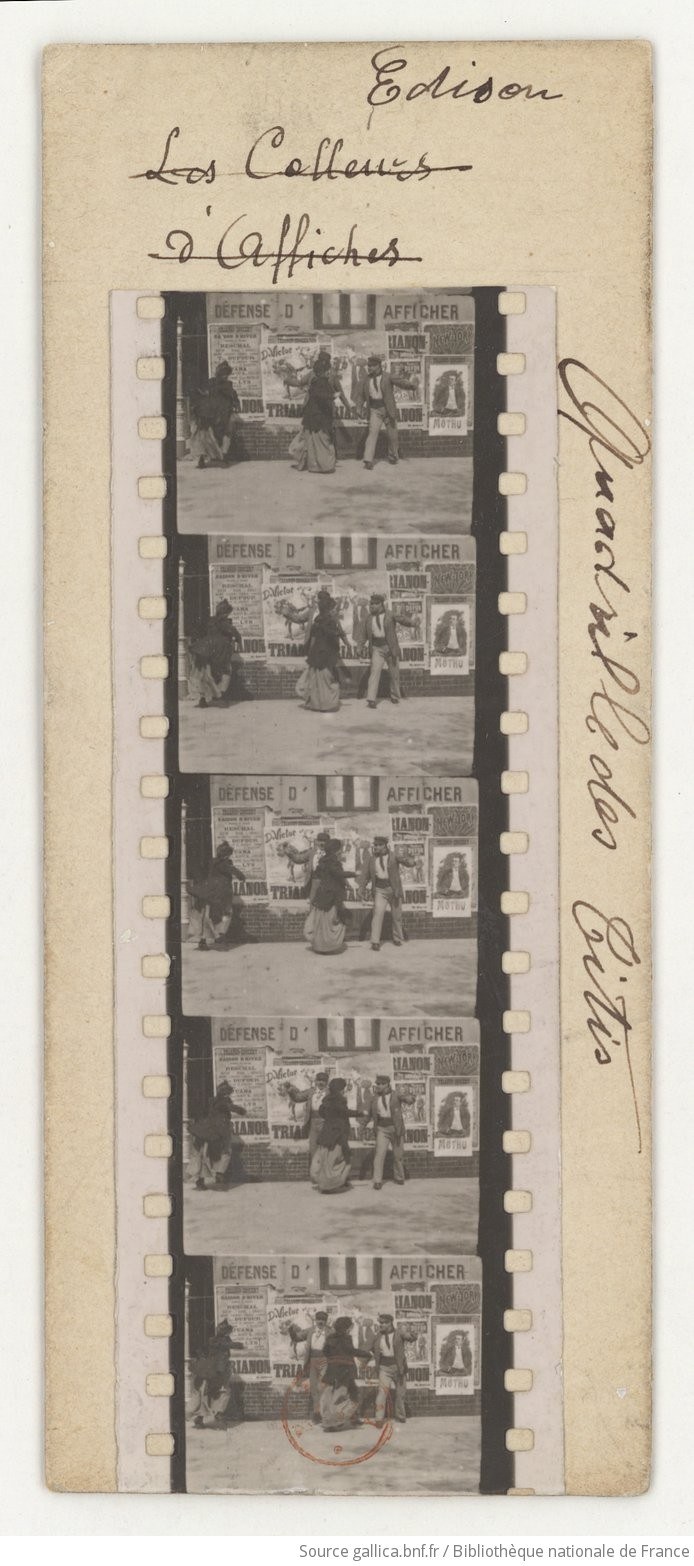
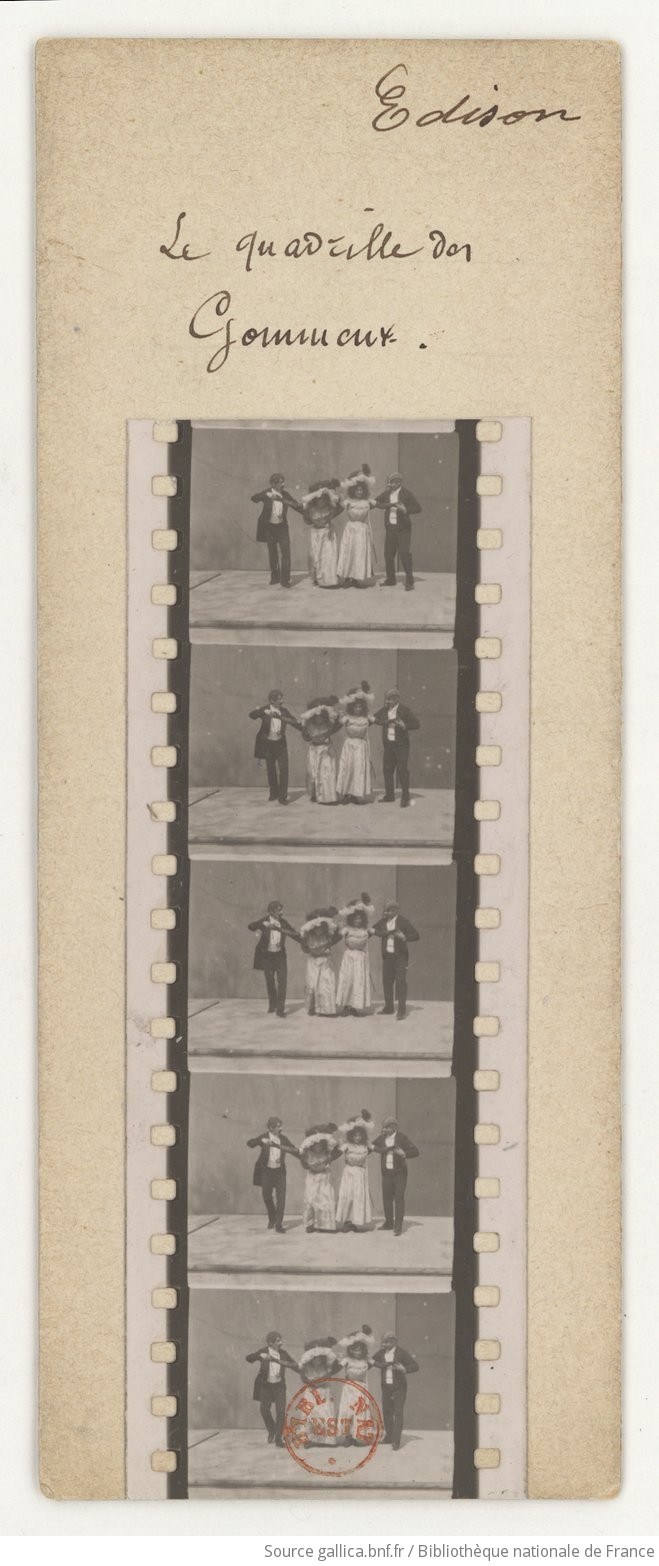
[Recueil. Le Quadrille des Gommeux, production d'Eugène Pirou. Paper prints]
Unknown artist
- Dance:
- Quadrille
- Era:
- Late 1800s (Victorian Ballroom)
- Source:
- Bibliothèque nationale de France (Gallica)
- Rights:
- Public domain — free to use, share and adapt.
- Recorded as:
- domaine public
This is one of the earliest motion-picture records of a named ballroom dance performed by trained dancers in theatrical costume. It shows quadrille technique and spacing at a moment when the dance was already becoming historical even as it remained theatrically popular. For dance historians, it provides rare visual evidence of how the quadrille looked in actual performance, rather than in written choreographic notation or still images.
What you are looking at
A film strip of five sequential frames shows four figures in formal evening dress performing a quadrille on a stage with a painted backdrop. The two men wear dark tailcoats and white shirts; the two women wear high-necked white gowns with full skirts in the Gibson Girl silhouette of the 1890s. The figures are arranged in the formal geometric pattern characteristic of the quadrille, with the men positioned at the outside and women toward the center. Each frame captures a moment in the progression of the figure, the poses nearly identical across frames, suggesting the photographer was documenting the structured, repetitive nature of the choreography. The lighting is even and frontal; the stage floor appears bare. A red archive stamp appears on the lowest frame.
The dancing
All four dancers maintain an upright, formal posture throughout. The women's arms are held at the sides or slightly extended in the classical ballroom frame; the men face their partners. The dancers are spaced in a square formation typical of quadrille structure. There is no visible closed couple hold; instead the positioning suggests the promenade or side-by-side arrangement characteristic of set dances. The repetition across frames shows the same moment captured multiple times rather than progression through a movement phrase, indicating this is a film strip documentation of a single pose or figure held for the camera.
The dance depicted
This documents a quadrille, specifically the 'Quadrille des Gommeux' (Gommeux Quadrille) as credited to Eugène Pirou's production. The quadrille was the dominant social ballroom dance of the 19th century, danced by four couples in a square set and structured in five distinct figures. The formality of dress and geometric spacing confirm this identification. The gommeux were young Parisian men of bohemian fashion and manner; a quadrille named for them suggests a popular or satirical version of the dance, possibly performed in music halls. The film-strip format indicates this is documentation from an early motion picture, likely made to capture and circulate a theatrical performance or dance instruction.
How it was made
This is a photographic film strip, mounted on card stock, showing five consecutive 35mm film frames. The print-out or positive print was made from motion picture film, allowing multiple identical or near-identical frames to be preserved and viewed in sequence. This medium indicates early cinema documentation, probably from the 1890s when such film strips were popular for both theatrical promotion and instructional purposes. The technique allowed a single performance moment to be captured with precision and distributed, making it valuable for dance instruction and as a record of theatrical performance. The mounting and preservation suggests it was part of a curated collection, possibly held by institutions or individuals documenting dance and performance.
About this work
This is a film-strip record of the 'Quadrille des Gommeux,' a theatrical quadrille performed in 1890s Paris and documented by pioneer filmmaker Eugène Pirou. The quadrille—a set dance for four couples in a square formation—dominated 19th-century ballrooms and persisted into theatrical performance and music-hall entertainment. The five frames show a moment of formal posture and positioning, all figures in evening dress on a bare stage, captured using early cinema technology. As documentation of how a popular dance was performed in a specific cultural moment and theatrical context, the work bridges social dance history and the history of cinema.
How to look at it
Observe the geometric positioning of the four figures and how it remains constant across all five frames—this reflects the quadrille's structure as a set dance with defined formations rather than continuous traveling or turning. Notice the formality of posture and the spacing between dancers: the quadrille was a dance of decorum and precision, not passion or close physical contact. The fact that five nearly identical frames are shown suggests the photographer wanted to ensure the pose was clearly captured and to emphasize the stillness or pause within the choreography. This is not action photography trying to catch mid-movement, but documentation of the formal positions that constitute the dance's visual vocabulary.
The artist
Eugène Pirou was a French pioneer of early cinema and the Lumière brothers' collaborator, known for filming scenes of Parisian life and popular entertainment in the 1890s. He worked as both cameraman and producer, documenting theater, music-hall performances, and social events. His interest in dance documentation reflects the broader fascination of early filmmakers with capturing movement and performance. Pirou's work was distributed through the Lumière network and represents the emerging use of cinema to record and preserve entertainment that would otherwise exist only in live performance.
The period
The quadrille reached its peak as a social dance in the early 19th century but remained a fixture of formal ballrooms and theatrical entertainment through the 1890s. By the time this film was made, newer dances like the waltz and emerging modern dances were competing for popularity, yet the quadrille persisted in conservative ballroom practice and as a subject for theatrical and music-hall performance. The 1890s was also the moment when cinema emerged as a technology for recording performance; early filmmakers were fascinated by dance and movement as subjects ideally suited to the new medium. The 'gommeux' were a recognizable cultural type of the Parisian fin de siècle, making a 'Quadrille des Gommeux' both a social commentary and a commercial entertainment.
Where it lives
The work is held in the Bibliothèque nationale de France (Gallica digital collections) and is catalogued as a paper-mounted film strip from the Pirou collection. It is part of the holdings documenting early cinema and theatrical performance from the 1890s. The red archive stamp visible on the lowest frame indicates institutional processing and preservation.
Dance in this work
Questions about this work
What is a quadrille?
A quadrille is a set dance for four couples arranged in a square formation, popular as a ballroom dance from the early 19th century onward. It consists of five distinct figures, each with its own choreography. The dance was highly formal and structured, and while it declined in social dance practice after the 1880s, it persisted in theatrical performance and formal ballroom contexts into the early 20th century.
Who were the gommeux?
The gommeux were young men of Parisian bohemian society in the late 19th century, known for distinctive fashion and a particular social style. A 'Quadrille des Gommeux' would have been a version of the dance associated with or performed by this cultural group, possibly with satirical or theatrical intent.
Why is this film strip important?
This is one of the earliest motion-picture records of a named ballroom dance performed in costume on a stage. It provides direct visual evidence of how dancers positioned themselves and moved within the quadrille's formal structure, and it documents the moment when cinema began to be used to preserve and circulate performance documentation.
Why are the frames almost identical?
The near-identity of the five frames suggests the photographer was documenting a moment of stillness or formal positioning within the dance, rather than capturing a sequence of movement. This reflects both the quadrille's structure (which includes distinct pauses and formal positions) and early cinema practice, which often focused on capturing recognizable poses rather than continuous motion.
More Quadrille artwork