25 works in this view — arrow keys or swipe to move between them.
Dance in Art
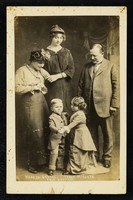
Hans and Gretel : tango midgets from Germany.
Unknown artist
- Dance:
- Tango
- Source:
- Wellcome Collection
- Rights:
- Rights vary by item — check the source record before reusing this image. Source record ↗
- Recorded as:
- Check
For dance historians, this is evidence of how tango circulated beyond elite ballrooms and theatrical stages in the early 20th century—it was marketed as a novelty attraction involving performers whose stature itself was the draw. For historians of performance, display, and the body, it documents the ethics and aesthetics of early entertainment, revealing assumptions about childhood, disability, and spectacle that were normalized at the time.
What you are looking at
This is a sepia-toned photograph or print showing five figures in late 19th-century dress arranged in an interior setting. Two adult figures—a man in a dark suit and bowler hat on the left, and a woman in a long dress and hat on the right—stand upright. Between and below them are three smaller figures: two children in the foreground appear to be in dancing or performance poses, while a third smaller figure stands to the right. The lighting is even and theatrical, suggesting this was a posed studio photograph. The backdrop and composition suggest this documents a performance or exhibition rather than a candid moment.
The dancing
The two central child figures are positioned in what appears to be a dance frame or performance stance. The child on the left wears light-colored clothing and appears to be in motion or a dance posture; the child on the right is similarly posed. Their bodies are angled toward each other in a configuration suggestive of partnered dance. The adult figures flank them formally, their posture upright and stationary, marking a clear distinction between the performers and their handlers or guardians. The scale contrast—emphasized by the photographer's framing—is striking and intentional.
The dance depicted
The catalogue identifies these as 'tango midgets from Germany,' suggesting they were professional performers or curiosities exhibited for their small stature. The composition and poses are consistent with early tango documentation, though the positioning is highly stylized for the camera rather than naturalistic. The tango partnership involves close proximity and a specific embrace frame, both suggested here, but the theatrical arrangement—with supervising adults and the children positioned as subjects to be displayed—indicates this documents a commercial exhibition or promotional photograph rather than social tango dancing. The garments and photographic style date to the early 20th century.
How it was made
This is a gelatin silver print or similar photographic print on albumen or gelatin paper, exhibiting the sepia toning and tonal range typical of early 20th-century studio photography. The formal studio setup, controlled lighting, and posed composition indicate professional production. The print is mounted on board with a decorative border, a common presentation method for entertainment or sideshow promotional materials of the period. The technique allowed for documentary evidence of performers while the mounting and framing suggest this was meant for display, sale, or archival record-keeping.
About this work
This photograph documents a curiosity or novelty act: child performers advertised as 'tango midgets,' likely from a traveling show, dime museum, or vaudeville circuit. The image freezes a moment of staged performance, capturing two small figures in a tango partnership while adult attendants establish the frame. It is a record of how dance—and specifically tango, then newly fashionable in Europe and America—was consumed as spectacle in the early 20th century. The work sits at the intersection of dance history, performance documentation, and the history of exhibition and display of human bodies as curiosities.
The image tells us that tango had penetrated popular entertainment and novelty circuits rapidly enough that child performers could be marketed specifically as 'tango dancers.' It also reveals the paternalistic and exploitative framing of such acts: the children are presented as objects under adult supervision, posed for the camera's gaze in a way that emphasizes their otherness.
How to look at it
Attend to the stillness of the pose: the photographer has frozen the children in a frame that evokes tango partnership without capturing actual movement. The formal posture, the placement of the adults as supervisors or handlers, and the studio setting all tell you this is not documentation of social dancing but rather a promotional or archival image of a marketable act. The sepia tone and the mounting style are consistent with early 20th-century entertainment ephemera. The image rewards a skeptical gaze: ask what story the composition tells about how these performers were presented to audiences and how their bodies were displayed.
The period
Tango emerged in Buenos Aires in the 1880s–90s and spread rapidly to Paris, London, and other European cities in the 1910s, becoming a fashionable craze among the social elite and subsequently among popular entertainment circuits. Simultaneously, traveling shows, dime museums, and vaudeville houses were at their height, offering audiences novelty acts and human curiosities. The early 20th century saw the professionalization and commodification of dance as entertainment; tango's sexual charge and Latin American exoticism made it especially marketable as spectacle. Child performers and performers with dwarfism or other visible differences were common attractions, often billed as 'curiosities' or 'freaks.' This photograph belongs to that history of entertainment capitalism and racialized/medicalized spectatorship.
Where it lives
The work is held by the Wellcome Collection, a major repository of medical, scientific, and social history materials. Its presence in the Wellcome suggests it was catalogued as a document of human difference or medical/anthropological interest, reflecting the era's conflation of entertainment, medicine, and taxonomic display.
Dance in this work
Questions about this work
Were 'tango midgets' a real form of entertainment?
Yes. In the early 20th century, touring shows, vaudeville theaters, and dime museums regularly featured performers with dwarfism or short stature as novelty acts. They were often given stage names and marketed with exoticizing or diminishing language. Tango's rapid popularity made it a natural attraction to attach to such acts. This photograph is evidence of how such performers were displayed and documented.
Is this actually tango?
The posed positioning and proximity of the two children is consistent with tango's partner frame, but this is a studio photograph, not a recording of actual dance. The image documents how tango was being marketed and consumed as spectacle, not how it was danced in ballrooms or theaters. The theatrical composition and the presence of supervising adults suggest a commercial exhibition rather than genuine social or theatrical performance.
What does this tell us about early 20th-century attitudes to dance?
It reveals the rapid commercialization of dance and its circulation through entertainment circuits that prioritized novelty and spectacle over artistry. Tango, newly arrived from Latin America and coded as transgressive and exotic, was especially marketable. The image also shows how performance could be weaponized as a tool for displaying and profiting from human difference in ways we would now recognize as exploitative.
More Tango artwork
![[Les noces de trottoir, par les compagnies Tango Sumo et Vendaval. Chalon dans la rue. 2007 / photographies de Joël Verhoustraeten] by Verhoustraeten, Joël (1954-2019). Photographe](https://gallica.bnf.fr/iiif/ark:/12148/bc6p058zgkc/f1/full/800,/0/native.jpg)