49 works in this view — arrow keys or swipe to move between them.
Dance in Art
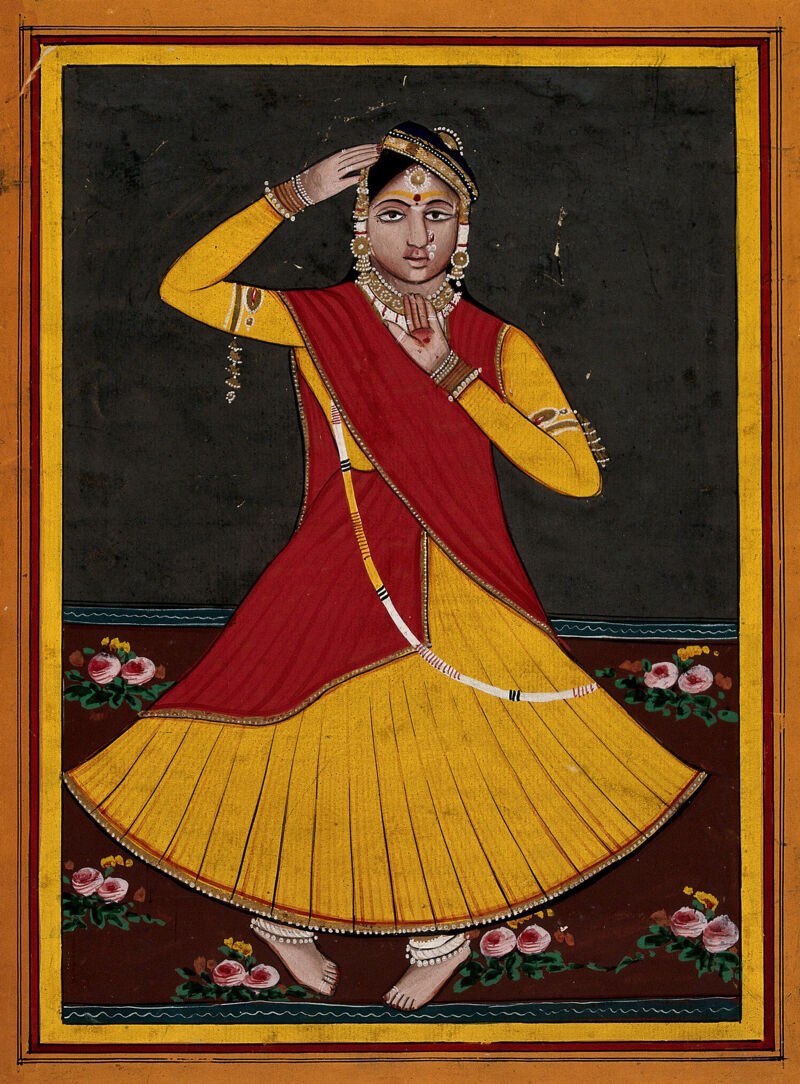
A nautch dancing girl. Gouache drawing.
Unknown artist
- Source:
- Wellcome Collection
- Rights:
- Rights vary by item — check the source record before reusing this image. Source record ↗
- Recorded as:
- Check
This image documents the appearance and ornamentation of a *nautch* dancer and provides concrete visual evidence of courtly dance costume and presentation in pre-colonial and early modern India. It also exemplifies how professional dancers were depicted in the high art tradition of Indian miniature painting—a status marker and form of cultural prestige. For historians of Indian dance and performance, the work is important evidence of the material culture, bodily practice, and social context of court dance traditions that were radically disrupted during colonial rule.
What you are looking at
A single female dancer is portrayed against a dark background, positioned in a dynamic contrapposto stance with her weight shifted and her upper body angled forward while her right arm is raised to her headdress in an elegant gesture. She wears a bright yellow pleated skirt (likely a *ghagra* or similar ankle-length garment) with detailed vertical pleating that extends to her feet, paired with a fitted yellow blouse and a flowing red shawl or *dupatta* draped diagonally across her torso. Her left arm hangs relaxed at her side, and both wrists are adorned with multiple bangles. She wears elaborate jewelry including a decorative headpiece with a pearl or jeweled finial, large earrings, a choker-style necklace, and rings. The lower register of the composition features a dark brown ground with scattered pink flowers and foliage that grounds the figure. A narrow turquoise band runs horizontally across the composition at mid-height, separating the dark background above from the floral foreground below. The entire work is framed by a yellow border and an outer decorative frame of dark red and gold, consistent with Indian miniature painting conventions.
The dancing
The dancer stands in a relaxed, graceful posture with the weight of her body on her left leg, her right leg slightly extended. Her right arm is lifted with the hand raised toward her decorative headpiece in a gesture that suggests adjustment or ornamentation rather than active movement—a moment of pause or repose. Her head is held upright, her gaze directed outward. The raised arm and tilted torso create gentle S-curve dynamics in the body line, characteristic of classical South Asian dance vocabulary, though the overall posture suggests a moment of stillness or presentation rather than mid-movement.
The dance depicted
This work depicts a *nautch* dancer, a professional courtesan-dancer of North India and the Mughal court tradition. The term 'nautch' (from *natch*, to dance) applied to both the dance form and the dancers themselves, who performed for aristocratic patrons in courtly and private settings. The pose and costume—the elaborate jewelry, the fine pleated skirt, the draped shawl, the decorative headpiece—align with the material culture of court dance in 18th-century or earlier India. The image captures the dancer in a moment of composed presentation rather than active choreography, which was consistent with the *tawaif* tradition, where the dancer's ornamentation and grace were themselves part of the spectacle. The specific style of the dress and jewelry suggest a North Indian courtly context, possibly during the late Mughal or early post-Mughal period.
How it was made
This is a gouache painting on paper, a technique well-suited to the luminous, jewel-like color palette and fine detail work visible here. Gouache allows for opaque, vibrant color layering and precise rendering of ornament and fabric texture—the pleating of the skirt, the shimmer of the jewelry, the subtle modeling of the face. The gold border and framing device are typical of Indian miniature painting presentation conventions. The work appears to be from a court or aristocratic collection, as suggested by its formal framing and the careful attention to decorative detail. Gouache on paper was the standard medium for Mughal and Rajasthani court paintings and remained so into the colonial period.
About this work
This is a gouache portrait of a *nautch* dancer—a professional courtesan-performer of the North Indian Mughal court tradition. The image freezes a moment of composed stillness, presenting the dancer's elaborate jewelry, costume, and bodily grace as the primary subjects of the work. The precise rendering of textiles, ornament, and the dancer's controlled posture reflect the high status and refined aesthetic context in which such dancers moved.
The work belongs to a substantial tradition of Indian miniature painting depicting court entertainers, a tradition that persisted from the Mughal period through the colonial era. It offers material evidence of the dress, jewelry, and presentation conventions of *nautch* performance, and of the artistic attention lavished on these figures within courtly visual culture. The work appears in the Wellcome Collection, a major repository of Indian and global historical materials formed in the early 20th century.
How to look at it
Notice the deliberately composed, almost portrait-like stillness of the pose—this is not a moment of active choreography but rather a formal presentation of the dancer's ornamented body. Attend to the artist's careful attention to textile and jewelry detail: the precise vertical pleating of the skirt, the modeling of the bangles on the wrist, the fineness of the necklace and earrings, the decorative headpiece. The raised arm and elegant hand gesture suggest the refined bodily control that court dance required. The floral border at the base and the formal framing device place this within the conventions of Indian miniature painting, emphasizing the high artistic and courtly context in which such dancers were viewed.
The period
The *nautch* tradition of North India flourished under the Mughal empire and continued into the 18th and 19th centuries. Court dancers held a complex social position: they were highly trained artists of significant cultural prestige, yet also courtesans whose sexual availability was often assumed by their patrons. The tradition of depicting such dancers in miniature painting speaks to their prominence in courtly life and visual culture. During the 18th and 19th centuries, as colonial rule advanced, the *nautch* tradition came under increasing moral and legal scrutiny from British administrators and Indian reformers alike. By the early 20th century—when this work may have been collected by the Wellcome Collection—such images became artifacts of a partly displaced practice. The work thus sits at the intersection of courtly aesthetic tradition and historical documentation of a changing performance world.
Where it lives
The work is held in the Wellcome Collection, a major British institutional archive of medical, scientific, and cultural materials assembled by Henry Wellcome in the early 20th century. It was catalogued simply as 'A nautch dancing girl' and classified as a gouache drawing, suggesting it was understood as a historical document or cultural artifact rather than a named artwork.
Dance in this work
Questions about this work
What is a nautch dancer?
*Nautch* (from *natch*, to dance) was a form of courtly dance in Mughal and post-Mughal North India, performed by professional dancers called *tawaif*. These were highly trained entertainers who performed music, dance, and poetry in aristocratic courts and private settings. They held significant cultural prestige but occupied an ambiguous social position. The tradition was largely suppressed or transformed during British colonial rule, which viewed such performance with moral disapproval.
What does the costume tell us?
The dancer wears the marks of high status and courtly taste: a fine pleated *ghagra* (long skirt), a fitted blouse, a draped shawl, and extensive jewelry including bangles, earrings, a choker, and a decorative headpiece. This was not everyday dress but the costume of a professional performer in an aristocratic context. The quality and ornamentation of the jewelry and textiles were central to the aesthetic and erotic appeal of the performance.
When and where was this made?
The catalogue record does not provide a precise date or place. The style of the costume and the conventions of the gouache painting suggest an origin in 18th-century or early 19th-century India, possibly North India during or after the Mughal period. The work may have been made as a historical record or collected as a cultural artifact by a European collector in the colonial period.
Why is she standing so still?
This is a formal portrait-style composition rather than a action-captured moment. The pose emphasizes the dancer's ornamentation, grace, and composed bodily presence—her status and refinement—rather than a particular choreographic sequence. This reflects the conventions of court portraiture and the importance of presentation in courtly performance culture.
More dance artwork