49 works in this view — arrow keys or swipe to move between them.
Dance in Art
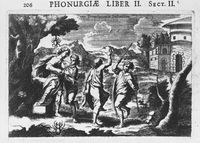
M0018281: People dancing the tarantella, 1673
Unknown artist
- Source:
- Wellcome Collection
- Rights:
- Rights vary by item — check the source record before reusing this image. Source record ↗
- Recorded as:
- Check
This is one of the few surviving visual documents of tarantella performance in the 17th century, and it records the dance at a point of transition—still recognizable as the Italian regional form, but already transformed by courtly protocol and aristocratic bodies. For historians of early modern dance, it offers direct evidence of costume, spacing, partnering, and the social context in which the tarantella circulated outside Italy. For dancers, it shows how a folk dance could be adopted and reframed without being entirely domesticated.
What you are looking at
An engraved scene of social dancing in an interior setting, rendered in the Northern European style of the late 17th century. Multiple figures occupy a columned hall or palace room; the composition is crowded and animated, with dancers at various moments in their movement. In the foreground, couples are paired and actively dancing, while background figures converse, observe, or prepare to join. The women wear voluminous skirts with the silhouette characteristic of the 1670s–80s, with fitted bodices and full sleeves; the men are in breeches, doublets, and plumed hats typical of aristocratic dress of the period. The architectural setting—with columns, arched doorways, and what appears to be a tiled floor—suggests a palace or great house. The engraving technique allows fine detail in the rendering of fabric, feathers, and the linear energy of the composition, which conveys rapid, spirited movement throughout the scene.
The dancing
The dancers move in couples with varied partnering patterns; some hold hands in a turned or facing position, others are in looser contact typical of Renaissance and early Baroque social dances. The women's arms are raised and extended; their skirts are caught mid-swirl, showing the rotational energy of their movement. The men's postures are upright but varied—some leaning or gesturing, suggesting courtship interaction or invitation. Legs and feet are rendered schematically but show weight shifts consistent with stepping patterns; no pointe work or turnout is present. The overall frame is one of social, reciprocal movement rather than performance hierarchy.
The dance depicted
The title identifies this as tarantella, a southern Italian circle or couple dance known from the 16th century onward and widespread across Europe by the 1670s. However, the dress, setting, and formal partnering visible here—indoors, in a palace, among aristocracy—suggest this may be a court adaptation or Europeanized version of the tarantella rather than the folk form itself. The rapid, turning movement of the women, the hand-holding patterns, and the social context align with documented 17th-century tarantella practice among the nobility, when the dance was incorporated into courtly repertoires. The engraving does not show the vigorous, solo-inflected stamping associated with later folk performances, but rather a composed, partnered social dance.
How it was made
This is an engraving—likely a copper-plate engraving—printed from a metal plate incised with fine lines to create tone and detail. The technique allowed for precise rendering of architectural space, textile pattern, and the disposition of multiple figures in depth. The print's scale and finish suggest it was intended for circulation among educated, aristocratic audiences—possibly as a record of court practice, a dancing master's illustration, or a study of manners. Engravings of this period were expensive and labour-intensive, indicating this work was made for a patron of means and served a documentary or didactic function beyond mere entertainment.
About this work
This is an engraved record of aristocratic tarantella dancing in a European court setting, dated to 1673 and held in the Wellcome Collection. It documents a moment when Italian folk and regional dances were being absorbed into Northern European noble practice and formalized for court consumption. The work preserves visual evidence of how a specific dance—the tarantella—was adapted, dressed, and performed among the elite, and how it was understood by artists and engravers of the period. It belongs in a dance gallery because it is neither a generic 'dancing scene' nor a fanciful invention, but a dated, titled record of a named dance at a precise historical moment.
How to look at it
Attend to the variety of postures and moments within the scene: some dancers are at the moment of a turn or spin (evident from the flare of the skirts), others are stepping or pausing, and still others are engaged in the courtship ritual of invitation or acceptance. Notice the women's arms—raised, extended, sometimes turned—which differ markedly from the men's more restrained upper bodies. The architectural frame of the scene is not neutral; it asserts that this is a formal, indoor, elite activity, not a street or village gathering. The engraver has chosen to show the dance in full social context, surrounded by musicians, observers, and attendants, implying that tarantella dancing was an integrated part of court ceremony, not a discrete performance.
The period
The 1670s were a time of intense cultural exchange between Italy and Northern Europe, particularly between the Italian peninsula and France, the Low Countries, and the Holy Roman Empire. Italian dances—including the tarantella, the passacaglia, and regional circle dances—were being collected, codified, and integrated into courtly repertoires. Dancing masters published treatises that attempted to notate and standardize these forms. Simultaneously, engraving was becoming a primary medium for the dissemination of knowledge about dance, manners, and court life; images circulated more widely than written treatises and reached audiences who could not access live performance. The Baroque period saw the formalization and aristocratization of peasant and regional dances, a process visible in both dancing master literature and visual art.
Where it lives
This work is held in the Wellcome Collection, a broad archive of medical, social, and cultural history assembled by the philanthropist Henry Wellcome. Its presence in the Wellcome archive suggests it may have been acquired for historical or ethnographic interest, or as part of a larger holding on manners, medicine, or social practice.
Dance in this work
Questions about this work
Is this really tarantella, or is the title a guess?
The title is stated in the catalogue record as 'People dancing the tarantella, 1673,' so it was identified and inscribed as such at the time of creation or shortly after. However, the formal courtly setting, the indoor palace space, and the refined dress suggest this is a court version of tarantella rather than the folk form. By the 17th century, the tarantella had become fashionable among European nobility, and this engraving may document that phase of cultural adoption.
What is tarantella and why would a court dance it?
Tarantella is a rapid, rotational couple or circle dance from southern Italy, with roots in folk tradition. By the 16th and 17th centuries, it had spread across Europe and been incorporated into courtly dancing repertoires. European nobles collected and performed regional and 'exotic' dances as markers of sophistication and cosmopolitanism. The tarantella's speed, turning, and flirtatiousness made it appealing to court dancers seeking variety from the more measured Baroque court dances like the minuet.
How do I know this is an engraving and not a painting?
The image shows the characteristic parallel lines, cross-hatching, and linear technique of engraving—a process where lines are incised into a metal plate and printed. The tonal range and fine detail are consistent with copper-plate engraving. No record of medium is provided, but the visual evidence makes the identification secure.
Who is the artist?
The artist is not recorded in the catalogue. The work may have been created by a court artist, a dancing master's illustrator, or a commercial engraver working from a patron's commission or description. Unsigned or anonymous engravings were common in the 17th century, particularly when produced for practical or didactic purposes rather than individual artistic reputation.
More dance artwork