49 works in this view — arrow keys or swipe to move between them.
Dance in Art
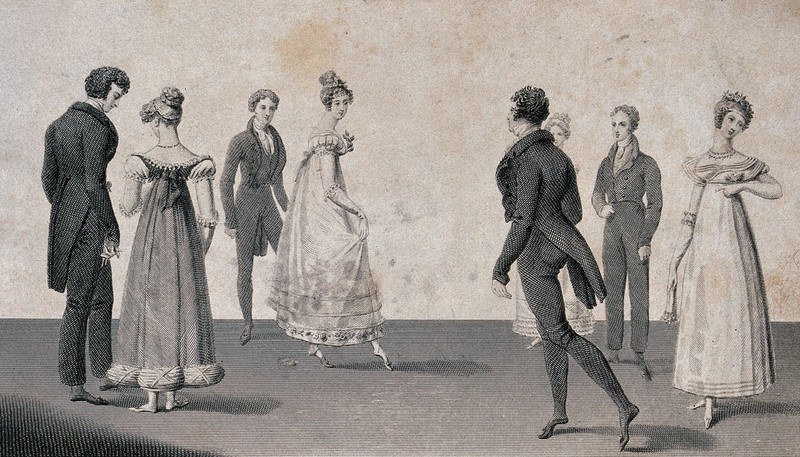
Four couples dancing the quadrille. Engraving, ca. 1825.
Unknown artist
- Source:
- Wellcome Collection
- Rights:
- Rights vary by item — check the source record before reusing this image. Source record ↗
- Recorded as:
- Check
The quadrille was the gateway dance of the 19th century, the form that made complex figure-dancing accessible to the middle classes and transformed social dancing from an aristocratic accomplishment into a democratic leisure pursuit. This engraving is a primary document of that transformation: it shows the dance in its Regency heyday, at the moment when it was spreading across Europe and America and becoming the template for ballroom dancing for the next hundred years. For dancers and historians, it is direct visual evidence of how the dance was understood, taught, and performed at the height of its cultural authority.
What you are looking at
An engraved scene of four couples dancing the quadrille, arranged in two groups facing each other across a neutral stage-like floor. The composition is symmetrical and formal: on the left, a man in dark tailcoat addresses a woman in a high-waisted Empire dress with short puffed sleeves, while a second couple stands nearby; on the right, a third man in tailcoat bows toward a woman in similar neoclassical dress, with a fourth couple completing the set. The figures are rendered in fine black-line engraving against a pale background, with careful attention to the silhouettes and proportions of Regency-era formal dress. The women's dresses feature the characteristic high waistlines, narrow skirts, and delicate details of circa 1820s fashion; the men wear fitted breeches, tailcoats, and show the formal posture of ballroom etiquette. The spacing and arrangement suggest a moment of salutation or the opening formation of the quadrille, with the couples poised but not yet engaged in active movement.
The dancing
The dancers maintain the upright, controlled posture of formal ballroom dancing. The men are depicted in three-quarter profile or frontal view, several with one arm extended in a gesture of acknowledgment or invitation; the women stand with the characteristic Regency frame—shoulders back, arms at the sides or gently held—and the slight forward inclination of the torso typical of the period. No closed holds are visible; the couples are separated, suggesting the quadrille's characteristic structure of forward and backward movement rather than sustained partnering. The precision of line and the dignity of each figure emphasize restraint and geometric order—the opposite of energetic display—which is entirely consistent with the quadrille's choreographic logic.
The dance depicted
This is a quadrille, the dominant social dance of the Regency and early 19th century. The quadrille is a four-couple square dance, typically danced in sets, with figures that progress through a series of salutations, promenades, and interlocking patterns. The four couples shown here represent the standard formation: two couples on the sides (first and third) and two couples on the ends (second and fourth), or possibly a single set arranged for clarity. The engraving documents the preparatory moment—the opening salutation—before the complex geometric figures begin. This was a dance of the ballroom and the assembly room, danced by the genteel classes throughout Europe and America from roughly 1810 onwards, and it required no previous training, only courtesy and the ability to follow a caller's instructions.
How it was made
This is a line engraving, a technique that produces fine, precise black lines on white paper and is well suited to depicting formal dress and the clear geometry of ballroom formation. Engraving was the standard medium for instructional dance prints and ballroom scenes in the early 19th century: it was reproducible, affordable, and exact enough to convey the postures and positions that mattered to dancers and dancing masters. The technique also emphasizes silhouette and linear clarity over volume or shadow, which aligns perfectly with Regency aesthetics and with the instructional purpose such prints often served—showing the correct stance and spatial arrangement. The fineness of the line work and the lack of hand-coloring suggest this is a reproduction print intended for wide circulation, possibly in a dancing manual or as a standalone instructional plate.
About this work
This is a circa-1825 engraving documenting the opening moment of a quadrille, the most fashionable and codified social dance of the Regency era. Four couples in formal dress stand poised in the characteristic formation, the men in tailcoats and the women in high-waisted Empire gowns, arranged in a symmetrical composition that reads as both a ballroom scene and a diagram of correct positioning. The engraving style and the formal precision of the figures mark this as an instructional or documentary image—a record of how the dance was understood, taught, and performed in polite society circa 1820–1830.
The work is valuable as evidence of the quadrille's centrality to Regency social life and as a visual record of the posture, dress, and spatial conventions of early 19th-century ballroom dancing. Engravings of this type circulated widely and were often used by dancing masters to teach the steps and figures to new pupils; they also reached the parlor and the study as both practical guides and fashionable prints. This image shows the dance not in motion but in the moment of formal greeting that inaugurated it—a choice that reveals both the social importance of courtesy and the quadrille's character as a highly structured, rule-governed form.
How to look at it
Look at the symmetry of the composition and the clarity of the spacing: the engraver has arranged the four couples to show the geometric principle of the quadrille, which is based on squares and counter-squares and interlocking movement. The postures are formal and upright, and the couples are separated rather than embraced; this reflects the quadrille's character as a dance of salutation and formation rather than sustained partnering. Notice the precision of the line work and the care taken to show the silhouette of the Regency dress; this is not a snapshot of a moment of exuberance, but a carefully composed diagram designed to teach and to document. The moment chosen—the opening salutation—is the moment that matters: it shows courtesy, propriety, and the visual foundation of the dance.
The period
The quadrille emerged in Paris in the early 1800s, probably from the contredanse, and rapidly became the fashionable dance across Europe and America. By the 1820s, when this engraving was made, it was the standard dance of the ballroom and the assembly room, taught by dancing masters and performed at balls and private parties by the gentry and the upper middle classes. The dance's appeal lay in its combination of geometric complexity (which satisfied the period's taste for order and reason) and accessibility (which allowed social dancers with minimal training to participate). Engravings documenting the quadrille and other fashionable dances were produced in large numbers from about 1810 onwards, both as instructional tools for dancing masters and as fashionable prints for parlor walls. The high-waisted Empire silhouette visible in the women's dress dates this engraving firmly to the 1810s–1830s, a period of peak fashion influence from Napoleon's court.
Where it lives
The work is held by the Wellcome Collection, which indicates it was catalogued as a historical artifact rather than as a work of fine art—likely because such prints were often circulated as part of medical or scientific literature, or because the Wellcome's emphasis is on cultural history rather than art history. The source and accession details are not recorded in the catalogue.
Dance in this work
Questions about this work
What is a quadrille?
A quadrille is a square dance for four couples, typically danced to a sequence of five or six figures (usually called first, second, third, etc.), each with its own music and choreography. The couples occupy the four sides of a square, and the figures progress through a series of salutations, promenades, chain movements, and turns. It emerged in Paris in the early 1800s and became the dominant social dance of the 19th century, remaining in use well into the 20th century.
Who danced the quadrille?
The quadrille was danced by the gentry, the aristocracy, and the rising middle classes—anyone with access to a ballroom or assembly room and the leisure time to attend balls. It required no previous training, only the ability to follow the caller's instructions and the social confidence to stand in a ballroom. It was taught by dancing masters and performed at formal balls, private parties, and public assemblies.
What do the dress and posture tell us about how the dance was performed?
The women's high-waisted Empire gowns with narrow skirts and the men's tailcoats indicate a period (circa 1820s) when ballroom dancing was formal, upright, and restrained. The posture shown here—shoulders back, arms at the sides—reflects the period's ideal of controlled elegance. The quadrille itself was a dance of formation and geometry rather than exuberant display, so the formal, dignified bearing shown in the engraving is entirely consistent with how the dance was actually performed.
Why was this engraved and circulated?
Engravings of fashionable dances served multiple purposes: they were used by dancing masters as teaching tools, they were circulated as fashionable parlor prints, and they were sometimes published in dancing manuals or in periodical literature. They allowed people to study the correct postures and formations before attending a ball, and they satisfied the public's curiosity about fashionable life. This engraving is precise enough and clear enough to serve all three functions.
More dance artwork