49 works in this view — arrow keys or swipe to move between them.
Dance in Art
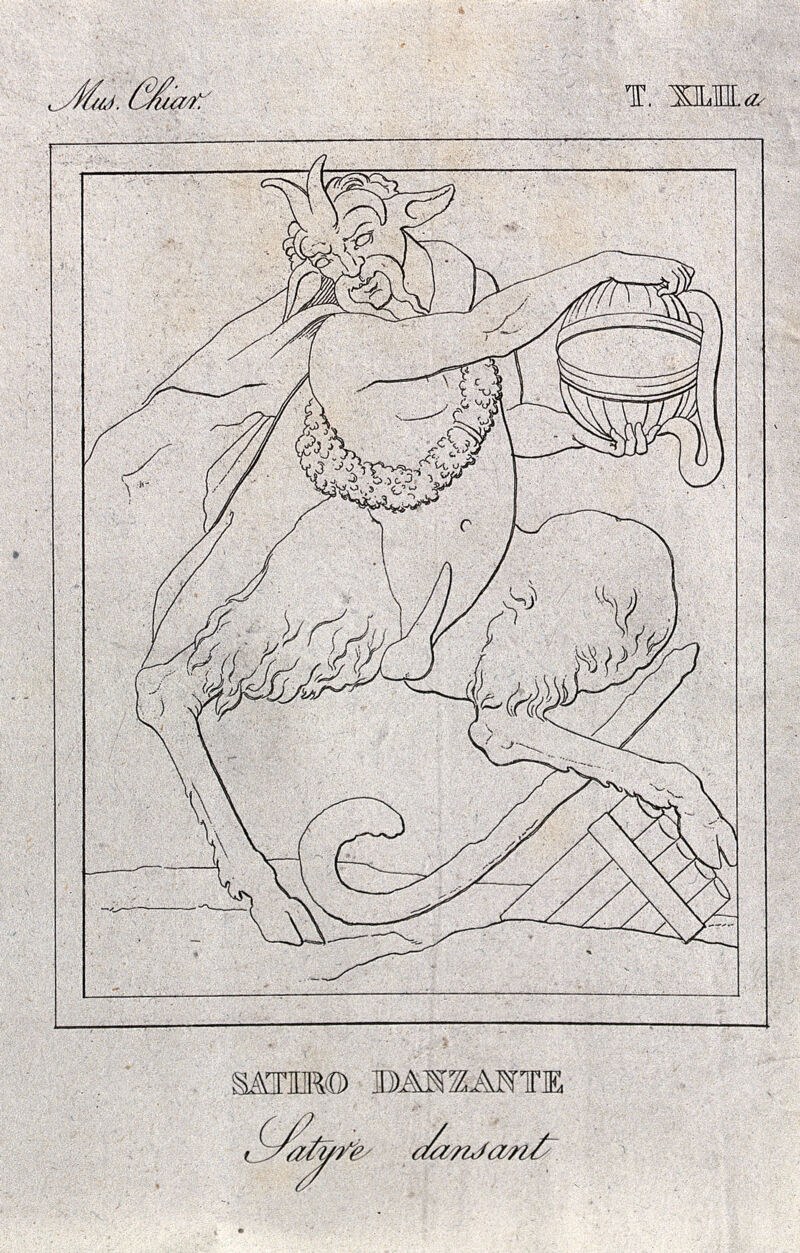
A dancing satyr, holding a casket. Engraving.
Unknown artist
- Source:
- Wellcome Collection
- Rights:
- Rights vary by item — check the source record before reusing this image. Source record ↗
- Recorded as:
- Check
Satyrs represent a crucial counter-image in early modern dance history: they embody unschooled, excessive, embodied motion in contrast to the rationalized, rule-bound movement codified in courtly dance. Seeing how artists rendered the satyr's body and posture tells us what contemporaries understood *vitality* and *disorder* in movement to look like. The work also documents the iconography available to spectacle-makers and dancers of the period, showing what a performer might study or recreate.
What you are looking at
An engraving depicting a dancing satyr in dynamic motion against a plain background. The satyr is shown in three-quarter view, leaning forward with considerable energy. His body is muscular and hirsute, with goat legs ending in hooves and a tail curving beneath him. He wears a garland or wreath of clustered fruits or flowers across his torso. His left arm extends forward and upward in an open gesture; his right arm bends back, holding an ornate cylindrical casket or vessel. His head is thrown back slightly, features animated, with prominent horns and a bearded face. The composition captures a moment of vigorous forward motion, the torso twisted and the weight driven through the legs. A geometric patterned object, possibly a shield or architectural element, appears at the lower right of the frame.
The dancing
A single male figure dominates the composition. The satyr's weight is distributed dynamically across splayed legs, with the body arched in a pronounced forward lean and spinal twist that suggests rapid movement. The extended left arm and the opposing curve of the back leg create a contrapposto-derived tension. The right arm is drawn inward and upward, cradling the casket. The musculature is heavily emphasized throughout, with particular attention to the chest, abdomen, and haunches, rendered through vigorous line work. The overall carriage suggests uninhibited, exuberant motion rather than controlled or codified technique.
The dance depicted
This is almost certainly a classical or Renaissance-period representation of a satyr—the mythological half-man, half-goat creature associated with Dionysian revelry and unbridled movement in ancient Greek and Roman art and drama. Satyrs do not represent a named dance style but embody a *quality* of movement: wild, celebratory, sensual, and untrained. The image draws on conventions of representing such figures in theatrical and allegorical contexts, particularly the satyrs that appeared in court masques and carnival traditions. The casket he holds may indicate a specific narrative episode (a theft, an offering, or a spectacle property), but the primary content is the satyr's own energetic, stumbling-forward motion—the antithesis of courtly restraint. This is *movement as character*, not as codified technique.
How it was made
This is an engraving, identifiable by the fine parallel line work (hatching) used to model form and create tonal variation, and the characteristic crisp, clean lines and sharp transitions between areas of light and shadow. The technique allowed wide distribution and reproducibility; engravings of this kind were collected, studied, and copied across Europe. The medium was particularly favored for anatomical studies, costume reference, and allegorical imagery during the Renaissance and early modern period. The skillful musculature and the confident anatomical rendering suggest the work was created by or after a trained artist familiar with classical sculpture and the conventions of representing the male figure.
About this work
This is a Renaissance or early modern engraving of a satyr in vigorous, unrestrained motion, holding a casket and turning sharply in space. Satyrs were stock characters in court spectacle, carnival, and theatrical tradition, embodying a kind of movement understood as wild, lustful, and disorderly—the inverse of the controlled, geometric dancing taught in courts and treatises. The image belongs in a gallery of dance art because it documents not a style but an *ethos* of movement, and because satyrs were frequent presences in dance spectacles, mummeries, and masques. The work is small-scale and reproducible, suggesting it was a study or reference print circulating among artists and perhaps spectacle-makers. It captures the moment of the satyr's *character through motion*, freezing in line what would have been conveyed on stage through costume, music, and the dancer's own body.
How to look at it
The satyr is frozen mid-stride, at the moment of maximum extension and twist—not at the apex of a jump or the stillness of a formal position, but in the act of *traversing space*. Notice how the body breaks into multiple vectors: the legs drive downward and forward, the torso spirals, the arms gesture outward in different directions. This is not the unified, geometric carriage of a trained dancer following a measure. The artist has chosen a moment of seeming chaos and urgency, emphasizing muscularity and the visibility of effort. The viewer is invited to read motion into the still image through the figure's dynamic posture and the strain visible in the articulation of the limbs.
The artist
Unknown. The engraving appears to be a study or reference print, possibly German or Italian in origin, dating to the Renaissance or early modern period. The style and technique are consistent with the Northern European engraving tradition of the 16th–17th centuries, though without an inscription or signature the artist cannot be identified. The work's small scale and apparent circulation as a print suggest it was made for professional reference rather than as a unique commission.
The period
In the 16th and 17th centuries, the satyr was a ubiquitous figure in European court spectacle, carnival, and theatrical innovation. Satyrs appeared in court ballets, intermezzi, and masques—often danced by male performers in costume—and they stood for everything that courtly dance was not: appetite, comedy, lasciviousness, and the celebration of the body outside hierarchical order. At the same time, the humanist revival of classical learning drove renewed interest in classical texts and imagery, including depictions of satyrs in antique art. Artists studying and disseminating classical knowledge through engravings and drawings created reference materials that spectacle-makers, dancers, and theater practitioners could consult. This engraving sits at the intersection of those currents: it is both a classical reference and a guide to how to move and look in a theatrical moment.
Where it lives
The work is held in the Wellcome Collection, a museum in London housing art, printed books, and artifacts related to the history of medicine, science, and human experience. How the satyr print entered the collection is not documented in the current catalogue record. It may have been acquired as part of a larger collection of prints or as a reference document for performance or costume study.
Dance in this work
Questions about this work
Was this an actual dance that people performed?
Not a named, codified dance. But satyrs were real roles in court spectacles and masques, danced by male performers in costume. This engraving is likely a study of how a satyr *character* should move and look—energetic, muscular, and wild. It's a record of theatrical convention rather than a technical manual.
Why is the satyr holding a casket?
The casket may reference a specific narrative or spectacle episode, but without more context or inscription we cannot say what it is. It may be a property used for comic or dramatic effect, or it may simply be an attribute identifying the satyr as a particular character or story-figure. Many Renaissance engravings of mythological figures include symbolic or narrative objects.
Is this definitely Renaissance?
The style, technique, and iconography are consistent with Renaissance or early modern (16th–17th century) Northern European printmaking, but the catalogue record does not give a firm date. The satyr's rendering and the engraving method both support that broad period.
What was the audience for this print?
Engravings like this circulated among artists, performers, designers, and educated collectors. A spectacle-maker or dancer might study it as a reference for costume and character; a painter or sculptor might consult it while learning classical imagery; a patron might collect it as part of a portfolio of allegorical and mythological prints.
More dance artwork