49 works in this view — arrow keys or swipe to move between them.
Dance in Art
Bharatanatyam Dance DVD
Swathi Group.
- Source:
- Internet Archive
- Rights:
- Rights vary by item — check the source record before reusing this image. Source record ↗
- Recorded as:
- Check
This image documents Bharatanatyam as it entered the digital age and became distributed through home media. It captures the classical form's emphasis on the dancer's whole presence—posture, costume, composure—not only in performance but in instructional contexts, making it valuable for understanding how this ancient form was taught and transmitted in modern formats.
What you are looking at
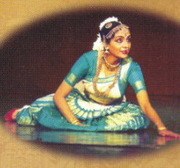
A single female dancer is shown in a seated or reclined pose against a warm, dark background. She wears a teal or turquoise silk blouse with a high neckline and fitted sleeves, paired with a cream or pale yellow pleated skirt that falls in careful folds. Her posture is relaxed yet controlled, with her body angled to the viewer's right; her left arm rests across her body while her right arm extends toward her lap. A jeweled ornament or bangle is visible on her wrist. The lighting is warm and soft, creating gentle shadows that model her form. Her gaze is directed downward and away, giving the pose an introspective or meditative quality. The composition is intimate and portrait-like, framed as if for a DVD cover or instructional materials.
The dancing
A single dancer is captured in a moment of stillness rather than dynamic movement. Her frame is upright but at ease, with no tension in the shoulders; the arms are soft and naturalistic rather than held in a formal position. The seated or kneeling posture suggests a preparatory or transitional moment in a choreographed sequence—neither mid-movement nor static portraiture. Her body alignment and the careful drape of her skirt suggest classical training and attention to line.
The dance depicted
This is identified as Bharatanatyam, a classical Indian dance form originating in Tamil Nadu. The image shows a moment outside the dynamic portion of a performance or practice sequence—a pose suggesting preparation, transition, or the meditative state cultivated in this dance form. Bharatanatyam is known for its rigid geometry, rhythmic footwork, and codified hand gestures (mudras), but this frame prioritizes the dancer's presence, costume, and bearing over technical display. The recording as a DVD suggests this is instructional or documentary material aimed at students or enthusiasts of the form.
How it was made
This is a digitised image from a DVD, likely a still frame or cover artwork from instructional or performance recording. The image shows characteristics of modern digital photography or graphic design for media packaging—the composition is carefully lit and framed for a rectangular screen format. The soft-focus background and studio lighting are typical of DVD artwork from the late 1990s or early 2000s. The Internet Archive source indicates this is a preserved digital object, suggesting the original DVD is no longer in common circulation.
About this work
This is a still image from a Bharatanatyam instructional or performance DVD by the Swathi Group, showing a single dancer in classical Indian attire during a moment of stillness or transition. The image functions as documentation of both the dance form and the body of the performer—recording not a peak moment of virtuosity but the composed, meditative quality that frames such moments in Bharatanatyam. The work belongs to the category of dance media and instruction, where the image carries pedagogical weight alongside aesthetic interest.
How to look at it
Notice the relationship between stillness and composition: the photographer or designer has chosen a moment of apparent rest to showcase the dancer's alignment, the fabric and color coordination of the costume, and the meditative quality valued in Bharatanatyam. Observe how the pose—neither fully seated nor in motion—suggests the dance's foundational principle of controlling and projecting energy even in apparent stillness. The camera angle and lighting privilege the upper body and face, aligning with how Bharatanatyam values the integration of facial expression, hand, and torso work.
The artist
The Swathi Group is credited as the creator of this DVD, but no further information about the group's membership, location, or artistic practice is available from the record. The name suggests an Indian dance ensemble or school, but the specific history and credentials of the group cannot be established from the image alone.
The period
Bharatanatyam underwent a major revival and transformation in the 20th century, moving from temple and court contexts into concert halls, educational institutions, and eventually film and digital media. By the time DVDs became a standard format for dance instruction (late 1990s–early 2000s), Bharatanatyam had been fully established as a classical art form worthy of international documentation and study. The packaging and presentation of this work reflects the era when classical Indian dance was being systematically recorded for wider distribution.
Where it lives
This image is held in the Internet Archive's digital collections, where it has been preserved as part of the archive's effort to record cultural materials. The original object is a DVD recording, likely produced in India or by an Indian diaspora community, though the precise date of production and original distributor are not recorded.
Dance in this work
Questions about this work
Is this a performance or a still photograph?
This appears to be a still image, likely taken in a studio setting or extracted from video footage for use as cover artwork or promotional material for a DVD. The careful lighting, neutral background, and formal framing suggest it was created specifically for media packaging rather than captured during a live performance.
Why is the dancer not moving?
In Bharatanatyam, stillness is not the absence of dance but a component of it. The pose shown here may represent a transition between movements, a moment of preparation, or a deliberate compositional choice to display the dancer's line and presence. The image conveys what the form values: precision, control, and the projection of energy even when the body is relatively still.
What does the costume tell us?
The silk blouse (choli) and pleated skirt (saree or odissi-style draping) are standard Bharatanatyam performance wear, indicating a classical context. The jeweled ornament and careful coordination of color and fabric suggest a performance or professional instructional setting rather than a casual class. The costume is part of the dance form's visual vocabulary and would be immediately recognizable to practitioners.
How was this DVD recorded and distributed?
The image is preserved in the Internet Archive, which holds many DVDs of cultural materials. While the original recording format is not specified in the catalogue, the digital image quality and aesthetic suggest production in the late 1990s or early 2000s, when DVDs were becoming the standard format for dance instruction and documentation.
More dance artwork