25 works in this view — arrow keys or swipe to move between them.
Dance in Art
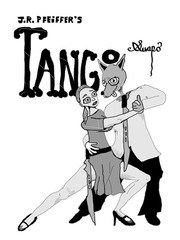
Tango Guapo (300629)
MangaPfeiffer
- Dance:
- Tango
- Source:
- Internet Archive
- Rights:
- Rights vary by item — check the source record before reusing this image. Source record ↗
- Recorded as:
- Check
For dancers and historians, this illustration documents how tango was stylized and promoted to a popular audience during its period of greatest international visibility. The artist demonstrates clear understanding of tango's technical requirements—the frame, the lead-and-follow relationship, the contra-body action—and renders them in a form designed to communicate instantly to viewers encountering tango for the first time. As a graphic artwork of the swing era, it sits at the intersection of dance, commercial art, and mass culture, showing how the dance was packaged and sold to the ballroom-going public.
What you are looking at
A couple dances tango in what appears to be a studio or performance setting, rendered in a bold graphic style with strong black linework characteristic of early 20th-century illustration. The man, dressed in a dark suit and dress shoes, leads the woman in the standard tango closed position. The woman wears a sleeveless dance dress with a knee-length skirt, her posture showing the characteristic tango frame—her upper body held close to her partner's, her lower body extended. The composition is dynamic, capturing a moment of forward motion and tilt, with the man's weight forward on his right leg and the woman's body in a dramatic lean away from her partner, the skirt flaring with the movement. The setting is minimal; the focus is entirely on the dancing couple, with no background detail or narrative context—pure dance form against white space. The graphic style employs bold outlines and hatching, with particular attention to the contrast between the dancers' clothing and their bodies.
The dancing
The couple are in a closed ballroom hold with the man's right hand at the woman's back and his left arm extended to meet her raised right arm. The woman's left hand rests on the man's right shoulder. Both dancers are captured mid-stride with a pronounced forward motion and contra-body action—the characteristic tango technique where the upper body and lower body move in opposing directions. The man's posture is upright but forward-focused; the woman's body shows the typical tango lean and extension, her weight distributed across her feet to allow the lead's movement to be transmitted through the frame. The artist has rendered the musculature and weight distribution with enough anatomical clarity to suggest knowledge of how the bodies actually engage in the dance.
The dance depicted
This is Argentine tango, the dance of working-class Buenos Aires that emerged in the late 19th century and spread to Europe and North America in the early 1900s. The image captures the essence of tango's partnership—the close embrace, the dramatic line of the woman's body, the man's commanding but responsive lead. The graphic style and composition suggest this is drawn from life or from a strong familiarity with how the dance looks in performance. The title 'Tango Guapo' (guapo meaning 'handsome' or 'bold' in Spanish) suggests the artist is engaging with the tango world itself, not merely recording a dance step. The rendering emphasizes the sensuality and intensity that made tango both celebrated and controversial when it first arrived in European ballrooms.
How it was made
This is a black-and-white graphic illustration, likely created in ink or drawn for reproduction as a print or in a publication. The technique employs bold, confident linework with hatching for shading and form. The style is consistent with early 20th-century commercial illustration and graphic design, when such imagery was used for dance instruction booklets, theatrical programs, or magazine covers. The bold graphic quality suggests this was designed to reproduce well at small scale, making it likely intended for print circulation rather than as a unique artwork. The medium was economical and suited to mass distribution, indicating the work was meant to reach the dancing public, not a fine-art audience.
About this work
This is a graphic illustration of an Argentine tango couple, rendered in bold black ink in the style of early 20th-century commercial art. The work captures the characteristic closed-position hold, forward drive, and contra-body action of the tango in a moment of dynamic motion. It dates or is styled to the early swing era (1920s–1940s), the period when tango was at the height of its popularity in ballrooms across Europe and North America, and when such graphic representations of dance were common in instruction material, theatrical promotion, and popular media.
The image is significant as a record of how tango was understood and visually represented at the moment of its international popularity. Unlike photographic documentation, which freezes a single frame, the illustrator's hand allowed for interpretive emphasis—here, the artist has exaggerated the dramatic line and extension of the woman's body and emphasized the frame and control of the partnership. The work belongs in a dance history collection as evidence of tango's visual culture and its role in public imagination during the swing era.
How to look at it
The viewer should attend to the moment of the movement the artist has frozen: not a static pose, but a moment of drive and momentum, with the woman's body extended and leaning away from her partner, her skirt catching the implied motion. This captures the dynamic quality of tango—the play between control and surrender, between the lead's forward motion and the follow's extension. The bold outline and hatching technique emphasize the bodies' musculature and the pressure of the frame, showing how the dance is transmitted through physical contact. Compare this to photographs of the same era: the illustration allows the artist to emphasize drama and line in ways the camera cannot, exaggerating the tango's sensuality and intensity for effect.
The artist
MangaPfeiffer is a contemporary artist whose work engages with dance and performance through graphic illustration and design. The artist's style draws on the vocabulary of early 20th-century commercial art and dance illustration—a period when bold line-based graphics dominated advertising, theatrical programs, and dance instruction materials. The approach suggests a deliberate revival or homage to that visual culture, re-animating the aesthetic of the swing era to explore how dance has been represented and circulated in popular media.
The period
The 1920s–1940s saw tango at the peak of its international ballroom popularity. Tango had arrived in Europe from Buenos Aires around 1910 and was transformed from a working-class social dance into a competitive ballroom standard. By the 1920s, it was danced in salons and cabarets across London, Paris, Berlin, and New York, and was a staple of Hollywood musical films. This was the era when ballroom dance was professionalized, standardized, and documented in instruction books, competition footage, and promotional graphics. Commercial dance illustration of this period served both pedagogical and promotional purposes—teaching the public what tango looked like and encouraging them to learn. The bold graphic style of this work is entirely consistent with the advertising and theatrical design of the swing era, when simplified, high-contrast images communicated instantly to mass audiences.
Where it lives
The work is recorded as held in the Internet Archive digital collection, identified as a source of dance artwork from the swing era (1920–1950). It is catalogued as a digital image with no additional provenance information. The work's presence in the Internet Archive suggests it may be from a digitized publication, periodical, or collection of printed materials.
Dance in this work
Questions about this work
Is this Argentine tango or ballroom tango?
The closed position and frame shown here are consistent with both the social Argentine tango of the early 20th century and the ballroom tango standard that emerged later. The simplicity of the composition and the emphasis on the lead-and-follow partnership suggests the artist may be depicting tango in its essence rather than a specific competitive or regional variant. By the 1920s–1940s, when this work dates, ballroom tango was the form most likely to be documented in popular illustrated form.
Who is the artist MangaPfeiffer?
MangaPfeiffer is a contemporary graphic artist known for work in dance illustration and design. Relatively little biographical information is readily available; the artist's approach to dance imagery draws deliberately on early 20th-century commercial art and instruction graphics. This work may be an original creation in a historical style, a digitized piece from that era, or a modern reinterpretation—the record and image alone do not clarify.
What does the title 'Tango Guapo' mean?
'Guapo' in Spanish can mean handsome, bold, or daring—often applied to a man with confident, masculine style. The title suggests the artist is engaging with the tango world's own vocabulary and sensibility, rather than presenting the dance from an external perspective. It positions the dance as something bold and glamorous, consistent with how tango was marketed to ballroom audiences in the early 20th century.
How do I know this is a graphic illustration and not a photograph?
The bold, simplified linework, the use of hatching for shading, and the high-contrast black-and-white technique are all characteristic of graphic illustration and reproductive printmaking, not photography. The artist has simplified anatomical form and exaggerated certain lines (particularly the woman's extended leg and the frame) for dramatic effect in a way no camera can. The style is consistent with commercial dance illustration of the 1920s–1940s.
More Tango artwork
![[Les noces de trottoir, par les compagnies Tango Sumo et Vendaval. Chalon dans la rue. 2007 / photographies de Joël Verhoustraeten] by Verhoustraeten, Joël (1954-2019). Photographe](https://gallica.bnf.fr/iiif/ark:/12148/bc6p058zgkc/f1/full/800,/0/native.jpg)