28 works in this view — arrow keys or swipe to move between them.
Dance in Art
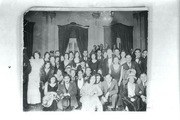
(18) Members of the Ackwees Athletic Club photographed about 1930 at their annual dance at the Washington Ballroom on Broad Street. Photo provided by Palmina Mascellino (FW - 1505 - 17)
Unknown artist
- Dance:
- Ballroom
- Era:
- 1920-1950 (Swing Era)
- Source:
- Internet Archive
- Rights:
- Reusable with conditions: credit the creator; non-commercial use only. Source record ↗
- Recorded as:
- https://creativecommons.org/licenses/by-nc/4.0/
This photograph is a historical record of African American social and recreational life during the early Depression, showing an organized ballroom dancing club and the formal social infrastructure that supported dance as community practice. The specific naming of the venue and organization makes this a concrete historical document, not a generic scene, and the provenance—provided by Palmina Mascellino—indicates a direct connection to lived experience of the period. For dance historians, it documents the material culture of ballroom dancing in urban African American communities: the venue, the dress codes, the organizational structures, and the social formality that governed such occasions.
What you are looking at
A large group photograph taken indoors at what appears to be a formal social dance or gathering. The setting is the Washington Ballroom on Broad Street, with ornate interior details visible in the background—columns, archways, and period wall treatments typical of early 20th-century ballroom architecture. Approximately 18 members of the Ackwees Athletic Club are arranged in a formal pose for the camera, distributed across multiple rows. The photograph is black-and-white and shows the subjects at rest, not in active motion; this is a commemorative group portrait rather than a candid dance-floor capture. The participants wear formal attire appropriate to the occasion: men in suits and ties, women in day dresses and heeled shoes. The composition is frontal and symmetrical, characteristic of documentary photography of the period, with the group positioned to make eye contact with the camera.
The dancing
The figures stand at ease in a formal grouping, without the dynamic hold or frame one would see in active ballroom dancing. There is no visible closed hold, no frame at all—the subjects are posed individually and in pairs, standing upright and facing forward. Their posture is correct and dignified, as befits formal dress and a commemorative photograph, but the image captures a moment of stillness rather than movement. The clothing and stance suggest people prepared for an evening of social dancing, but the photograph itself documents the club membership, not the dance itself.
The dance depicted
This is a documentary photograph of a social dance event, not a depiction of dance in progress. The Ackwees Athletic Club held an annual dance at the Washington Ballroom—a venue for social ballroom dancing in the early 1930s. The photograph serves as a record of attendance and membership at this formal social occasion. Ballroom dancing of the period would have included waltzes, foxtrots, and other standard ballroom styles, but this image captures the club members before, after, or between dances, in their formal attire and posed for the photographer rather than in the act of dancing.
How it was made
This is a black-and-white photograph, likely taken with a studio or large-format camera of the 1930s. The sharp focus, formal composition, and indoor setting with visible architectural detail suggest professional photography, probably commissioned by the club for a commemorative record. The photograph's scale and formal arrangement indicate it was intended for publication or preservation as a historical document. The technique allows the photographer to capture facial features, clothing detail, and the full assembly of the group in a single frame—a practical necessity for documenting club membership of this size and formality.
About this work
This is a documentary photograph of the Ackwees Athletic Club's annual dance in 1930, a social event held at the Washington Ballroom on Broad Street. The image shows the club members assembled in formal dress, posed for a commemorative group portrait. While it documents a ballroom dance event, it does not itself depict dancing in progress; rather, it is a record of a specific moment in the social life of this organization during the Depression era. The photograph is valuable as evidence of organized social dance among African American communities in the early 1930s, of ballroom culture in a named venue, and of the formal attire and social protocols that framed such occasions.
How to look at it
Attend to the formality of the composition and the contrast between the ballroom setting—a space dedicated to movement and dance—and the stillness of the pose. Note the clothing in detail: the men's suits and ties, the women's formal day dresses and heeled shoes, all appropriate to ballroom dancing of the period. Observe how the photographer has arranged the group to show faces clearly while also conveying group identity and size. This is not a 'dance photograph' in the sense of capturing choreography or technique in motion; it is a social document that uses the setting and occasion of a dance event to mark membership, respectability, and community participation.
The period
Ballroom dancing was a central social practice in American urban communities during the 1920s and 1930s, with dedicated dance halls and ballrooms serving as sites of formal social interaction, courtship, and community gathering. The Washington Ballroom on Broad Street was likely one of Philadelphia's or another major city's public dance venues, operating during an era when such spaces were racially segregated but nonetheless central to African American social life. The formal attire, posed photography, and organizational identity of the Ackwees Athletic Club reflect the respectability politics and formal social codes that governed Black middle-class and working-class community organizations of the period. By 1930, photographs of dance events and social clubs had become standard ways of documenting community achievement and membership.
Where it lives
The photograph is from the internet_archive digital collection and was provided by Palmina Mascellino (accession reference FW - 1505 - 17). It appears to be part of a community history or oral history project, suggesting it was preserved as a personal or family record of a specific social occasion and organization.
Questions about this work
Is this a picture of people dancing?
No. This is a posed group photograph taken at a ballroom dance event. The members of the Ackwees Athletic Club are assembled and standing still for the camera, wearing the formal attire they would have worn to dance, but the photograph itself captures a moment of stillness, not dancing in progress. It is a commemorative record of the club's membership.
What was the Washington Ballroom?
The Washington Ballroom was a public dance venue on Broad Street, operating during the early 20th century as a site for formal social ballroom dancing. Its precise location and history would require local research, but it served as the venue for the Ackwees Athletic Club's annual dance on the occasion this photograph was taken.
Who were the Ackwees Athletic Club?
The Ackwees Athletic Club was a social and recreational organization that held annual dances at the Washington Ballroom around 1930. The name and membership suggest a formal social club, likely serving an African American community, but further information about the organization's history, membership criteria, and activities would require additional historical research.
What kind of dance would they have done?
At a ballroom in the early 1930s, dancers would have engaged in standard ballroom styles of the period: waltzes, foxtrots, and the newer dances of the Jazz Age. This photograph does not show the dancing itself, but the formal dress and ballroom setting indicate the social dances of the period were the occasion for this gathering.
More Ballroom artwork