13 works in this view — arrow keys or swipe to move between them.
Dance in Art
Cotillion Program
Newark (N.J.)
- Dance:
- Cotillion
- Source:
- Internet Archive
- Rights:
- Reusable with conditions: credit the creator; non-commercial use only. Source record ↗
- Recorded as:
- https://creativecommons.org/licenses/by-nc/4.0/
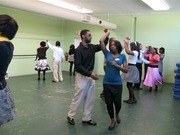
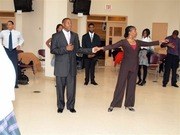
This photograph documents a specific instance of cultural continuity and community practice: how African American cotillion traditions have maintained formal partner dancing and social ritual across generations. For historians and dancers, it provides evidence of where and how cotillion dances were actually performed in contemporary practice, beyond historical records or academic description.
What you are looking at
A formal social gathering in an interior space, likely a community center or hall in Newark, New Jersey. Men in dark suits and ties stand in small clusters; women wear dresses typical of early 2010s casual formal wear. The room has institutional fixtures—fluorescent lighting, wood paneling, and basic furnishings—suggesting a public or civic space rather than a ballroom. The photograph captures a moment of social mingling: people are standing, conversing, and oriented toward one another in the relaxed posture of pre-dance gathering rather than active dancing. The setting and dress code indicate this is documentation of a contemporary social event, not a historical recreation.
The dancing
The attendees stand upright in conversational groups, with open body language and relaxed arm positions. No dancers are actively moving or in closed hold positions. The spacing and grouping suggest people preparing for or between activities rather than engaged in partnered dance. The absence of any visible dance frame, weight shift, or coordinated movement distinguishes this as a social assembly rather than active dancing.
The dance depicted
This is a photograph of a cotillion event—a formal social gathering organized around structured partner dances and social etiquette. The cotillion tradition, rooted in 18th-century French court dance, has been preserved in African American communities as a coming-of-age ritual and social event emphasizing formal dress, manners, and introductions. The photograph documents the pre-dance moment: attendees assembled, ready to participate in choreographed group dances and partner exchanges. Without visible active dancing, we see the ceremonial framing rather than the kinetic content.
How it was made
This is a digital photograph, likely taken with a standard camera or smartphone. The color saturation, artificial lighting, and image quality are consistent with amateur event documentation from the 2010s. The photograph is indexical—a direct record of a specific moment and place—rather than an artistic interpretation. This medium privileges factual documentation of the event's social context, participants, and setting over the dance technique itself.
About this work
This is a photograph documenting a contemporary cotillion event in Newark, New Jersey, circa 2010. The cotillion is a formal social dance tradition with roots in European court dance, sustained and transformed in African American communities as a rite of passage and expression of social identity. The image captures the preparatory moment of such an event: formally dressed guests assembled in a community space, moments before structured dances begin. It is evidence of how the cotillion—a dance form born in the 18th century—continues as a living social practice in early 21st-century urban America.
How to look at it
Look past the absence of active dancing to read what the photograph shows: the formality of dress, the structured grouping, the interior setting, and the composed readiness of attendees. The documentary quality—the straightforward lighting and composition—serves the subject: this is evidence of social practice, not artistic interpretation. The image's value lies in what it attests to about where, when, and how people gathered to dance.
The artist
The photographer is not identified in the catalogue record. This appears to be event documentation—possibly by a family member, volunteer, or professional event photographer—rather than work by an established artist. The image was archived by the Internet Archive, suggesting it may have been shared online or held in a public or institutional collection in Newark.
The period
In the 2010s, cotillion traditions in African American communities were experiencing renewed visibility and scholarship. Simultaneously, formal partner dancing was declining in mainstream American social culture, making cotillions an important repository of ballroom technique and formal social ritual. This photograph documents that context: a living practice sustained within a specific community even as it had largely disappeared from broader American social life.
Where it lives
This photograph is held in the Internet Archive digital collection. The catalogue record provides only a location (Newark, N.J.) and approximate date (2010), suggesting it may have been digitized from a local source, family collection, or community organization archive without full cataloguing.
Dance in this work
Questions about this work
What is a cotillion?
A cotillion is a formal social gathering organized around structured group dances and partner exchanges, with roots in 18th-century French court dance. In African American communities, cotillions became a significant tradition for coming-of-age celebrations and social events emphasizing formal etiquette, dress, and partner dancing. They remain active in some communities today.
Why is there no dancing visible in this photograph?
The photograph captures the assembly moment before dances begin. Cotillion events typically include a formal gathering, introductions, and social mingling, followed by structured dances. This image documents the preparatory phase, which is itself part of the event's social significance.
What does this tell us about dance in 2010?
The photograph provides evidence that formal partner dancing, though marginalized in mainstream American culture, remained an active practice in specific communities. It shows the institutional settings and contemporary social contexts where ballroom dance traditions were kept alive.
More Cotillion artwork