49 works in this view — arrow keys or swipe to move between them.
Dance in Art
Dancers
Edgar Degas (French, 1834–1917)
- Source:
- Internet Archive
- Rights:
- Public domain — free to use, share and adapt.
- Recorded as:
- https://creativecommons.org/publicdomain/zero/1.0/
For dancers and dance historians, this work documents Degas's mature understanding of the dancing body in motion and at rest—not as a record of technique but as a vehicle for emotion and visual form. It shows a major artist of the 19th century turning to the dance studio as a laboratory for modernist painting, and it reveals how deeply dance shaped avant-garde practice.
What you are looking at
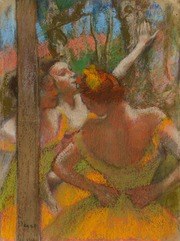
Three female dancers occupy a shallow interior space defined by vertical architectural elements—columns or doorways—rendered in warm ochres and blues. The nearest figure, center-left, wears a rust-colored bodice and leans into a pronounced contrapposto with her weight shifted low; her raised arm extends toward the picture plane in a gesture of appeal or invitation. Behind and to the right, a second dancer in yellow-orange reaches upward with both arms, her body arched in extension. A third figure, partially obscured in the background right, wears cooler tones and stands more upright. The palette is warm and earthy—ochres, terracottas, pale yellows—with touches of blue-green shadow. The brushwork is loose and expressionistic, building form through color and gestural mark rather than precise outline. The light is diffuse and interior, falling across the figures without strong directional source.
The dancing
The primary dancer's weight settles on bent legs in a deep plié or lunge, torso tilted forward from the hips, one arm raised to shoulder height with the palm open. The second dancer lifts both arms in an overhead reach, her spine extended and chest lifted—a pose of aspiration or emotional openness. Neither figure touches the other, and their spacing suggests solitude within proximity rather than partnered work. The poses emphasize the vertical axis of the body and the expressive capacity of the limbs; there is no formal closed hold, no neat frame, no closed position of the feet.
The dance depicted
The image most plausibly depicts rehearsal or study from life rather than a named technical style. The dancers wear simple practice dress (bodices, skirts) and the poses—deep weight, extended arms, inward emotional register—suggest modern or contemporary movement of the late 19th or early 20th century. The artist has chosen moments of transition rather than fixed positions: a dancer settling into weight, another reaching. This is consistent with Degas's long engagement with the Paris Opéra Ballet and dance rehearsal, though the expressionistic treatment here moves toward a more symbolist or modernist sensibility than his more naturalistic earlier studies.
How it was made
The work appears to be executed in pastel or colored chalk, a medium Degas favored for studies and finished works alike from the 1860s onward. Pastel allowed him to work rapidly and revise extensively, building color through layering and blending without the constraint of wet media. The loose handling visible here—color applied in broad strokes, contours left open, the surface texture assertive—is typical of Degas's later manner and suited to exhibition as a complete work rather than a study alone. The medium's softness and capacity for both precision and suggestion made it ideal for capturing the interior light and textile surfaces of the dance studio.
About this work
This is a study of three dancers in a studio or interior setting, executed in Degas's characteristically loose pastel technique. The work belongs to his extensive engagement with dance as a subject—particularly the Paris Opéra Ballet and the figure of the dancer in rehearsal, rest, and private gesture. Rather than depicting a performance or a formal dance style, it captures a moment of study or transition: the emotional and physical texture of movement rehearsal. The painting exemplifies Degas's long interest in movement, light, and the dancer's body as a site of artistic investigation. It also marks a shift in his work toward more expressionistic, color-centered compositions in which the dance is as much a pretext for exploring form and mood as a record of what occurred.
How to look at it
Attend first to the pose of the nearest figure: the settling of weight, the reach of the arm, the tilt of the head. This is not a peak moment of technique but a passing gesture—the kind of moment a dancer might not consciously register. Degas's choice to isolate and enlarge this instant reflects his conviction that the most important moments in dance were often the smallest and most private. Notice also the color: how the warm ochres and yellows construct form without relying on line, and how the blue-green shadows suggest the cool light of an interior studio. The composition is asymmetrical and seemingly casual, as if the artist had simply looked up from his sketchbook and captured what was there. This casualness is deliberate and hard-won.
The artist
Edgar Degas (1834–1917) was a French painter and sculptor who became the leading visual artist of the Paris Opéra Ballet. From the 1860s until his death, he made hundreds of drawings, paintings, pastels, and sculptures of dancers—in rehearsal, in dressing rooms, on stage, and in private study. Degas was not a dance specialist but a modernist painter for whom dance offered an ideal subject: complex movement, interior light, the play of costume and body, and a world parallel to bourgeois society. His treatment ranged from naturalistic study to increasingly abstract and expressionistic compositions. He was equally committed to the technical aspects of dance—he understood positions and movements with a draftsman's precision—and to the emotional and formal properties of the dancing figure.
The period
This work dates to Degas's later years, a period when Impressionism and modernism were reshaping painting. In dance, the 1880s–1910s saw the emergence of new choreographic languages: the Russian Imperial Ballet under Marius Petipa, the growth of modern dance in the United States and Europe, and a broader shift away from purely classical ballet toward more varied, expressive, and sometimes abstracted movement. Degas's late paintings and pastels reflect this transition: his dancers are less often performing a named technique than inhabiting a psychological or formal space. His work influenced modernist dance theory and practice, and his studies of the body became a resource for dancers, choreographers, and dance historians seeking to understand how artistic attention could be turned toward movement.
Where it lives
The work is part of the Internet Archive digital collection, which aggregates images from multiple holding institutions. The catalogue record does not specify a current location or accession number. The date in the record (2024) is a metadata error and likely refers to digitization rather than creation.
Dance in this work
Questions about this work
Did Degas dance or train as a dancer?
No. Degas was a painter and sculptor who became obsessed with the visual experience of dance and the dancer's body. He trained at the École des Beaux-Arts in Paris and drew from life obsessively. His knowledge of movement came from close observation of rehearsals, performances, and studio work, and from his own rigorous study of anatomy and the mechanics of the body.
Why did Degas care so much about dancers?
For Degas, dancers offered what no other subject could: complex, continuous movement within a defined social space (the studio and theater). The dance studio allowed him to observe bodies under discipline, in transition, and in relationship to light and architecture. Dancers were also members of the working Paris he wanted to paint—not the leisure class but skilled, hardworking, sometimes vulnerable women navigating a hierarchical institution.
Is this a finished work or a study?
By Degas's late period, the distinction had largely dissolved. He exhibited pastels of this kind as complete works. The loose handling and open composition are deliberate artistic choices, not signs of incompleteness. For Degas, a work was finished when it had achieved the formal and emotional qualities he intended.
More dance artwork