49 works in this view — arrow keys or swipe to move between them.
Dance in Art
Dancers 1950s
Unknown artist
- Source:
- Internet Archive
- Rights:
- Public domain — free to use, share and adapt.
- Recorded as:
- http://creativecommons.org/publicdomain/zero/1.0/
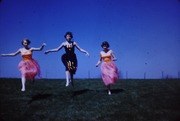
This photograph provides visual evidence of how ballet was taught, performed, and represented in American culture during the 1950s—a period when classical ballet was experiencing revival and expansion in the United States. The image documents the appearance, costume, and formal pose conventions of mid-century student ballet, preserving details of tutus, pointe shoes, and body positions that shaped a generation's understanding of what ballet looked like.
What you are looking at
Three young female dancers stand against a deep blue twilight sky, positioned across an open, dark ground. The girl on the left wears a pink tutu and pointe shoes; the center dancer is dressed in a dark leotard; the girl on the right mirrors the left in a pink tutu. All three have their arms raised and extended outward in a lyrical pose, creating a symmetrical composition. The lighting is theatrical—the figures are lit from above and slightly in front, creating a luminous quality against the darkening sky. The setting appears to be outdoors on a flat plane, with no visible scenery or props. The photograph captures a moment of suspended, delicate movement, the dancers' bodies aligned in what appears to be a rehearsed tableau rather than a candid action shot.
The dancing
All three dancers stand upright with legs extended and turned out in classical positions. Their arms are raised to shoulder height and extended laterally with soft, rounded elbows—a port de bras characteristic of classical ballet vocabulary. The two girls in pink tutus appear to be in fifth or first position, with their bodies erect and elongated. The center dancer in dark clothing maintains the same arm position despite her different costume. The symmetry of the three figures and their synchronized arm placement suggests either a formal pose for documentation or the final tableau of a short piece. No pointe work in motion is visible.
The dance depicted
This appears to be a theatrical ballet photograph, likely from a student performance, school recital, or documentation of a ballet class or rehearsal. The tutus, pointe shoes, and classical arm positions are unambiguous markers of ballet training and practice. The 1950s date suggested by the photograph's color and aesthetic, combined with the formal studio lighting and composition, indicates this is likely promotional or archival documentation of a ballet school or amateur ballet production. The pose is a standard classical ballet finish or opening tableau—formal, symmetrical, and designed for visual display rather than the dynamism of active movement.
How it was made
This is a color photograph, likely Kodachrome or an early color film stock, characterized by the saturated, cool-toned blue of the sky and the warm flesh tones of the dancers' skin. The photographic technique employs theatrical gel lighting or outdoor evening light to create a backdrop of uniform color, isolating the figures against an abstract background. The choice to photograph outdoors at dusk rather than in a studio setting suggests either experimental art photography or documentation of an outdoor performance. The color process and lighting approach were sophisticated for amateur dance documentation in the 1950s, implying either a professional photographer or deliberate artistic intent.
About this work
This is a 1950s color photograph of three young ballet dancers posed in classical formation against a twilight sky. The image documents either a ballet school rehearsal, student performance, or artistic photographic project featuring girls in tutus and pointe shoes. The photograph's formal composition, sophisticated lighting, and careful framing suggest it was created with deliberate artistic purpose—whether as promotional material for a ballet school, documentation of a student production, or an experimental art photograph exploring dance and landscape. The work belongs in a dance art gallery because it captures both the classical vocabulary of mid-twentieth-century ballet training and the aesthetic conventions of how dance was photographed and presented to audiences during this period.
How to look at it
Attend to the deliberate symmetry of the composition: the two pink tutus frame a dark center figure, creating visual balance and formal order. Notice the soft, extended arm positions—these are not accidental gestures but carefully taught classical positions designed to elongate the body and create an aesthetic line. The choice to photograph at dusk, with the sky providing a cool, abstract background, removes the dancers from any specific location and elevates the image toward an idealized, timeless quality. The moment frozen here is not a peak of dynamic movement but a held pose—the kind of finish a choreographer would use to mark the end of a piece or the moment a photographer would ask dancers to hold for documentation.
The period
The 1950s saw a significant expansion of ballet's presence in American culture following the success of major ballet companies and the rise of television performances. Ballet schools proliferated in urban and suburban communities, and documentation of student performances became common. Photography was increasingly used to record dance, particularly color photography, which was still relatively expensive and therefore reserved for important occasions. The aesthetic of this photograph—the romantic outdoor setting, the symmetrical pose, the soft lighting—reflects mid-century ideas about ballet as an elegant, aspirational, and fundamentally feminine art form. The formal tableaux pose was standard in ballet documentation of the era, emphasizing visual beauty and classical line over action or narrative.
Where it lives
The work comes from the Internet Archive digital collection, which indicates it was either donated or digitized from an institutional or private holding. The 1950s dating and photographic style suggest it may be a school or studio photograph, though the specific collection and original holding institution are not recorded.
Dance in this work
Questions about this work
Are these professional ballet dancers?
Almost certainly not. The formal pose, the outdoor 'studio' setting chosen for the photograph, and the overall aesthetic suggest these are students—likely from a ballet school or performing in a student recital. The photograph appears to be documentation of amateur or semi-professional ballet activity rather than a professional company performance.
Why are they posed outdoors?
Outdoor or unconventional settings for dance photography were increasingly common in the 1950s as photographers began experimenting with art photography techniques. The twilight sky provides an abstract, dramatic backdrop that isolates the dancers and creates an ethereal quality. This may also reflect practical limitations—the photograph might have been taken outdoors due to lack of studio space, or the outdoor setting may have been a deliberate artistic choice.
What is the difference between the girl in the dark outfit and the two in pink?
The costume difference may indicate role or position in the piece, or it may simply reflect the school's available costumes. In some ballet traditions, a central soloist wears a different color. The dark outfit could also indicate a corps de ballet member or a supporting role, though without knowing the choreography, this cannot be determined with certainty. All three dancers maintain identical classical arm positions, suggesting they are performing the same step or held tableau.
How do I know this is ballet and not another form of dance?
The pink tutus, pointe shoes visible on the dancers in pink, the turned-out positions, and the classical arm positions are all definitive markers of theatrical ballet. The pose itself—a formal, symmetrical tableau—is consistent with how ballet was choreographed and photographed in the mid-twentieth century.
More dance artwork