40 works in this view — arrow keys or swipe to move between them.
Dance in Art
French Folk Dance
laurent guidali
- Dance:
- Folk/Country
- Source:
- Internet Archive
- Rights:
- Reusable with conditions: credit the creator; share any adaptation under the same license. Source record ↗
- Recorded as:
- https://creativecommons.org/licenses/by-sa/4.0/
This work matters because it documents folk dance as lived social practice—the teaching, learning, and community participation that constitutes the actual continuation of tradition. Rather than showing folk dance as performance or history, it records the embodied transmission between dancers in real time.
What you are looking at
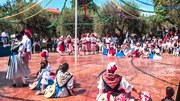
A large outdoor gathering on a red-clay or earth ground, photographed in bright daylight. Dozens of people in casual modern dress are arranged in loose clusters across the space, many seated or crouching on the ground. In the foreground, several figures are in close physical contact—some appear to be in paired or grouped formations suggesting partner work or ensemble coordination. The background shows a dense crowd of spectators standing and watching. Trees and what appears to be a natural or rural setting frame the scene. The overall composition suggests a participatory event or workshop rather than a staged performance, with the emphasis on group participation and social interaction.
The dancing
The figures in the foreground display varied body positions: some are bent at the knees or hips, engaging in what appears to be contact or weight-sharing with partners; others are standing or semi-upright. The poses suggest grounded, connected movement—bodies are close together, arms are often between or around partners, and the weight appears to be distributed low through the legs. This is characteristic of partner work or ensemble contact dance. The lack of lifted, extended arms or balletic posture, and the emphasis on proximity and ground-level positioning, distinguishes this from formal theatrical dance.
The dance depicted
This appears to document a folk or social dance workshop or gathering, most likely European folk dance given the catalogue attribution to 'French Folk Dance.' The outdoor, participatory setting and the mixed-gender pairings with close contact suggest a traditional couple dance or group circle dance common to French or Western European folk traditions. The photograph captures not a performance but the teaching or practice phase—people learning or dancing together in a naturalistic setting. The emphasis on partnership, ground connection, and casual dress suggests this is authentic folk practice rather than a stage recreation.
How it was made
This is a color photograph, likely digital given the vibrant saturation and clarity. The photographic medium allows documentation of real-time social dancing in its actual context, capturing the spontaneity and communal aspect that distinguishes folk dance from choreographed performance. The outdoor natural light and the inclusive framing—showing both active dancers and surrounding spectators—suggest this is documentary or ethnographic photography rather than artistic portraiture. The medium's specificity of time and place is essential to the work's value as evidence.
About this work
This photograph documents a participatory folk dance event or workshop, presenting French or Western European traditional dance as a living social practice rather than a staged or historical artifact. The work captures the embodied knowledge and community participation central to folk dance transmission, showing how bodies learn and share movement through proximity, partnership, and repeated practice. As documentation of folk dance in contemporary practice, it serves as both ethnographic record and evidence of how traditional forms persist and adapt in modern contexts.
How to look at it
Pay attention to the body contact and partnering: how close dancers stand, where hands and arms are positioned relative to partners, the bend in the knees and forward lean of the torso. These details reveal the specific movement vocabulary and weight-sharing of the dance form. Notice also the casual dress and outdoor setting—these signal authenticity and social rather than theatrical context. The photographer's choice to show both active dancers and watching community members emphasizes folk dance as participatory culture.
The artist
Laurent Guidali is a contemporary photographer documenting dance and movement. Limited information is available beyond the catalogue record; the photographer's practice appears to center on capturing authentic movement in social and educational contexts rather than staged performance documentation.
The period
Dated 2022, this photograph sits within contemporary documentation practices that emphasize folk dance as active, evolving social culture rather than museum artifact or nostalgic recreation. The rise of digital photography and online archiving has enabled wider documentation and circulation of grassroots dance practice. The image reflects 21st-century interest in folk dance revival and transmission, particularly in European contexts where folk traditions have seen renewed attention.
Where it lives
The work is held in the Internet Archive digital collection. It is a contemporary photograph and appears to be part of a broader documentation project, though specific collection context is not recorded.
Dance in this work
Questions about this work
Is this a performance or actual folk dance practice?
This appears to be actual folk dance practice or workshop—a gathering where people learn and dance together in a participatory setting. The outdoor location, casual dress, and mixed-skill groupings suggest social or educational context rather than staged performance. The photographer's framing prioritizes community and process over spectacle.
What French folk dances involve close partner contact like this?
Several traditions fit: bourrées and branles (circle and line dances with partner contact), various regional couple dances, and modern revivals of traditional forms. The specific style cannot be definitively identified from the photograph alone, but the close positioning and partner work are characteristic of French folk couple traditions.
Why photograph folk dance outdoors and casually rather than on stage?
Outdoor, naturalistic documentation emphasizes folk dance as living social culture embedded in community practice rather than historical re-creation or theatrical spectacle. This approach honors how folk traditions are actually transmitted and sustained—through people teaching and learning together in everyday spaces.
More Folk/Country artwork