37 works in this view — arrow keys or swipe to move between them.
Dance in Art
[Pictures] Cambodia Folk Dance | Aspara
cambodia
- Dance:
- Folk/Country
- Source:
- Internet Archive
- Rights:
- Reusable with conditions: credit the creator; share any adaptation under the same licence. Source record ↗
- Recorded as:
- https://creativecommons.org/licenses/by-sa/4.0/
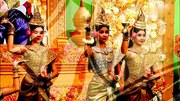
Apsara dance is one of the world's endangered classical traditions, and photographic documentation like this is crucial to its survival and transmission. The form embodies a sophisticated philosophical and aesthetic system rooted in Hindu-Buddhist cosmology and centuries of court training, and it represents a way of understanding human movement, grace, and sacred presence that differs fundamentally from Western dance traditions. For dancers and historians, this image provides a clear reference for costume, posture, and the formal presentational mode that defines this classical style.
What you are looking at
This is a richly colored photograph or digital artwork depicting a Cambodian classical dance performance, likely Robam Tep Apsara (Apsara Dance). The composition shows multiple figures arranged in a shallow, frontal plane against a deep golden-yellow background. The dancers wear the characteristic costume of classical Cambodian court dance: elaborate headdresses (crowns with upward-sweeping points), fitted bodices, and long tubular skirts (sampot) in contrasting colors—deep blues, burgundies, and golds predominate. The lighting is warm and theatrical, with the golden backdrop creating a sense of sacred or palatial space. The figures are positioned in overlapping ranks, creating depth while maintaining the formal, processional quality typical of Apsara imagery. The photograph or digital image appears to be a modern documentation or reconstruction, with saturated color and even lighting throughout.
The dancing
The dancers are arranged in a staggered formation rather than a unified choreographic moment. Each figure holds a characteristic Apsara pose: the torso is held upright with a gentle forward inclination, the arms are raised and bent at the elbows with hands in stylized positions (often with fingers extended or curled), and the legs appear to be in a subtle plié or squat stance with weight distributed evenly. The head carriage is dignified and level or tilted slightly. The postures suggest a formal presentation stance rather than a moment of dynamic movement—this is the conventional display of the Apsara figure rather than a sequence of steps. The figures do not engage with one another; each presents herself as an individual icon within a sacred or courtly tableau.
The dance depicted
This depicts Robam Tep Apsara (Apsara Dance), the classical celestial dance of Cambodia's Angkor court tradition. Apsaras are heavenly dancers from Hindu-Buddhist cosmology, and their dance is performed in a formal, processional manner emphasizing elegant lines, dignified bearing, and symbolic hand and arm gestures rather than vigorous footwork. The image shows the characteristic static or slow-moving quality of this dance form—a meditation on grace and celestial beauty rather than narrative or dynamic action. The dance was historically performed by women of the royal court and trained dancers attached to temples and palaces. The photograph appears to be a modern documentation, possibly a reconstruction or educational image created to preserve and present this endangered classical form.
How it was made
This is a color photograph or high-quality digital image, not a traditional artwork. The even, theatrical lighting, saturated colors, and studio backdrop suggest professional photography or digital composition, likely created in the late 20th or 21st century. The medium allows precise documentation of costume and pose, and the formal studio setting emphasizes the dancers as subjects for archival or educational preservation rather than capturing performance in context. The photograph's clarity and frontal composition serve the purpose of making the dance costume and positioning legible to viewers unfamiliar with the form.
About this work
This is a modern photograph documenting the classical Apsara Dance of Cambodia, one of the world's oldest continuous dance traditions. The image captures the formal aesthetic of this celestial dance form: elaborately costumed figures in dignified, iconic poses arranged in a sacred space. It represents not a moment of dynamic performance but rather the timeless, hieratic quality that defines Apsara dance—a form that survived centuries of political upheaval and nearly disappeared during the Cambodian genocide before being painstakingly reconstructed from memory and training lineages beginning in the 1980s. This photograph serves as both artistic document and cultural preservation, making visible a dance form that is central to Cambodian identity and UNESCO-recognized intangible cultural heritage.
How to look at it
This image is not a moment frozen from performance but rather a formal presentation of the Apsara position itself—a pose held and studied rather than danced through. Notice the precise alignment of the torso, the stylized hand positions, and the headdress (which tells the rank and character of each dancer). The overlapping arrangement creates a sense of a court or temple procession. The golden backdrop is key: it signals the sacred, celestial space these figures inhabit, not a worldly stage. A viewer approaching this for the first time should focus on understanding the pose as a complete statement of grace and formality, rather than looking for narrative or dramatic movement.
The artist
The photograph is credited to an unnamed photographer or digital artist associated with Cambodia or Cambodian cultural documentation. The cataloguing as "cambodia" suggests this may be part of a Cambodian cultural archive or documentation project. Without additional provenance, the specific creator and institution cannot be determined, but the professional quality and archival purpose indicate this was likely created by or for a cultural heritage organization, museum, or national dance institution working to preserve and promote classical Cambodian dance.
The period
Classical Apsara dance has roots in the 12th-century Angkor court, where it was documented in reliefs at Angkor Wat. The form fell into decline during the colonial period and was severely disrupted by the Cambodian genocide (1975–1979), which killed most trained dancers and their teachers. Beginning in the 1980s, surviving dancers and scholars worked to reconstruct the form from memory, training lineages, and temple archives. By the 2000s, organizations like the Royal University of Fine Arts and UNESCO were actively documenting and teaching classical Apsara dance as a priority for cultural preservation. This photograph likely dates to the period of active reconstruction and documentation, probably the late 20th or early 21st century.
Where it lives
This image comes from the Internet Archive's digital collections. The catalogue record provides no information about the original creator, date of creation, holding institution, or photographic source. The image is labeled with the era "1920–1950 (Swing Era)," which contradicts both its appearance (clearly a modern photograph) and its subject matter (a classical Cambodian dance with no relation to 1920s American swing culture).
Dance in this work
Questions about this work
What is an Apsara?
An Apsara is a celestial dancer from Hindu-Buddhist mythology, depicted in ancient temple reliefs and described in sacred texts as a heavenly being who dances for the gods. In the classical Cambodian dance form, dancers embody these mythological figures through formal, graceful movement and elaborate costume. The Apsara represents idealized beauty, grace, and spiritual presence.
Was Apsara dance really performed in the Cambodian court?
Yes. Apsara dance was performed in the royal court of Angkor from at least the 12th century onward. It was documented in stone reliefs at Angkor Wat and remained part of royal ceremonial and entertainment through the colonial period. The form was nearly lost during the Cambodian genocide but has been reconstructed and is now taught and performed internationally.
Why do all the dancers look the same?
They are not identical, but they share the fundamental Apsara pose and costume vocabulary. Small variations in costume color and headdress design indicate different character types or ranks within the celestial hierarchy. The formal, repeated quality reflects the nature of Apsara dance, which emphasizes iconic beauty and spiritual presence rather than individual personality or narrative.
Is this a real performance photograph?
This appears to be a studio documentation photograph rather than a performance capture. The formal arrangement, studio lighting, and neutral backdrop are typical of archival or educational photography created to document and preserve dance forms. It may have been created by a cultural heritage organization as part of efforts to record and teach classical Apsara dance.
More Folk/Country artwork