49 works in this view — arrow keys or swipe to move between them.
Dance in Art
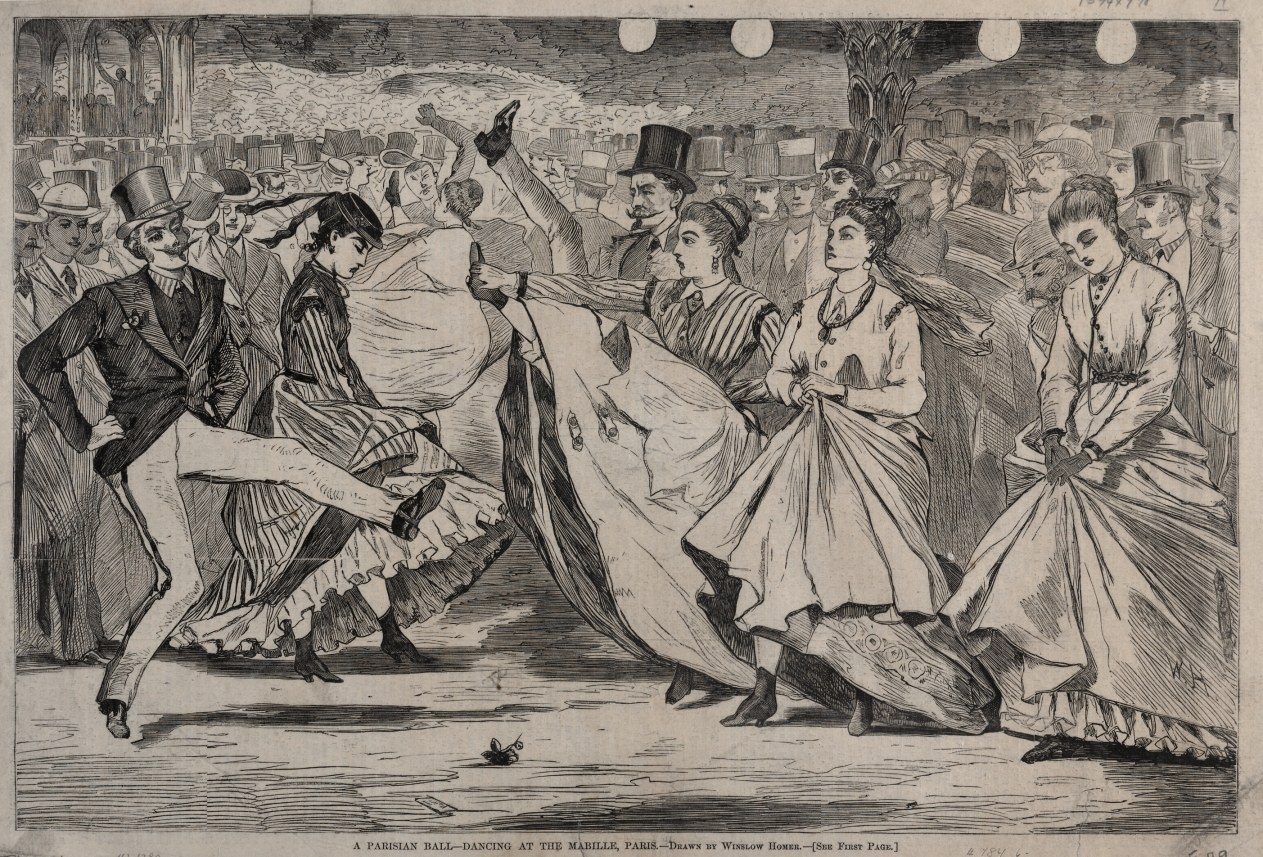
A Parisian Ball - Dancing at the Mabille Paris
Winslow Homer (American, 1836–1910)
- Source:
- Cleveland Museum of Art
- Rights:
- Public domain — free to use, share and adapt.
- Recorded as:
- CC0 (Public Domain)
This work is rare evidence of how acrobatic, high-kicking social dance was performed and understood in the mid-19th century, predating or contemporary with the codification of the can-can. It captures the moment when uninhibited ballroom dancing became a spectacle for observation and commentary, marking a rupture between formal ballroom etiquette and the emerging cult of sexual display. For dancers and historians, it documents not movement as taught or theorized, but movement as lived and witnessed in a specific place and class context.
What you are looking at
A crowded ballroom in Paris during the Gilded Age, rendered in fine engraving technique with meticulous detail and cross-hatching. The dance floor is thronged with elegantly dressed couples and onlookers, depicted mid-motion under soft gas or candlelight suggested by white circular orbs overhead. In the foreground, a man in evening dress with a top hat executes an energetic, high-kicking movement, his leg raised sharply, his body angled backward in an exuberant pose. A woman beside him, dressed in a fitted bodice and full skirt with horizontal striping, watches or participates in the display. Around them, other couples in formal dress stand, converse, or dance; the composition creates a sense of lively social mixing and theatrical display. The setting appears to be a grand interior space—possibly the Bal Mabille itself, a famous dance venue in Montmartre—with architectural details suggesting a public ballroom. The engraving captures a specific moment of uninhibited movement amid fashionable society.
The dancing
The central male figure displays a dramatic, almost acrobatic posture: torso reclined, one leg kicked high in an exaggerated extension, arms gesturing expressively. This is not a closed ballroom hold but a solo or semi-solo display movement, theatrical in its reach and momentum. The woman beside him maintains a more restrained pose, her body vertical, suggesting she is either a partner reacting to his display or an audience member. Other couples visible in the mid-ground and background maintain traditional upright posture in closed holds or face-to-face positions, suggesting a mix of conventional social dance and more eccentric, performative movement.
The dance depicted
This engraving documents the Bal Mabille, a working-class and mixed-class dance hall in Paris known for uninhibited social dancing, spirited high kicks, and theatrical self-display—particularly the can-can, though the term itself was emerging during this period. The high-kick gesture and the exaggerated, flexible torso motion shown here are consistent with the acrobatic elements of mid-to-late 19th-century Parisian ballroom improvisational dance. The formal dress of many figures indicates this was a commercialized public venue attracting tourists and flâneurs as well as local dancers. The image captures not classical ballroom dance in the international standard sense, but rather the energetic, often risqué vernacular social dances that horrified and fascinated Victorian audiences.
How it was made
This is a line engraving or wood engraving, likely produced for reproduction in a newspaper, periodical, or album of contemporary scenes. The signature at lower right reads 'Drawn by Winslow Homer,' identifying the image as based on an American artist's design, though engraved by another hand for mass circulation. Engraving allowed rapid, economical printing and wide distribution; the fine parallel lines (hatching and cross-hatching) build tone and suggest movement through accumulated linear marks. This technique was the standard for illustrated journalism and social documentation in the 1860s–1880s and implies this was created for a readership concerned with fashion, Parisian nightlife, and the manners of the day.
About this work
This engraving documents a moment of uninhibited social dance in a famous Parisian ballroom of the late 19th century, capturing both the formal ballroom conventions and the energetic, acrobatic display dance—including elements of what would be formalized as the can-can—that characterized working-class and mixed Parisian leisure venues. The artist, Winslow Homer, was known for his keen observation of contemporary life, and this composition records a specific cultural moment: the transgressive allure of Montmartre dance halls for Parisian society and international tourists. The engraving's fine detail and wide distribution through periodicals make it a primary visual document of 19th-century vernacular dance culture and the anxieties surrounding female physicality and social mobility that Parisian dance provoked.
How to look at it
Attend first to the central figure's posture: the artist has frozen a moment of dynamic, almost reckless momentum—a high kick combined with a backward-tilted torso that breaks every rule of formal ballroom carriage. This is the moment of display, not the preparation or recovery. Notice too the contrast between the formal evening dress of all figures and the informality of the movement; the high kick is rendered without shame or moral commentary in the line itself. The mass of onlookers and the theatrical lighting create a sense of performance for an audience; this is not intimate partner dancing but spectacular self-presentation. Finally, observe Homer's technique of building the scene through accumulation: dozens of small figures, all precisely delineated, that create a sense of crowded, energetic urban leisure.
The artist
Winslow Homer (1836–1910) was an American painter and illustrator celebrated for his scenes of contemporary American life, Civil War documentation, and maritime subjects. He worked extensively as an illustrator for Harper's Weekly and other periodicals, developing a sharp eye for social detail and human gesture. His travel to Paris in the 1860s exposed him to the visual culture of European leisure and nightlife. Homer's compositions for illustrated journalism combined documentary precision with a subtle sympathetic wit, capturing both the dignity and the pathos of his subjects. This Parisian ballroom scene exemplifies his practice of rendering contemporary manners and the boundary between respectability and transgression.
The period
The Bal Mabille was at the height of its fame and notoriety during the 1860s–1870s, a period when Parisian popular culture was undergoing rapid transformation due to urbanization, commercialization, and the mixing of social classes in new public venues. The can-can and related high-kicking dances emerged not as theatrical forms but as improvised, competitive, sexually charged vernacular social dances, often performed by working women and working-class men. Simultaneously, ballet and ballroom dance were becoming increasingly formalized and codified through dancing masters and schools. The explosion of illustrated journalism and wood engraving allowed middle-class and upper-class readers to consume images of these transgressive venues without attending them, creating a voyeuristic distance. Homer's image sits at the intersection of documentary ambition and the picturesque genre of 'types' of Parisian low life, popular in both French and Anglo-American visual culture.
Where it lives
The work is held in the Cleveland Museum of Art and appears in their collection of dance-related imagery. It is documented as sourced from CMA (Cleveland Museum of Art records). The specific title, 'A Parisian Ball – Dancing at the Mabille Paris,' identifies both the venue and the artist attribution to Homer.
Dance in this work
Questions about this work
Is this the can-can?
The high kick and acrobatic posture shown here are consistent with mid-19th-century Parisian social dancing at venues like the Mabille, and likely incorporate elements that would be formalized later as the can-can. However, the can-can was not yet a standardized theatrical form when this engraving was made; it was a vernacular, improvised social dance. This image captures the moment before codification.
Who was Winslow Homer?
Homer was an American painter and illustrator (1836–1910) known for documentary images of American life, particularly Civil War scenes and maritime subjects. He worked as an illustrator for Harper's Weekly and traveled to Paris in the 1860s, where he produced scenes of European urban life and leisure for American periodical readers.
What was the Bal Mabille?
The Bal Mabille was a famous dance hall in the Montmartre district of Paris, operating in the mid-to-late 19th century. It was known as a venue where working-class and mixed-class dancers could perform uninhibited social dances, and it became notorious and fascinating to upper-class Parisians and tourists as a site of transgressive leisure and female display.
What is an engraving and why does this look the way it does?
This is a line engraving, made by incising fine parallel and crossed lines into a metal plate to create tones and texture. It was then printed for mass distribution in newspapers and illustrated magazines. The fine hatching and precise line work allowed for rapid reproduction and economical printing, making it ideal for visual journalism and social documentation.
More dance artwork