45 works in this view — arrow keys or swipe to move between them.
Dance in Art
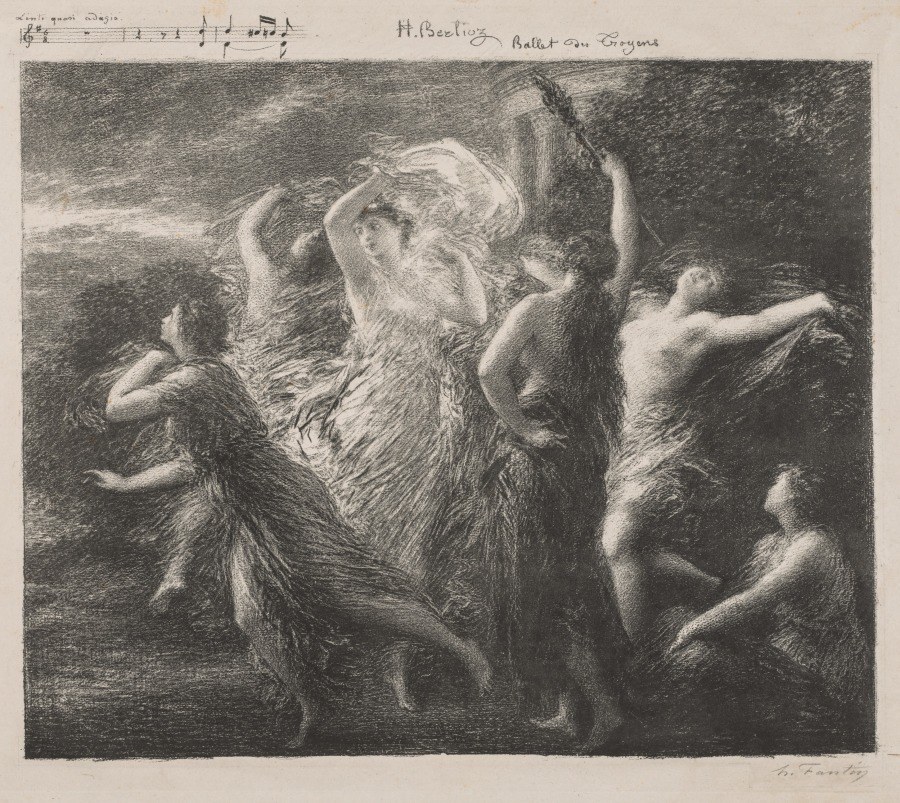
Ballet du Troyons
Henri Fantin-Latour (French, 1836–1904)
- Dance:
- Ballet
- Source:
- Cleveland Museum of Art
- Rights:
- Public domain — free to use, share and adapt.
- Recorded as:
- CC0 (Public Domain)
This engraving documents how ecstatic, uninhibited movement was imagined and celebrated in early modern European elite culture, offering a counterpoint to the formal, geometric dances of the court. The Bacchic subject matter and the compositional emphasis on bodily abandon and intoxication reveal the cultural value placed on forms of movement that escaped rational control—an important dimension of early modern dance culture that court records and ballroom treatises do not capture. For historians tracing the genealogy of expressive and contemporary dance, this work attests to an enduring fascination with movement as a vehicle for depicting states beyond social convention.
What you are looking at
This engraving depicts a bacchanalian scene dominated by a bearded, elderly male figure—likely Bacchus or Silenus—in the center, his body twisted in a convulsive dance. His long robes and drapery swirl around him; one arm is raised to his head while the other extends outward. He is surrounded by younger figures, including several putti (cherub-like youths) and attendants, who circle and support him. The composition is dense and energetic, with bodies overlapping and intertwining in the space. The figures on the right appear younger and more lightly clad, while the central figure dominates through mass and gesture. The background is dark and undefined, rendered in heavy cross-hatching that creates depth and emphasizes the foreground action. The overall mood is one of ecstatic movement, intoxication, and mythological revelry.
The dancing
The central male figure displays an unstable, ecstatic posture—his weight appears shifted and his frame twisted, with raised arms suggesting loss of balance or divine possession. The surrounding putti and youths adopt supporting and attendant poses, their bodies angled toward the central figure in a composition that suggests circular movement rather than partnered dance technique. None of the figures demonstrate the upright alignment, turnout, or controlled frame associated with formal dance training; instead, their gestures are loose and expressive, suited to mythological rapture rather than balletic discipline. The youth figures are rendered smaller and lighter, emphasizing their role as attendants to the main protagonist.
The dance depicted
This is a representation of Bacchic or Dionysian revelry in the classical mythological tradition. It depicts ecstatic, frenzied movement—the kind associated with bacchanal processions and the worship of Bacchus/Dionysus—rather than any codified theatrical dance. The subject matter and visual language place this squarely within the tradition of depicting Bacchic abandon and divine ecstasy through art. This type of scene was popular in Renaissance and Baroque engraving as a vehicle for exploring bodily excess, transformation, and the suspension of social order. The dance here is mythological and ritualistic rather than social or theatrical; it represents intoxication and divine inspiration rather than learned technique.
How it was made
This is an engraving executed in the fine-line tradition. The composition is rendered entirely through careful cross-hatching and linear marks, creating tone and form without color. The technique allows for fine detail in drapery and musculature while emphasizing the dramatic contrast between figures and background. The densely worked background and the precision of the line work suggest a professional print, likely created for circulation as a collectible or study object. Engravings of this quality were expensive to produce and distribute among elite collectors, connoisseurs, and artists; the subject matter—mythological and Bacchic—indicates an educated audience familiar with classical literature and the humanist artistic tradition.
About this work
This is an engraving depicting a Bacchic scene centered on an ecstatic, dancing figure of Bacchus or Silenus surrounded by putti and attendants. The work belongs to a long tradition of Bacchanalian imagery in European art, particularly strong in Renaissance and Baroque printmaking, where such scenes served both as classical references and as explorations of bodily movement, excess, and divine inspiration. The attribution and date remain unknown, but the stylistic language—the fine cross-hatching, the composition, the classical subject—places it firmly within the tradition of Renaissance or Baroque engraving. For a dance historian, this image is valuable not as a record of actual dance practice, but as evidence of how ecstatic, non-codified bodily movement was imagined and valued in early modern European art, and how the body in motion served as a vehicle for depicting mythological and spiritual states.
How to look at it
Attend to the instability and asymmetry of the central figure's posture: this is an image of ecstasy, not balance. The raised arm to the head and the twisted torso convey intoxication and loss of rational control—very different from the upright, symmetrical alignment valued in court dance. Notice how the surrounding figures do not frame or support the main figure in the way dance partners would; instead, they circle him in a loose, worshipful arrangement. The heavy background and the weight of the drapery create a sense of momentum and turbulence. The engraving technique itself—the careful accumulation of fine lines—creates a vibration and instability that echoes the movement of the figures.
The artist
The artist is not identified in the catalogue record. The quality of execution and the classical subject matter suggest a trained engraver working within the humanist tradition of the Renaissance or Baroque. The inscription 'H. Boelius' appears at the upper right, possibly indicating the artist or a later hand. Without further documentation, the precise identity and practice of the maker remain uncertain.
The period
Bacchanalian scenes were a staple of Renaissance and Baroque printmaking, reflecting both the revival of classical learning and a fascination with depicting bodily excess and transformation. In the context of dance history, this period saw a sharp distinction between the measured, geometric court dances (pavane, galliard, minuet) documented in dancing masters' treatises and the mythological, ecstatic movement celebrated in art and literature. Engravings of Bacchic scenes served as sophisticated visual references to classical literature (Ovid, Seneca) and as sites for exploring the aesthetics of bodily freedom and divine inspiration. The Bacchic theme also allowed artists and patrons to engage with themes of gender fluidity, bodily transformation, and the suspension of social hierarchy—all matters of interest to Renaissance humanists and Baroque court culture.
Where it lives
The work is catalogued in the Cleveland Museum of Art as part of its dance-related art collection. It enters the record as an artwork of unknown era and unknown medium attribution, though the image itself clearly identifies it as an engraving. No further provenance information is recorded.
Questions about this work
Is this a record of an actual dance?
No. This is a mythological scene depicting Bacchic ecstasy and divine intoxication, not a representation of a social or theatrical dance that people actually performed. The movement here is meant to convey spiritual rapture and loss of rational control, not learned technique or choreography. Such scenes were common in Renaissance and Baroque art as a way of exploring bodily freedom and the limits of social order.
What is the subject of the image?
The image depicts a Bacchanalian scene, most likely centered on the figure of Bacchus (the Roman god of wine) or his companion Silenus (a satyr), surrounded by putti and attendants. The setting is mythological and represents the ecstatic processions and rituals associated with the worship of Bacchus in classical antiquity and Renaissance imagination.
How does this relate to the court dances of the Renaissance?
The contrast is stark. Court dances of the period—pavanes, galliards, minuets—were geometric, measured, and governed by rules of decorum and symmetry. Bacchic scenes like this one celebrated the opposite: bodily excess, loss of control, and ecstatic movement outside the bounds of social convention. Both existed in the same culture, but represented different values and contexts for bodily movement.
More Ballet artwork