49 works in this view — arrow keys or swipe to move between them.
Dance in Art
Bugaku Dancer
Kamisaka Sekka (Japanese, 1866–1942)
- Source:
- Cleveland Museum of Art
- Rights:
- Public domain — free to use, share and adapt.
- Recorded as:
- CC0 (Public Domain)
Bugaku is one of the world's oldest surviving court dance traditions, with a continuous practice stretching back over a thousand years. This image documents the costume and presentation of the dancer at a historical moment when the tradition was actively performed. For historians of Asian performing arts and court culture, the work is evidence of how Bugaku dancers were understood and represented in the Japanese visual tradition.
What you are looking at
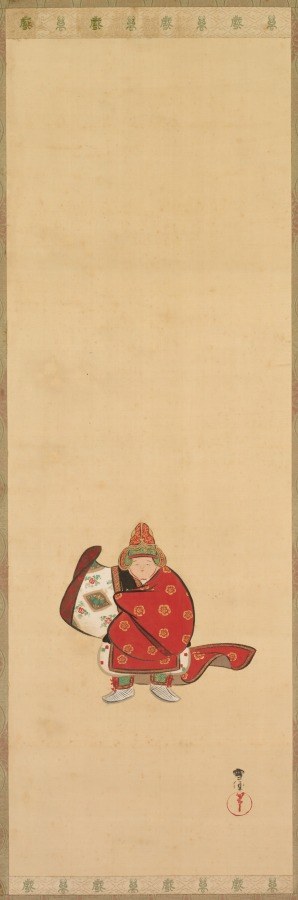
A single dancer occupies the center of a tall, narrow vertical composition, set against a pale cream background with a decorative patterned border top and bottom. The figure wears a brilliant red robe with geometric circular patterns in gold and white, and a tall red headdress with upturned finials. The dancer holds a fan in one hand and stands with weight distributed evenly, body angled slightly in profile. The pose is formal and restrained—the dancer does not leap or gesture expansively but occupies space with composed dignity. The palette is warm and limited: red dominates, with gold accents, white details, and the cream ground. The composition suggests a moment of presentation or stillness rather than kinetic action, and the style indicates East Asian painting tradition, likely Japanese.
The dancing
The single dancer stands in a nearly frontal pose with subtle asymmetry: one arm holds a folded fan, the other hangs at the side. The posture is upright and grounded, weight balanced, with no suggestion of extreme extension or lift. The headdress sits large and stable on the head. There is no evidence of the turned-out positions, elevated frame, or balletic vocabulary typical of European theatrical dance; instead the stance and carriage suggest a more restrained, formal bearing.
The dance depicted
This is a Bugaku dancer—a performer from the Japanese classical court dance tradition that flourished from the 8th century onward. Bugaku was performed at imperial and aristocratic courts and was characterized by highly formalized movement, rich costume, and association with ceremonial occasions. The red robe, gold patterning, and tall headdress are consistent with Bugaku costume. The stillness and frontality of the pose reflect Bugaku's aesthetic: movement is economical and deliberate, with emphasis on the beauty of costume and the dignity of the figure rather than acrobatic display. The fan (likely a *shaku* or ceremonial baton, or a decorative *ougi*) is a Bugaku accessory. This image documents the appearance of a Bugaku performer in formal dress.
How it was made
The work is painted in ink and color on paper in the vertical hanging-scroll (*kakemono*) format characteristic of Japanese art. The technique appears to be a combination of carefully applied mineral pigments—particularly the opaque red and gold—with ink line work defining details. The painting style is refined and precise, with attention to patterning and surface decoration. The composition and format suggest this was made for display in a household or institutional collection, and the subject—a court dance performer in full regalia—indicates an educated, elite audience.
About this work
This is a formal portrait of a Bugaku dancer in ceremonial costume, painted in the Japanese hanging-scroll tradition. Bugaku was the classical court dance of Japan, restricted to imperial and aristocratic contexts and performed at celebrations, religious observances, and state occasions. The image preserves the visual record of how a Bugaku dancer appeared in performance dress: the elaborate patterned robe, the tall headdress, the fan as an accoutrement of rank and office. The painting itself is not a documentary photograph but a composed work of art that celebrates the dignity and formal beauty of the tradition.
How to look at it
Attend to the costume: every element—the patterning, the color, the headdress, the fan—is prescribed by Bugaku convention and carries meaning about the role and rank of the dancer. Notice the stillness and frontality: this is not a moment of peak action but a moment of formal presentation. The dancer's face and expression are calm and composed. The painter has chosen to show the dancer in full regalia, stationary, as if the viewer is witnessing the dancer's appearance before or between the movement of the dance. The decorative border around the composition reinforces the formal, ceremonial character of the image.
The artist
The artist is unknown. The painting style and subject matter suggest a Japanese artist working in the classical tradition, likely during the Edo period or later, when documentation and artistic commemoration of court dances were common. The precision of execution and the refinement of the composition indicate training in the scholarly and aristocratic painting traditions.
The period
Bugaku emerged during the Heian period (794–1185) as the refined court dance of the Japanese imperial household. By the medieval and early modern periods, Bugaku had become a highly codified and prestigious tradition, performed at specific ceremonial occasions and transmitted through hereditary dance guilds. The practice was restricted to the imperial court and a small number of elite shrines and temples. During the Edo period (1603–1868), when this painting may have been made, Bugaku was preserved and documented as a marker of classical Japanese culture and imperial authority. The tradition continues today, designated as an Important Cultural Property of Japan.
Where it lives
The work is held in the Cleveland Museum of Art as part of their collection of dance-related art. The source record indicates it came to the museum as part of their Japanese art holdings.
Dance in this work
Questions about this work
What is Bugaku and who performed it?
Bugaku is the classical court dance tradition of Japan, performed exclusively at the imperial court and certain prestigious shrines and temples. It emerged around the 8th century and is characterized by highly formalized movement, elaborate costume, and association with state and religious occasions. Only trained dancers from hereditary guilds were permitted to perform it.
What do the costume elements mean?
Every component of Bugaku costume—the robe pattern, the headdress, the fan—is prescribed by tradition and indicates the specific dance role and its narrative or ceremonial function. The red robe with geometric patterning and the tall headdress suggest a high-status or leading role. Bugaku costumes are among the most elaborate and color-rich in Japanese performing arts.
Why is the dancer standing so still?
Bugaku movement is deliberate and restrained, not expansive or acrobatic. This painting captures the dancer in a composed stance that may be a formal opening position or a moment of stillness between movements. The emphasis in Bugaku is on the beauty of the costume, the dignity of carriage, and precise, controlled gesture rather than dynamic action.
Is Bugaku still performed today?
Yes. Bugaku is one of the world's oldest continuously performed dance traditions. It is designated as an Important Cultural Property of Japan and is performed at the imperial court and at certain temples and shrines, particularly during specific ceremonial occasions. The tradition has been carefully preserved and transmitted.
More dance artwork