49 works in this view — arrow keys or swipe to move between them.
Dance in Art
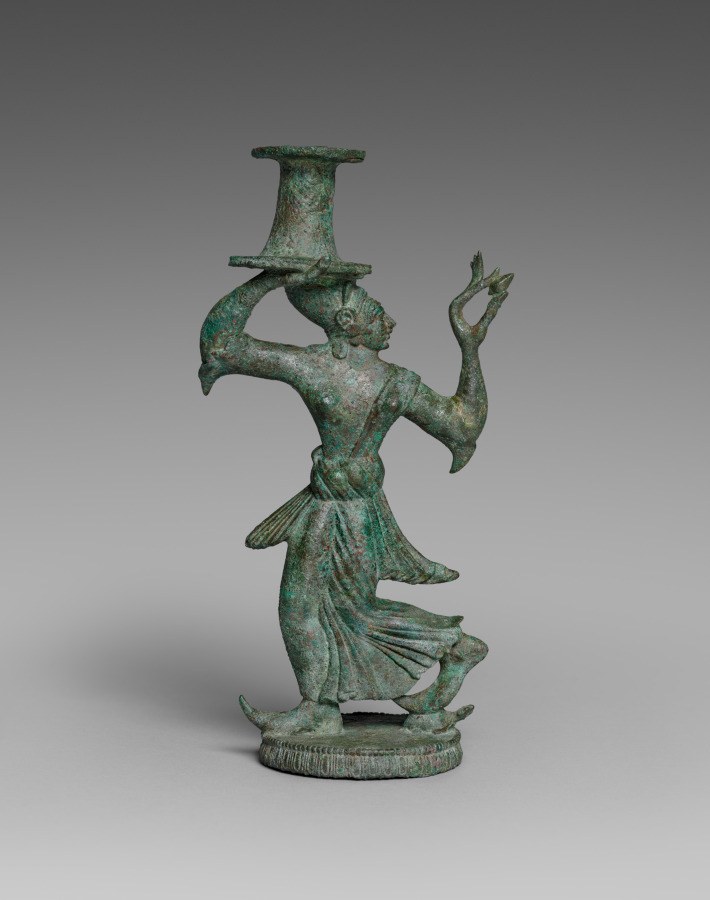
Candelabrum Stand of a Dancing Maenad
Unknown artist
- Source:
- Cleveland Museum of Art
- Rights:
- Public domain — free to use, share and adapt.
- Recorded as:
- CC0 (Public Domain)
Maenadic dance was one of the oldest and most significant sacred dance forms in Western culture, yet we know it primarily through imagery and literary description. This bronze preserves the sculptor's understanding of how that dance moved: the ecstatic posture, the loss of self in rotation and abandonment. For historians and practitioners of sacred or trance dance, it is direct evidence.
What you are looking at
A bronze figure of a maenad stands in a dynamic contrapposto pose, her body animated with the characteristic ecstatic movement of Dionysian ritual. She wears a chiton and himation arranged in flowing folds that suggest rapid movement. Her left arm is raised with palm open in a gesture of abandon or invocation, while her right arm extends downward. A large vessel or krater sits atop her head, balanced precariously, suggesting both an offering and a feat of physical control. Her head turns sharply, and her body twists in a serpentine curve that conveys the trance-like state of maenadic possession. The bronze has developed a rich patina of greens and blues, indicating considerable age. The figure stands on a circular base with a beveled lip.
The dancing
A single female figure in a twisted, elevated stance with the weight shifted to one leg in a near-arabesque or attitude position. The raised arm reaches upward with splayed fingers; the opposite arm extends lower. The spine curves in an emphatic S-bend that suggests rotation through the torso. The head is turned away from the body's central axis, eyes averted. The arrangement of the drapery—clinging in some places, billowing in others—indicates an artist observing or imagining rapid rotational movement and the inertia of cloth in motion.
The dance depicted
This represents a maenad, a female devotee of Dionysus, engaged in ecstatic ritual dance. The maenadic dance was a frenzied, trance-inducing movement form central to Bacchic cult practices in ancient Greece, characterized by spinning, throwing back the head, and states of divine possession. The artist has captured the moment of peak ecstasy—the lifted gaze, the torsion of the spine, the abandonment of the raised arm. This is not a codified theatrical dance but a sacred-ceremonial practice, and the bronze sculptor has understood and conveyed the physical grammar of trance and ritualized intoxication.
How it was made
This is a cast bronze sculpture, likely created using the lost-wax technique standard in antiquity. Bronze allows for the thin, elegant limbs and the cantilevered pose of the raised arm without support—a technical achievement that makes the figure appear weightless and suspended in movement. The patina suggests the work dates to antiquity or a deliberate ancient-style casting. The form is compact and vertical, suitable for a functional object: this is a candelabrum stand, meaning the krater on the head held oil lamps or served as a practical base. The merging of utilitarian and representational purposes is characteristic of Greek bronze vessels.
About this work
This candelabrum stand fuses decorative and functional purposes through a figure of a maenad caught in ecstatic motion. The work is rooted in the Greek artistic tradition of depicting Dionysian ritual and appears to date to antiquity or the Greco-Roman period. It represents one of the most significant sacred dance forms of the ancient Mediterranean world—the inspired, possessed dancing of maenads—and renders it not as a static pose but as a moment of kinetic intensity, with the body twisted in the serpentine curve that ancient sources associate with divine possession.
The work belongs in a gallery of dance because it documents a form of ritualized movement that structured religious and social life in ancient Greece, and because the sculptor has grasped its essential physical language: the trance posture, the backward gaze, the lifted arm, the spine's spiral torque. It is also a document of how dance was understood as a channel for divine experience—not entertainment, but communion.
How to look at it
Observe the violent torsion of the spine: the hips face forward, the shoulders turn, the head turns further still—this is the sculptural equivalent of a full-body spiral. Notice how the drapery clings to the active leg and billows away from the moving torso, suggesting speed and momentum frozen. The upturned face and raised arm convey the moment of surrender to divine possession. The artist has understood that ecstatic dance is not about grace or control but about the abandonment of the body to an external force.
The period
Maenadic dance was practiced throughout the classical period of ancient Greece and remained culturally significant through the Hellenistic and Roman periods. Greek bronzes depicting maenads or satyrs in ecstatic motion became canonical subjects in the decorative arts, especially in vessels and functional objects destined for symposia and ritual contexts. The merging of the figure with a utilitarian form—here, a candelabrum—was typical of Greek bronze workshops, which produced objects that were simultaneously art and furniture. The style and patina suggest a date somewhere in the classical to Greco-Roman period, though a later intentional archaizing work cannot be ruled out without scientific analysis.
Where it lives
The work is held by the Cleveland Museum of Art and documented as part of the museum's dance-related art collection. The catalogue record provides no data on medium, date, or artist, which is common for ancient bronzes in larger collections; such works were often acquired as fragments of larger collecting histories.
Dance in this work
Questions about this work
What is a maenad and how did they dance?
Maenads were female followers of Dionysus, god of wine and ecstatic experience, who participated in ritual dances called Bacchic rites. Ancient sources describe maenadic dancing as frenzied, nocturnal, and trance-inducing, involving spinning, head-tossing, and the wearing of animal skins. The dance was understood as a form of possession by the god and was central to Dionysian religion throughout the ancient Greek world. They are frequently depicted in Greek art in states of ecstasy or moving with violent energy.
Is this a portrait of a real person or an idealized figure?
This is an idealized figure type, not a portrait. Maenads in Greek art represent a character or role—the ecstatic devotee—rather than any individual. The candelabrum stand itself was a luxury object created for symposia (drinking parties) or religious contexts, and the maenad figure was chosen as a subject for its associations with divine inspiration and festivity. The work belongs to a tradition of repeated motifs in Greek and Greco-Roman decorative arts rather than to the portraiture tradition.
How do we know what ancient dance looked like if there are no videos?
We reconstruct ancient dance from multiple sources: literary descriptions (especially in drama and religious texts), vase paintings, relief sculpture, mosaics, and three-dimensional objects like this bronze. None of these sources is complete, but together they give us postures, gestures, the presence of musical instruments, and the contexts in which movement occurred. Sculptural works like this one are especially valuable because they show the artist's interpretation of how a moving body holds itself in space.
More dance artwork